
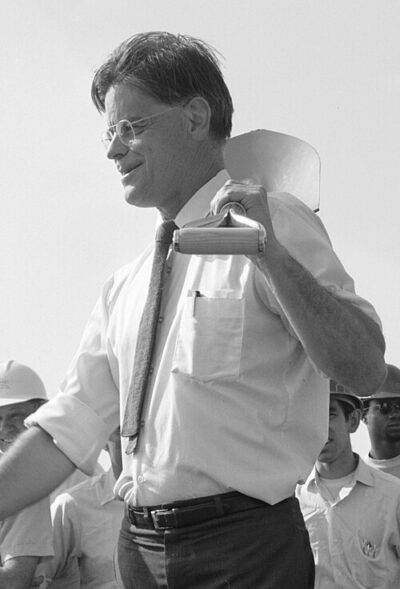
Robert R. Wilson
Robert R. Wilson was an American physicist. Born March 4, 1914, in Frontier. Died January 16, 2000, in Ithaca. Educated at University of California, Berkeley. Awards include Elliott Cresson Medal, National Medal of Science and Richtmyer Memorial Lecture Award.
Facts
26 facts · 2 confirmed by two sources · 12 cited · 12 from one source
Where this comes from
Papalocal keeps its own record. It started from these sources; what each one said is kept here as it was copied, so a change on their side never changes this page by itself. Tap one to read its version.
What Wikidata says · copied November 16, 2026 · revision 2540258510
- Described as
- American physicist (1914–2000)
- Other names
- Robert Rathbun Wilson, Robert Wilson
- Born
- March 4, 1914 · 4 references
- Died
- January 16, 2000 · 4 references
- Born in
- Frontier · 1 reference
- Died in
- Ithaca · 1 reference
- Buried in
- Pioneer Cemetery · 1 reference
- Citizen of
- United States
- Occupation
- physicist · 2 references; university teacher · 1 reference; nuclear physicist · 1 reference; particle physicist · 1 reference
- Worked for
- Princeton University; Harvard University; Cornell University; Columbia University
- Education
- University of California, Berkeley
- Member of
- National Academy of Sciences; American Academy of Arts and Sciences
- Awards
- Elliott Cresson Medal (1964) · 1 reference; National Medal of Science (1973); Richtmyer Memorial Lecture Award (1968) · 1 reference; Fellow of the American Physical Society; Enrico Fermi Award (1984) · 1 reference; Guggenheim Fellowship · 1 reference; Andrew Gemant Award (1995) · 1 reference
- Field
- nuclear physics
- Spouse
- Jane S. Wilson (1940–2000) · 1 reference
- Wikipedias with a page
- 22
Wikidata item Q705994 (wikidata.org/wiki/Q705994), public domain (CC0). Copied November 16, 2026.
What Wikipedia says · copied November 16, 2026 · revision 1380703016
Robert Rathbun Wilson (March 4, 1914 – January 16, 2000) was an American physicist known for his work on the Manhattan Project during World War II, as a sculptor, and as an architect of the Fermi National Accelerator Laboratory (Fermilab), where he was the first director from 1967 to 1978.
A graduate of the University of California, Berkeley, Wilson received his doctorate under the supervision of Ernest Lawrence for his work on the development of the cyclotron at the Berkeley Radiation Laboratory. He subsequently went to Princeton University to work with Henry DeWolf Smyth on electromagnetic separation of the isotopes of uranium. In 1943, Wilson and many of his colleagues joined the Manhattan Project's Los Alamos Laboratory, where Wilson became the head of its Cyclotron Group (R-1), and later its Research (R) Division.
After the war, Wilson briefly joined the faculty of Harvard University as an associate professor, then went to Cornell University as professor of physics and the director of its new Laboratory of Nuclear Studies. Wilson and his Cornell colleagues constructed four electron synchrotrons, and Cornell's synchrotron facility was later named the Wilson Synchrotron Laboratory in his honor. In 1967 he assumed directorship of the National Accelerator Laboratory, subsequently known as Fermilab. He managed to complete the facility on time and under budget, but at the same time made it aesthetically pleasing, with a main administrative building purposely reminiscent of the Beauvais Cathedral, and a restored prairie with a herd of American Bison. He resigned in 1978 in a protest against inadequate government funding.
- Born, in its opening lines
- March 4, 1914
- Died, in its opening lines
- January 16, 2000
From the Wikipedia article “Robert R. Wilson” (en.wikipedia.org/wiki/Robert_R._Wilson), by its contributors, under CC BY-SA 4.0 (creativecommons.org/licenses/by-sa/4.0/). Copied November 16, 2026; not changed.
Confirmed Two sources agree. Cited One source, and it names where it got it. One source One source, without a reference of its own. Sources disagree The sources disagree. We show the best-supported value and keep theirs below.
