
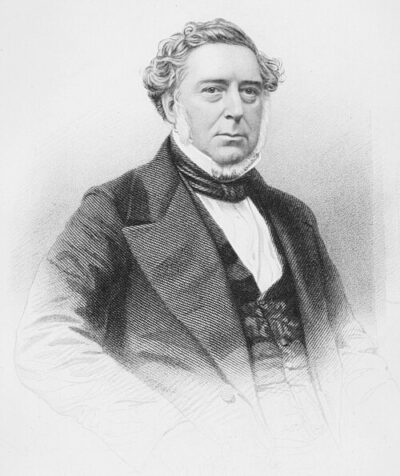
Robert Stephenson
Robert Stephenson was a British railway engineer and locomotive designer. Born October 16, 1803, in Willington Quay. Died October 12, 1859, in London. Positions held include member of the 18th Parliament of the United Kingdom (1859), member of the 17th Parliament of the United Kingdom (1857–1859) and member of the 16th Parliament of the United Kingdom (1852–1857). Known for High Level Bridge and Conwy Railway Bridge. Educated at University of Edinburgh. Awards include Fellow of the Royal Society, Knight of the Legion of Honour and Fellow of the American Academy of Arts and Sciences.
Facts
27 facts · 2 confirmed by two sources · 10 cited · 15 from one source
Where this comes from
Papalocal keeps its own record. It started from these sources; what each one said is kept here as it was copied, so a change on their side never changes this page by itself. Tap one to read its version.
What Wikidata says · copied November 16, 2026 · revision 2568764860
- Described as
- British railway engineer and locomotive designer (1803-1859)
- Other names
- Robert III Stephenson
- Born
- October 16, 1803 · 6 references
- Died
- October 12, 1859 · 5 references
- Born in
- Willington Quay · 1 reference
- Died in
- London · 1 reference
- Buried in
- Westminster Abbey
- Citizen of
- United Kingdom of Great Britain and Ireland; United Kingdom · 1 reference
- Occupation
- civil engineer · 1 reference; politician · 1 reference; railway engineer · 1 reference; engineer · 1 reference
- Positions held
- member of the 18th Parliament of the United Kingdom (1859); member of the 17th Parliament of the United Kingdom (1857–1859) · 1 reference; member of the 16th Parliament of the United Kingdom (1852–1857) · 1 reference; member of the 15th Parliament of the United Kingdom (1847–1852) · 1 reference
- Political party
- Conservative Party
- Education
- University of Edinburgh
- Member of
- Royal Society of London; American Academy of Arts and Sciences
- Known for
- High Level Bridge; Conwy Railway Bridge
- Awards
- Fellow of the Royal Society; Knight of the Legion of Honour; Fellow of the American Academy of Arts and Sciences
- Field
- construction · 1 reference
- Father
- George Stephenson · 1 reference
- Mother
- Frances Henderson
- Wikipedias with a page
- 41
Wikidata item Q328728 (wikidata.org/wiki/Q328728), public domain (CC0). Copied November 16, 2026.
What Wikipedia says · copied November 16, 2026 · revision 1384129516
Robert Stephenson (16 October 1803 – 12 October 1859) was an English civil engineer and designer of locomotives. The only son of George Stephenson, the "Father of Railways", he built on the achievements of his father.
Robert Stephenson became an apprentice under mining engineer Nicholas Wood after completing his education in 1819. In 1821, he and his father surveyed the Bishop Auckland area to help Edward Pease build a railway that would transport coal from the area to Darlington and Stockton-on-Tees. In 1823, the Stephensons and Pease founded Robert Stephenson and Company to manufacture locomotives; the company designed such locomotives as the Lancashire Witch in 1828 and the John Bull in 1831, the latter of which became the first steam locomotive to run in New Jersey.
Throughout the 1830s Robert oversaw the construction of several railways, including the Canterbury and Whitstable Railway, the Bolton & Leigh railway, the Warrington & Newton Railway and the Leicester and Swannington Railway. He drew the plans for the London and Birmingham Railway, which opened in 1838. In 1832 he was appointed surveyor for a project to build a railway between Lanehead Farmhouse and Consett in County Durham, but the railway line closed in 1840, six years after its completion. In 1839 he spent three months in France, Spain and Italy advising on railways, and after returning to England he advised Parliament and arbitrated in disputes between railway companies and contractors. He was made Knight of the Order of Leopold in 1841 for his improvements to locomotive engines.
In 1845 Robert designed an iron bridge that would cross the River Dee; the Dee bridge was completed in 1846 but collapsed under a locomotive, causing the deaths of five people. Robert was accused of manslaughter during the inquest, but a verdict of accidental death was ultimately returned. He also designed the Britannia Bridge, which crosses the Menai Strait and consists of four tubes; it was opened to public traffic in 1850. The High Level Bridge, another of his works, crosses the Tyne and was opened in 1849 by Queen Victoria. She offered Robert a knighthood, but he refused.
Robert, who was a member of the Conservative Party, was elected as the Member of Parliament for Whitby; he held the position until his death in 1859.
Robert has been called the greatest engineer of the 19th century. Stephenson's death was widely mourned, and his funeral afforded marks of public honour. He is buried in Westminster Abbey.
- Born, in its opening lines
- October 16, 1803
- Died, in its opening lines
- October 12, 1859
From the Wikipedia article “Robert Stephenson” (en.wikipedia.org/wiki/Robert_Stephenson), by its contributors, under CC BY-SA 4.0 (creativecommons.org/licenses/by-sa/4.0/). Copied November 16, 2026; not changed.
Confirmed Two sources agree. Cited One source, and it names where it got it. One source One source, without a reference of its own. Sources disagree The sources disagree. We show the best-supported value and keep theirs below.
