
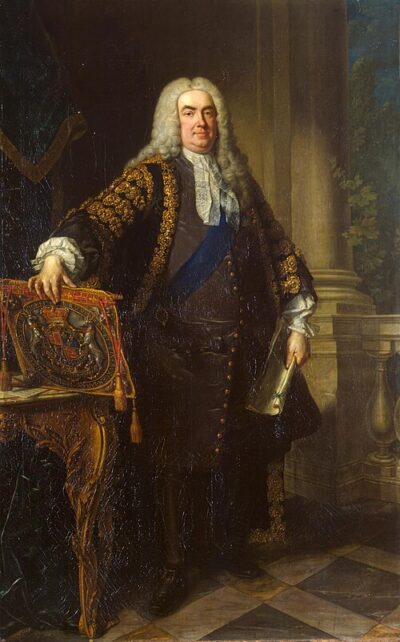
Robert Walpole
Robert Walpole was a British statesman and art collector, 1st Earl of Orford. Born August 26, 1676, in Houghton. Died March 18, 1745, in St James's. Positions held include Chancellor of the Exchequer (1721–1742), Prime Minister of the United Kingdom (1721–1742) and Member of Parliament in the Parliament of England. Educated at King's College and Eton College. Awards include Knight of the Garter and Knight of the Bath.
Facts
45 facts · 2 confirmed by two sources · 18 cited · 25 from one source
Where this comes from
Papalocal keeps its own record. It started from these sources; what each one said is kept here as it was copied, so a change on their side never changes this page by itself. Tap one to read its version.
What Wikidata says · copied November 16, 2026 · revision 2568765532
- Described as
- British statesman and art collector, 1st Earl of Orford (1676–1745)
- Other names
- Robert Walpole, Earl of Orford, Sir Robert Walpole, 1st Earl of Orford, Sir Robert Walpole, Robert Orford, Robert Walpole, 1st Earl of Orford, Bob Lynn
- Born
- August 26, 1676 · 1 reference
- Died
- March 18, 1745 · 2 references
- Born in
- Houghton · 1 reference
- Died in
- St James's
- Buried in
- St Martin at Tours' Church, Houghton · 1 reference
- Citizen of
- Kingdom of England (–1707); Kingdom of Great Britain (1707–)
- Occupation
- politician · 1 reference; art collector · 1 reference
- Positions held
- Chancellor of the Exchequer (1721–1742); Prime Minister of the United Kingdom (1721–1742); Member of Parliament in the Parliament of England; member of the 1st Parliament of Great Britain; member of the 2nd Parliament of Great Britain; member of the 3rd Parliament of Great Britain; member of the 4th Parliament of Great Britain; member of the 5th Parliament of Great Britain; member of the 6th Parliament of Great Britain; member of the 7th Parliament of Great Britain; member of the 8th Parliament of Great Britain; member of the 9th Parliament of Great Britain; Member of the 1701 Parliament; Member of the 1701-02 Parliament; Member of the 1702-05 Parliament
- Political party
- Whigs
- Education
- King's College · 1 reference; Eton College · 1 reference
- Member of
- Privy Council of the United Kingdom
- Awards
- Knight of the Garter (1726); Knight of the Bath (1725)
- Spouse
- Maria, Lady Walpole · 2 references; Catherine, Lady Walpole (1700–) · 2 references
- Children
- Horace Walpole · 1 reference; Robert Walpole, 2nd Earl of Orford · 1 reference; Edward Walpole · 1 reference; Katherine Walpole · 1 reference; Lady Mary Walpole · 2 references; Lady Maria Walpole · 2 references
- Father
- Robert Walpole · 1 reference
- Mother
- Mary Burwell · 1 reference
- Siblings
- Dorothy Walpole · 1 reference; Horatio Walpole, 1st Baron Walpole · 1 reference; Galfridus Walpole; Mary Walpole · 1 reference
- Religion
- Church of England
- Wikipedias with a page
- 90
Wikidata item Q104190 (wikidata.org/wiki/Q104190), public domain (CC0). Copied November 16, 2026.
What Wikipedia says · copied November 16, 2026 · revision 1376845482
Robert Walpole, 1st Earl of Orford (; 26 August 1676 – 18 March 1745), known between 1725 and 1742 as Sir Robert Walpole, was a British Whig statesman who is generally regarded as the de facto first Prime Minister of Great Britain, serving from 1721 to 1742. His formal titles included First Lord of the Treasury, Chancellor of the Exchequer, and Leader of the House of Commons. He is the longest serving prime minister in UK history, with a tenure of over 20 years.
Although the exact dates of Walpole's dominance, dubbed the "Robinocracy", are a matter of scholarly debate, the period 1721–1742 is often used. He dominated the Walpole–Townshend ministry, as well as the subsequent Walpole ministry, and holds the record as the longest-serving British prime minister. W. A. Speck wrote that Walpole's uninterrupted run of 20 years as prime minister "is rightly regarded as one of the major feats of British political history. Explanations are usually offered in terms of his expert handling of the political system after 1720, [and] his unique blending of the surviving powers of the crown with the increasing influence of the Commons".
Walpole was a Whig from the gentry class who was first elected to Parliament in 1701 and held many senior positions. He was a country squire and looked to country gentlemen for his political base. Historian F. O'Gorman says his leadership in Parliament reflected his "reasonable and persuasive oratory, his ability to move both the emotions as well as the minds of men, and, above all, his extraordinary self-confidence". Julian Hoppit says Walpole's policies sought moderation, he worked for peace, lower taxes and growing exports, and allowed a little more tolerance for Protestant Dissenters. He mostly avoided controversy and high-intensity disputes as his middle way attracted moderates from both the Whig and Tory camps; his appointment to Chancellor of the Exchequer after the South Sea Bubble stock-market crisis drew attention to perceived protection of political allies by Walpole.
Historian H. T. Dickinson sums up his historical role by saying that "Walpole was one of the greatest politicians in British history. He played a significant role in sustaining the Whig party, safeguarding the Hanoverian succession, and defending the principles of the Glorious Revolution (1688). He established stable political supremacy for the Whig party and taught succeeding ministers how best to establish an effective working relationship between Crown and Parliament." Some scholars rank him highly among British prime ministers.
- Born, in its opening lines
- August 26, 1676
- Died, in its opening lines
- March 18, 1745
From the Wikipedia article “Robert Walpole” (en.wikipedia.org/wiki/Robert_Walpole), by its contributors, under CC BY-SA 4.0 (creativecommons.org/licenses/by-sa/4.0/). Copied November 16, 2026; not changed.
Confirmed Two sources agree. Cited One source, and it names where it got it. One source One source, without a reference of its own. Sources disagree The sources disagree. We show the best-supported value and keep theirs below.
