
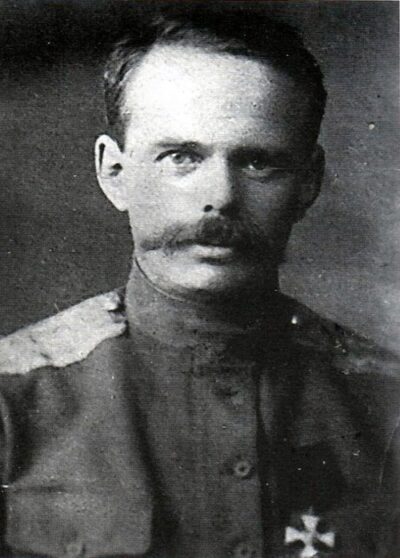
Roman von Ungern-Sternberg
Roman von Ungern-Sternberg was an Austrian anti-communist general. Born December 29, 1885, in Graz. Died September 15, 1921, in Novosibirsk. Educated at Pavel Military School. Awards include Order of Saint Anna, 3rd class, Order of Saint Anna, 4th class and Order of St. Vladimir, 4th class.
Facts
23 facts · 1 confirmed by two sources · 4 cited · 17 from one source · 1 where the sources disagree
What’s different
- Born: we show December 29, 1885 (Sources disagree). Wikipedia says January 10, 1886
Where this comes from
Papalocal keeps its own record. It started from these sources; what each one said is kept here as it was copied, so a change on their side never changes this page by itself. Tap one to read its version.
What Wikidata says · copied November 16, 2026 · revision 2568865314
- Described as
- Austrian anti-communist general (1886-1921)
- Other names
- Roman Frh. von Ungern-Sternberg
- Born
- December 29, 1885 · 1 reference
- Died
- September 15, 1921 · 2 references
- Born in
- Graz · 1 reference
- Died in
- Novosibirsk · 1 reference
- Cause of death
- gunshot wound
- Citizen of
- Russian Empire
- Occupation
- military officer; politician · 1 reference; anti-communist; warlord
- Education
- Pavel Military School
- Awards
- Order of Saint Anna, 3rd class (1916); Order of Saint Anna, 4th class (1914); Order of St. Vladimir, 4th class (1915); Order of Saint Stanislaus, 3rd class (1915); Order of St. George, 4th class (1914); Order of Saint Stanislaus · 1 reference
- Father
- Theodor Leonhard Rudolf Frh. von Ungern-Sternberg
- Mother
- Sophia, Freiin von Wimpffen · 1 reference
- Religion
- Tibetan Buddhism
- Military branch
- Imperial Russian Army · 1 reference
- Military rank
- lieutenant general; general · 1 reference
- Wikipedias with a page
- 49
Wikidata item Q70542 (wikidata.org/wiki/Q70542), public domain (CC0). Copied November 16, 2026.
What Wikipedia says · copied November 16, 2026 · revision 1383448114
Baron Nikolai Robert Maximilian Freiherr von Ungern-Sternberg (Russian: Роман Фёдорович фон Унгерн-Штернберг, romanized: Roman Fyodorovich fon Ungern-Shternberg; 10 January 1886 – 15 September 1921), often referred to as Roman von Ungern-Sternberg or Baron Ungern, was a Russian military leader of German descent who served in the Russian Civil War and later became an independent warlord who intervened in Mongolia against China.
Part of the Russian Empire's Baltic German minority, Ungern was an ultraconservative monarchist who aspired to restore the Russian monarchy after the 1917 Russian Revolution and to revive the Mongol Empire under the rule of the Bogd Khan. His attraction to Vajrayana Buddhism and his eccentric, often violent, treatment of enemies and his own men earned him the sobriquet "the Mad Baron" or "the Bloody Baron".
In February 1921, at the head of the Asiatic Cavalry Division, Ungern expelled Chinese troops from Mongolia and restored the monarchic power of the Bogd Khan. During his five-month occupation of Outer Mongolia, Ungern imposed order on the capital city, Ikh Khüree (now Ulaanbaatar), by fear, intimidation and brutal violence against the Bolsheviks and Chinese. In June 1921, he travelled to eastern Siberia to support anti-Bolshevik partisan forces and to head off a joint Red Army-Mongolian rebel invasion. That action ultimately led to his defeat and capture two months later. He was taken prisoner by the Red Army and, a month later, was put on trial for counter-revolution in Novonikolayevsk, now Novosibirsk. He was found guilty after a six-hour show trial, and on 15 September 1921 he was executed.
- Born, in its opening lines
- January 10, 1886
- Died, in its opening lines
- September 15, 1921
From the Wikipedia article “Roman von Ungern-Sternberg” (en.wikipedia.org/wiki/Roman_von_Ungern-Sternberg), by its contributors, under CC BY-SA 4.0 (creativecommons.org/licenses/by-sa/4.0/). Copied November 16, 2026; not changed.
Confirmed Two sources agree. Cited One source, and it names where it got it. One source One source, without a reference of its own. Sources disagree The sources disagree. We show the best-supported value and keep theirs below.
