
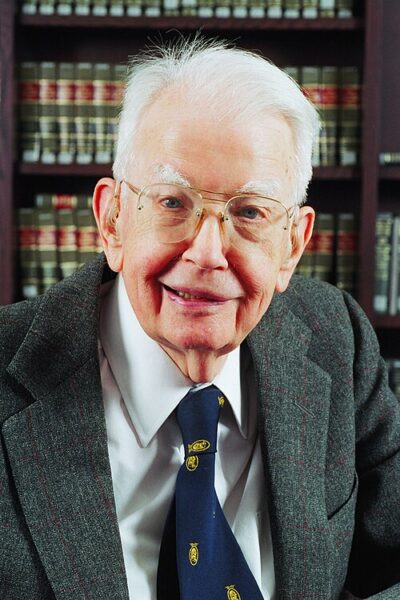
Ronald Coase
Ronald Coase was a British economist and Nobel laureate. Born December 29, 1910, in Willesden. Died September 2, 2013, in Chicago. Educated at London School of Economics and Political Science and University of Virginia. Awards include Prize in Economic Sciences in Memory of Alfred Nobel, Distinguished Fellow of the American Economic Association and honorary doctor of the University of Paris 1 Pantheon-Sorbonne.
Facts
29 facts · 2 confirmed by two sources · 9 cited · 18 from one source
Where this comes from
Papalocal keeps its own record. It started from these sources; what each one said is kept here as it was copied, so a change on their side never changes this page by itself. Tap one to read its version.
What Wikidata says · copied November 16, 2026 · revision 2563198390
- Described as
- British economist and Nobel laureate (1910–2013)
- Other names
- Ronald Harry Coase, R. H. Coase, Ronald H. Coase
- Born
- December 29, 1910 · 7 references
- Died
- September 2, 2013 · 6 references
- Born in
- Willesden · 1 reference
- Died in
- Chicago · 2 references
- Buried in
- Graceland Cemetery · 1 reference
- Citizen of
- United Kingdom; United Kingdom of Great Britain and Ireland (–1927)
- Occupation
- economist · 1 reference; historian; writer; university teacher
- Worked for
- University of Chicago; University at Buffalo; University of Virginia; University of Dundee; The Ronald Coase Institute · 1 reference
- Education
- London School of Economics and Political Science; University of Virginia; Queens Park Community School; University of London · 1 reference; Kilburn Grammar School
- Member of
- American Academy of Arts and Sciences; Mont Pelerin Society
- Awards
- Prize in Economic Sciences in Memory of Alfred Nobel (1991) · 1 reference; Distinguished Fellow of the American Economic Association; honorary doctor of the University of Paris 1 Pantheon-Sorbonne (1998) · 2 references
- Field
- economics · 2 references; economic theory · 1 reference; law and economics · 1 reference
- Wikipedias with a page
- 65
Wikidata item Q188113 (wikidata.org/wiki/Q188113), public domain (CC0). Copied November 16, 2026.
What Wikipedia says · copied November 16, 2026 · revision 1365082733
Ronald Harry Coase (; 29 December 1910 – 2 September 2013) was a British economist and author. Coase was educated at the London School of Economics, where he was a member of the faculty until 1951. He was the Clifton R. Musser Professor of Economics at the University of Chicago Law School, where he arrived in 1964 and remained for the rest of his life. He received the Nobel Memorial Prize in Economic Sciences in 1991.
Coase believed economists should study real-world wealth creation, in the manner of Adam Smith, stating, "It is suicidal for the field to slide into a hard science of choice, ignoring the influences of society, history, culture, and politics on the working of the economy." He believed economic study should reduce emphasis on price theory or theoretical markets and instead focus on real markets. He established the case for the corporation as a means to pay the costs of operating a marketplace. Coase is best known for two articles: "The Nature of the Firm" (1937), which introduces the concept of transaction costs to explain the nature and limits of firms; and "The Problem of Social Cost" (1960), which suggests that well-defined property rights could overcome the problems of externalities if it were not for transaction costs (see Coase theorem). Additionally, Coase's transaction costs approach has been influential in modern organizational economics, where it was re-introduced by Oliver E. Williamson.
- Born, in its opening lines
- December 29, 1910
- Died, in its opening lines
- September 2, 2013
From the Wikipedia article “Ronald Coase” (en.wikipedia.org/wiki/Ronald_Coase), by its contributors, under CC BY-SA 4.0 (creativecommons.org/licenses/by-sa/4.0/). Copied November 16, 2026; not changed.
Confirmed Two sources agree. Cited One source, and it names where it got it. One source One source, without a reference of its own. Sources disagree The sources disagree. We show the best-supported value and keep theirs below.
