
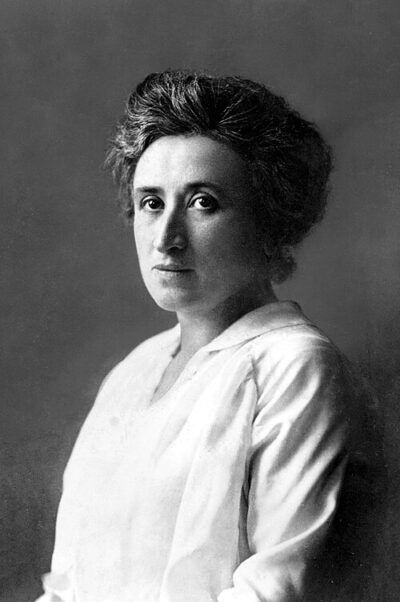
Rosa Luxemburg
Rosa Luxemburg was a Polish-German Marxist revolutionary. Born March 5, 1871, in Zamość. Died January 15, 1919, in Berlin. Known for The Accumulation of Capital and Social Reform or Revolution. Educated at University of Zurich.
Facts
27 facts · 2 confirmed by two sources · 11 cited · 13 from one source · 1 where the sources disagree
What’s different
- Name at birth: we show Rozalia Luksenburg (Sources disagree). Wikidata also lists Rozalia Luxenburg
Where this comes from
Papalocal keeps its own record. It started from these sources; what each one said is kept here as it was copied, so a change on their side never changes this page by itself. Tap one to read its version.
What Wikidata says · copied November 16, 2026 · revision 2563979336
- Described as
- Polish-German Marxist revolutionary (1871–1919)
- Other names
- Red Rosa Luxemburg, Rosa Luksemburg, Rozalia Luksenburg, Rozalia Luxenburg, Róża Luksemburg, Róża Luxemburg
- Born
- March 5, 1871 · 6 references
- Died
- January 15, 1919 · 11 references
- Born in
- Zamość · 6 references
- Died in
- Berlin · 8 references
- Buried in
- Zentralfriedhof Friedrichsfelde · 1 reference
- Cause of death
- gunshot wound
- Name at birth
- Rozalia Luxenburg; Rozalia Luksenburg · 1 reference
- Citizen of
- Germany · 2 references; Russian Empire
- Occupation
- politician · 2 references; philosopher; revolutionary; economist · 2 references; editor · 1 reference; political theorist; Master's Degree in Economics · 2 references; opinion journalist · 1 reference
- Political party
- Social Democratic Party of Germany (1898–1915); Communist Party of Germany (1919–); Independent Social Democratic Party of Germany (1917–1918); Spartacus League (1915–1918)
- Education
- University of Zurich · 1 reference
- Known for
- The Accumulation of Capital; Social Reform or Revolution
- Spouse
- Gustav Lübeck (1889–1903); Julian Marchlewski (1893–) · 1 reference
- Religion
- atheism
- Wikipedias with a page
- 191
Wikidata item Q7231 (wikidata.org/wiki/Q7231), public domain (CC0). Copied November 16, 2026.
What Wikipedia says · copied November 16, 2026 · revision 1385299357
Rosa Luxemburg ( LUK-səm-burg; Polish: Róża Luksemburg [ˈruʐa ˈluksɛmburk] ; German: [ˈʁoːza ˈlʊksm̩bʊʁk] ; 5 March 1871 – 15 January 1919) was a Polish and naturalised-German Marxist theorist and revolutionary. She was a leading theorist of the Social Democratic Party of Germany (SPD) and later co-founded the anti-war Spartacus League, which evolved into the Communist Party of Germany (KPD). An influential member of the international socialist movement, she is remembered for her writings on imperialism and revolution, and as a champion of socialist democracy.
Born and raised in Russian-ruled Poland to a secular Jewish family, Luxemburg became active in revolutionary politics in her youth. She co-founded the Social Democracy of the Kingdom of Poland and Lithuania (SDKPiL), a party that rejected Polish nationalism in favour of an international class struggle. After moving to Germany in 1898, she became the foremost voice of the SPD's revolutionary wing. In her 1900 pamphlet Social Reform or Revolution?, she defended the necessity of revolution against the reformist theories of Eduard Bernstein, arguing that the struggle for reforms was a means to an end, not an end in itself. Inspired by the 1905 Russian Revolution, she developed a theory of the mass strike as the proletariat's most important revolutionary tool, emphasizing the spontaneous creativity of the working class.
As World War I approached, Luxemburg's anti-militarist and anti-imperialist convictions brought her into increasing conflict with the SPD leadership. In her major work, The Accumulation of Capital (1913), she argued that capitalism's need to expand into non-capitalist regions to survive was the driving force behind imperialism. She fiercely condemned the party's support for the war and was imprisoned for most of the conflict. From prison, she wrote the influential Junius Pamphlet, which declared the war a betrayal of the working class and popularized the phrase "socialism or barbarism" to describe the choice facing humanity. While she celebrated the Russian Revolution of 1917, in a posthumously published manuscript she offered a sharp critique of the Bolsheviks' authoritarian policies, defending democratic freedoms and the need for a revolution rooted in mass participation. Her writings on the Russian Revolution were later viewed by some as a prescient critique of Stalinism.
Released from prison during the German Revolution of 1918–1919, Luxemburg co-founded the KPD and became a central figure in the January 1919 Spartacist uprising in Berlin. After the uprising was crushed by the Freikorps, a government-sponsored paramilitary group, Luxemburg and her comrade Karl Liebknecht were captured and killed. Following her death, Luxemburg became a heroine and martyr for Marxists. Her legacy has been a subject of intense debate, with her emphasis on spontaneity and democracy celebrated by many on the left—particularly by the New Left and those in the libertarian socialist tradition—but sharply criticized by the Stalinist tradition, which denounced "Luxemburgism" as a heresy.
- Born, in its opening lines
- March 5, 1871
- Died, in its opening lines
- January 15, 1919
From the Wikipedia article “Rosa Luxemburg” (en.wikipedia.org/wiki/Rosa_Luxemburg), by its contributors, under CC BY-SA 4.0 (creativecommons.org/licenses/by-sa/4.0/). Copied November 16, 2026; not changed.
Confirmed Two sources agree. Cited One source, and it names where it got it. One source One source, without a reference of its own. Sources disagree The sources disagree. We show the best-supported value and keep theirs below.
