
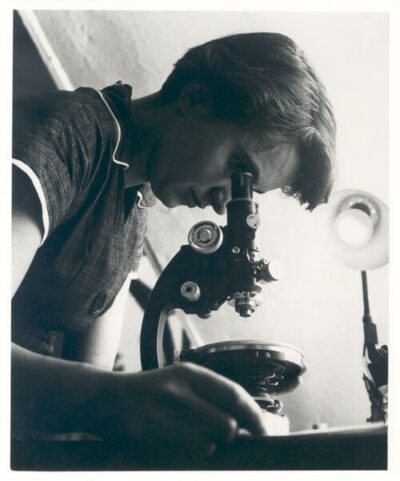
Rosalind Franklin
Rosalind Franklin was a British chemist, biophysicist, and X-ray crystallographer. Born July 25, 1920, in Notting Hill. Died April 16, 1958, in Royal Marsden Hospital. Educated at University of Cambridge and St Paul's Girls' School. Awards include Louisa Gross Horwitz Prize and 72 scientist women names on the Eiffel tower.
Facts
27 facts · 2 confirmed by two sources · 22 cited · 3 from one source
Where this comes from
Papalocal keeps its own record. It started from these sources; what each one said is kept here as it was copied, so a change on their side never changes this page by itself. Tap one to read its version.
What Wikidata says · copied November 16, 2026 · revision 2569741980
- Described as
- British chemist, biophysicist, and X-ray crystallographer (1920–1958)
- Other names
- R E Franklin, Rosalind E. Franklin, Rosalind Elsie Franklin
- Born
- July 25, 1920 · 9 references
- Died
- April 16, 1958 · 10 references
- Born in
- Notting Hill · 1 reference
- Died in
- Royal Marsden Hospital · 1 reference
- Buried in
- Willesden Jewish Cemetery · 2 references
- Cause of death
- ovarian cancer · 1 reference
- Name at birth
- Rosalind Elsie Franklin · 1 reference
- Citizen of
- United Kingdom of Great Britain and Ireland · 1 reference; United Kingdom
- Occupation
- chemist · 1 reference; molecular biologist · 1 reference; physicist · 1 reference; biochemist · 1 reference; biophysicist · 1 reference; crystallographer · 2 references; university teacher · 1 reference; geneticist · 2 references
- Worked for
- King's College London (1951–1953) · 2 references; Birkbeck, University of London · 2 references
- Education
- University of Cambridge (–1945) · 2 references; St Paul's Girls' School (1931–1938) · 2 references; Newnham College (1938–1941) · 2 references; Norland Place School
- Awards
- Louisa Gross Horwitz Prize (2008) · 1 reference; 72 scientist women names on the Eiffel tower
- Field
- X-ray crystallography · 2 references
- Father
- Ellis Arthur Franklin · 1 reference
- Wikipedias with a page
- 117
Wikidata item Q7474 (wikidata.org/wiki/Q7474), public domain (CC0). Copied November 16, 2026.
What Wikipedia says · copied November 16, 2026 · revision 1384834639
Rosalind Elsie Franklin (25 July 1920 – 16 April 1958) was an English chemist and X-ray crystallographer. Her work was central to the understanding of the molecular structures of DNA (deoxyribonucleic acid), RNA (ribonucleic acid), viruses, coal, and graphite. Although her works on coal and viruses were appreciated in her lifetime, Franklin's contributions to the discovery of the structure of DNA were largely unrecognised during her life, for which Franklin has been variously referred to as the "wronged heroine", the "dark lady of DNA", the "forgotten heroine", a "feminist icon", and the "Sylvia Plath of molecular biology". James Watson believed that, had she not died, ideally, Franklin would have been awarded a Nobel Prize in Chemistry.
Franklin graduated in 1941 with an undergraduate degree in natural sciences from Newnham College, Cambridge, and then enrolled for a PhD degree in physical chemistry under Ronald George Wreyford Norrish, the 1920 Chair of Physical Chemistry at the University of Cambridge. Disappointed by Norrish's lack of enthusiasm, she took up a research position under the British Coal Utilisation Research Association (BCURA) in 1942. The research on coal helped Franklin earn a PhD degree from Cambridge in 1945. Moving to Paris in 1947 as a chercheur (postdoctoral researcher) under Jacques Mering at the Laboratoire Central des Services Chimiques de l'État, she became an accomplished X-ray crystallographer. After joining King's College London in 1951 as a research associate, Franklin discovered some key properties of DNA, which eventually facilitated the correct description of the double helix structure of DNA. Owing to disagreement with her director, John Randall, and her colleague Maurice Wilkins, Franklin moved to Birkbeck College in 1953.
Franklin is best known for her work on the X-ray diffraction images of DNA while at King's College London, particularly Photo 51, taken by her student Raymond Gosling, which led to the discovery of the DNA double helix for which Francis Crick, James Watson, and Maurice Wilkins shared the Nobel Prize in Physiology or Medicine in 1962. While Gosling actually took the famous Photo 51, Wilkins showed it to Watson without Franklin's permission.
Working under John Desmond Bernal, Franklin led pioneering work at Birkbeck on the molecular structures of viruses. On the day before she was to unveil the structure of tobacco mosaic virus at an international fair in Brussels, Franklin died of ovarian cancer at age 37 in 1958. Her team member Aaron Klug continued her research, winning the Nobel Prize in Chemistry in 1982.
- Born, in its opening lines
- July 25, 1920
- Died, in its opening lines
- April 16, 1958
From the Wikipedia article “Rosalind Franklin” (en.wikipedia.org/wiki/Rosalind_Franklin), by its contributors, under CC BY-SA 4.0 (creativecommons.org/licenses/by-sa/4.0/). Copied November 16, 2026; not changed.
Confirmed Two sources agree. Cited One source, and it names where it got it. One source One source, without a reference of its own. Sources disagree The sources disagree. We show the best-supported value and keep theirs below.
