
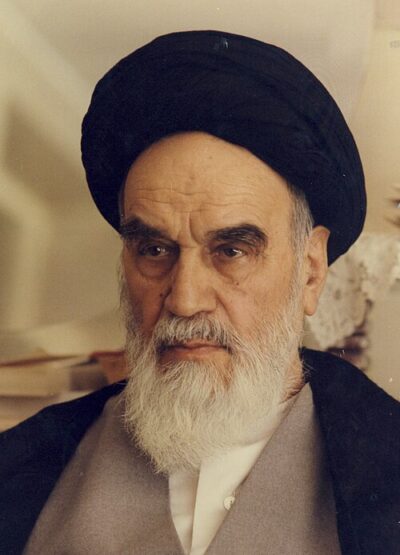
Ruhollah Khomeini
Ruhollah Khomeini was a Supreme Leader of Iran from 1979 to 1989. Born May 17, 1900, in Khomein. Died June 3, 1989, in Tehran. Positions held include Supreme Leader of Iran (1979–1989) and Commander-in-Chief of the Iranian Armed Forces (1981–1989). Known for Forty Hadith, Kashf al-Asrar and Islamic Government. Educated at Qom Hawza and Najaf Seminary. Awards include Time Person of the Year.
Facts
39 facts · 2 confirmed by two sources · 7 cited · 30 from one source
What’s different
- Born: we show May 17, 1900 (Confirmed). Wikidata also lists September 24, 1902
- Died: we show June 3, 1989 (Confirmed). Wikidata also lists March 3, 1989
Where this comes from
Papalocal keeps its own record. It started from these sources; what each one said is kept here as it was copied, so a change on their side never changes this page by itself. Tap one to read its version.
What Wikidata says · copied November 16, 2026 · revision 2565532170
- Described as
- Supreme Leader of Iran from 1979 to 1989
- Other names
- Ruhollah Mostafavi Musavi Khomeini, Ayatollah Khomeini, Ruhollāh Mostafavi Xomeyni
- Born
- September 24, 1902 · 4 references; May 17, 1900 · 1 reference
- Died
- June 3, 1989 · 3 references; March 3, 1989 · 1 reference
- Born in
- Khomein · 2 references
- Died in
- Tehran · 1 reference
- Buried in
- imam Khomeini Mausoleum · 1 reference
- Cause of death
- myocardial infarction · 2 references
- Name at birth
- سید روحالله مصطفوی
- Citizen of
- Iran
- Occupation
- ulema; Islamic jurist; marji'; politician · 3 references; preacher; philosopher; poet; revolutionary
- Positions held
- Supreme Leader of Iran (1979–1989); Commander-in-Chief of the Iranian Armed Forces (1981–1989)
- Political party
- Islamic Republican Party (1979–1987) · 1 reference
- Worked for
- Najaf Seminary
- Education
- Qom Hawza; Najaf Seminary
- Known for
- Forty Hadith; Kashf al-Asrar; Islamic Government; Tahrir al-Wasilah; The Greatest Jihad
- Awards
- Time Person of the Year (1979)
- Spouse
- Khadijeh Saqafi (1929–1989)
- Children
- Mostafa Khomeini · 1 reference; Ahmad Khomeini · 1 reference; Zahra Mostafavi Khomeini; Farideh Mostafavi
- Father
- Seyyed Mostafa Khomeini
- Siblings
- Seyed Nooruddin Hindi; Seyed Morteza Pasandideh
- Religion
- Islam · 1 reference; Twelver Shiism · 2 references
- Website
- http://www.imam-khomeini.ir/ · 1 reference
- Wikipedias with a page
- 133
Wikidata item Q38823 (wikidata.org/wiki/Q38823), public domain (CC0). Copied November 16, 2026.
What Wikipedia says · copied November 16, 2026 · revision 1385415483
Ruhollah Mostafavi Khomeini (17 May 1900 – 3 June 1989) was an Iranian politician and Shia cleric who served as the first supreme leader of Iran from 1979 until his death in 1989. He was the leader of the Iranian Revolution, which overthrew Mohammad Reza Pahlavi, ended the Pahlavi era, and transformed the country into an Islamic republic. As supreme leader, he implemented policies that came to be known as Khomeinism.
Born in the city of Khomeyn, in what is now Iran's Markazi province, Khomeini's father was murdered when he was two years old. He began studying the Quran and Arabic from a young age assisted by his relatives. Khomeini became a high-ranking cleric in Twelver Shi'ism, an ayatollah, a marja' ("source of emulation"), a mujtahid, a faqīha (expert in fiqh), a hafiz, and the author of more than 40 books. His opposition to the White Revolution resulted in his state-sponsored expulsion to Bursa in 1964. Nearly a year later, he moved to Najaf, where speeches he gave outlining his religiopolitical theory of Guardianship of the Jurist were compiled into the book Islamic Government.
After the success of the Iranian Revolution, Khomeini served as the country's de facto head of state from February 1979 until his appointment as supreme leader in December of that same year. Khomeini was Time magazine's Man of the Year in 1979 for his international influence and in the next decade was described as the "virtual face of Shia Islam in Western popular culture". He was known for his support of the hostage takers during the Iran hostage crisis; his fatwa calling for the murder of Indian-born British novelist Salman Rushdie for Rushdie's description of the Islamic prophet Muhammad in his novel The Satanic Verses, which Khomeini considered blasphemous; pursuing the overthrow of Saddam Hussein in the Iran–Iraq War; and for referring to the United States as the "Great Satan", the Soviet Union as the "Lesser Satan" and Israel as the "Little Satan".
The subject of a pervasive cult of personality, Khomeini held the title Ayatollah and is officially known as Imam Khomeini inside Iran and by his supporters internationally. His state funeral was attended by up to 10 million people, one fifth of Iran's population at the time, and is considered the one of the largest funerals in history.
Khomeini's legacy is controversial. In Iran, he is legally considered "inviolable"—insulting him is punishable with imprisonment; his gold-domed tomb in Tehran's Behesht-e Zahra cemetery has become a shrine for his adherents. While some view him as a champion of Islamic revival, independence, anti-imperialism, and resistance to foreign influence in Iran, Khomeini has been criticized for anti-Western and antisemitic rhetoric, anti-democratic actions, numerous human rights violations including the Iranian Cultural Revolution purges, 1981–1982 Iran massacres, 1988 mass executions of Iranian political prisoners, and for using child soldiers extensively during the Iran–Iraq War for human wave attacks. There were many protests during his rule, including in 1979 and 1981.
- Born, in its opening lines
- May 17, 1900
- Died, in its opening lines
- June 3, 1989
From the Wikipedia article “Ruhollah Khomeini” (en.wikipedia.org/wiki/Ruhollah_Khomeini), by its contributors, under CC BY-SA 4.0 (creativecommons.org/licenses/by-sa/4.0/). Copied November 16, 2026; not changed.
Confirmed Two sources agree. Cited One source, and it names where it got it. One source One source, without a reference of its own. Sources disagree The sources disagree. We show the best-supported value and keep theirs below.
