
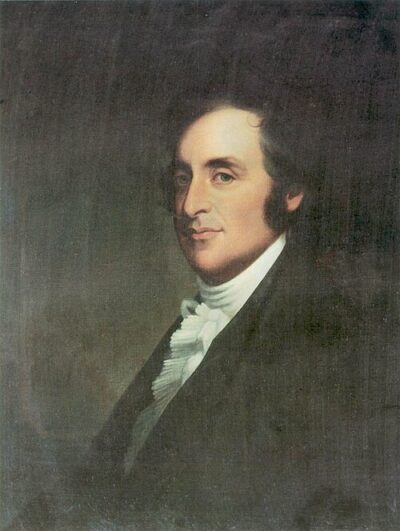
Samuel Dexter
Samuel Dexter was an American politician (1761–1816) who served in Congress and in Presidential Cabinets of John Adams and Thomas Jefferson. Born May 14, 1761, in Boston. Died May 4, 1816, in Cambridge. Positions held include United States representative, United States Secretary of the Treasury (1801) and member of the Massachusetts House of Representatives. Educated at Harvard College and Harvard University. Awards include Fellow of the American Academy of Arts and Sciences.
Facts
24 facts · 2 confirmed by two sources · 4 cited · 18 from one source
Where this comes from
Papalocal keeps its own record. It started from these sources; what each one said is kept here as it was copied, so a change on their side never changes this page by itself. Tap one to read its version.
What Wikidata says · copied November 15, 2026 · revision 2562736464
- Described as
- American politician (1761–1816) who served in Congress and in Presidential Cabinets of John Adams and Thomas Jefferson
- Born
- May 14, 1761 · 2 references
- Died
- May 4, 1816 · 2 references
- Born in
- Boston
- Died in
- Cambridge
- Buried in
- Mount Auburn Cemetery · 1 reference
- Citizen of
- United States
- Occupation
- politician · 1 reference; lawyer
- Positions held
- United States representative; United States Secretary of the Treasury (1801); member of the Massachusetts House of Representatives; United States Secretary of War (1800–1801); United States senator (1799–1800) · 1 reference
- Political party
- Federalist Party
- Worked for
- United States Department of the Treasury
- Education
- Harvard College; Harvard University
- Member of
- American Academy of Arts and Sciences
- Awards
- Fellow of the American Academy of Arts and Sciences
- Children
- Franklin Dexter · 1 reference; Katherine Gordon Dexter
- Father
- Samuel Dexter
- Mother
- Hannah Sigourney
- Lived in
- Massachusetts
- Wikipedias with a page
- 24
Wikidata item Q594570 (wikidata.org/wiki/Q594570), public domain (CC0). Copied November 15, 2026.
What Wikipedia says · copied November 15, 2026 · revision 1379665556
Samuel Dexter (May 14, 1761 – May 4, 1816) was an early American statesman who served both in Congress and in the Presidential Cabinets of John Adams and Thomas Jefferson. A native of Boston, Massachusetts, Dexter was a 1781 graduate of Harvard College. After receiving his degree he studied law, attained admission to the bar in 1784, and began to practice in Lunenburg, Massachusetts.
A Federalist, Dexter served in the Massachusetts House of Representatives from 1788 to 1790. In 1792 he was elected to the United States House of Representatives, and he served in the 3rd United States Congress. The state legislature subsequently elected Dexter to the United States Senate, and he served from March 1799 to May 1800. Dexter resigned his senate seat to accept appointment as the fourth United States Secretary of War, and he served from 1800 to 1801. In January 1801, Dexter was appointed the third United States Secretary of the Treasury, and he served until resigning on the day before his fortieth birthday.
After leaving office, Dexter practiced law in Washington, D.C. until he returned to Boston in 1805. Dexter joined the Democratic-Republican Party because of its support for the War of 1812, and he was a candidate for governor in 1814 and 1815. In 1815, Dexter declined President James Madison's appointment as Minister to Spain. He was a candidate for governor again in 1816, but died on May 4, 1816, aged 54, while visiting his son in Athens, New York. Dexter was buried at Mount Auburn Cemetery in Cambridge, Massachusetts.
- Born, in its opening lines
- May 14, 1761
- Died, in its opening lines
- May 4, 1816
From the Wikipedia article “Samuel Dexter” (en.wikipedia.org/wiki/Samuel_Dexter), by its contributors, under CC BY-SA 4.0 (creativecommons.org/licenses/by-sa/4.0/). Copied November 15, 2026; not changed.
Confirmed Two sources agree. Cited One source, and it names where it got it. One source One source, without a reference of its own. Sources disagree The sources disagree. We show the best-supported value and keep theirs below.
