
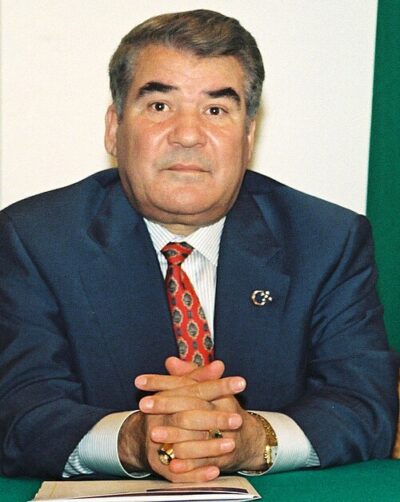
Saparmyrat Nyýazow
Saparmyrat Nyýazow was a President of Turkmenistan from 1990 to 2006. Born February 19, 1940, in Gypjak. Died December 21, 2006, in Ashgabat. Positions held include President of Turkmenistan (1990–2006), people's deputy of union of socialist soviet republics and Member of the Politburo of the CPSU Central Committee (1990–1991). Known for Ruhnama, National anthem of Turkmenistan and Walk of Health. Educated at Peter the Great Saint Petersburg State Polytechnical University and Higher Party School at the Central Committee of the CPSU. Awards include Order of Neutrality, Order of the Renaissance (Turkmenistan) and Order of Friendship of Peoples.
Facts
41 facts · 2 confirmed by two sources · 4 cited · 35 from one source
Where this comes from
Papalocal keeps its own record. It started from these sources; what each one said is kept here as it was copied, so a change on their side never changes this page by itself. Tap one to read its version.
What Wikidata says · copied November 16, 2026 · revision 2563060726
- Described as
- President of Turkmenistan from 1990 to 2006
- Other names
- Saparmyrat Ataýewiç Nyýazow, Saparmurat Atayevich Niyazov, Saparmurat Niyazov
- Born
- February 19, 1940 · 8 references
- Died
- December 21, 2006 · 10 references
- Born in
- Gypjak · 3 references
- Died in
- Ashgabat · 2 references
- Buried in
- Türkmenbaşy Mosque · 1 reference
- Cause of death
- myocardial infarction
- Citizen of
- Soviet Union; Turkmenistan · 3 references
- Occupation
- politician · 4 references; autobiographer
- Positions held
- President of Turkmenistan (1990–2006); people's deputy of union of socialist soviet republics; Member of the Politburo of the CPSU Central Committee (1990–1991)
- Political party
- Communist Party of the Soviet Union (1962–1991); Democratic Party of Turkmenistan (1991–2006)
- Education
- Peter the Great Saint Petersburg State Polytechnical University (1962–1967) · 1 reference; Higher Party School at the Central Committee of the CPSU (–1976)
- Member of
- Politburo of the Central Committee of the Communist Party of the Soviet Union (1990–1991)
- Known for
- Ruhnama; National anthem of Turkmenistan; Walk of Health
- Awards
- Order of Neutrality (1998); Order of the Renaissance (Turkmenistan) (1997); Order of Friendship of Peoples (1981); Medal "For Labour Valour"; Jubilee Medal "In Commemoration of the 100th Anniversary of the Birth of Vladimir Ilyich Lenin" (1970); Order of St. Mesrop Mashtots (2000); Order of Prince Yaroslav the Wise, 1st class (2000); Order of Holy Prince Daniel of Moscow 1st class (2000); Hero of Turkmenistan (6 times) (1992, 1995, 1998, 1999, 2000, 2001); honorary doctor of Baku State University
- Field
- politics · 1 reference
- Spouse
- Muza Niýazowa
- Children
- Myrat Nyýazow
- Father
- Atamyrat Nyýazow
- Mother
- Gurbansoltan Eje
- Religion
- Sunni Islam; Islam · 1 reference
- Military branch
- Armed Forces of Turkmenistan · 1 reference
- Military rank
- general of the army; supreme commander · 1 reference
- Wikipedias with a page
- 90
Wikidata item Q82918 (wikidata.org/wiki/Q82918), public domain (CC0). Copied November 16, 2026.
What Wikipedia says · copied November 16, 2026 · revision 1384172866
Saparmurat Atayevich Niyazov (19 February 1940 – 21 December 2006) was a Turkmen politician and dictator who led Turkmenistan from 1985 until his death in 2006. He was the first secretary of the Communist Party of Turkmenistan from 1985 until 1991 and supported the 1991 Soviet coup attempt. He continued to rule Turkmenistan as the first president for 15 years after independence from the Soviet Union in 1991.
Turkmen media referred to Niyazov using the title His Excellency Saparmyrat Türkmenbaşy, President of Turkmenistan and Chairman of the Cabinet of Ministers. His self-given title Türkmenbaşy, meaning Head of the Turkmen or the Leader of all Turkmen, referred to his position as the founder and president of the Association of Turkmens of the World. In 1999, the Assembly of Turkmenistan declared Niyazov President for life.
In his time, Niyazov was one of the world's most repressive and autocratic dictators. He promoted a cult of personality around himself and imposed his personal eccentricities upon the country, such as renaming Turkmen months and days of the week to references to his autobiography, the Ruhnama. He made it mandatory to read the Ruhnama in schools, universities and governmental organizations; new governmental employees were tested on the book at job interviews and an exam on its teachings was a part of the driving test in Turkmenistan. In 2005, he closed down all rural libraries and hospitals outside of the capital city Ashgabat, in a country where at the time more than half the population lived in rural areas, once stating that, "If people are ill, they can come to Ashgabat."
Under Niyazov's rule, Turkmenistan had the lowest life expectancy in Central Asia. Global Witness, a London-based human rights organisation, reported that money under Niyazov's control and held overseas may be in excess of US$3 billion, of which between $1.8–$2.6 billion was allegedly situated in the Foreign Exchange Reserve Fund at Deutsche Bank in Germany.
- Born, in its opening lines
- February 19, 1940
- Died, in its opening lines
- December 21, 2006
From the Wikipedia article “Saparmurat Niyazov” (en.wikipedia.org/wiki/Saparmurat_Niyazov), by its contributors, under CC BY-SA 4.0 (creativecommons.org/licenses/by-sa/4.0/). Copied November 16, 2026; not changed.
Confirmed Two sources agree. Cited One source, and it names where it got it. One source One source, without a reference of its own. Sources disagree The sources disagree. We show the best-supported value and keep theirs below.
