
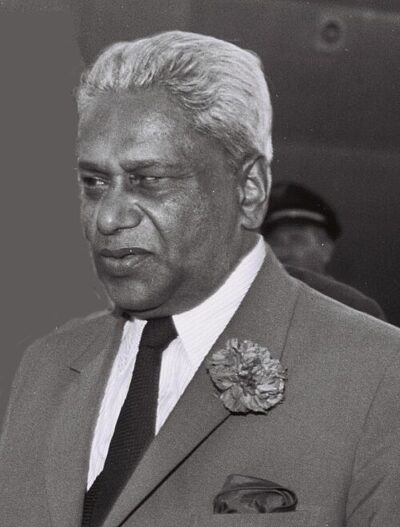
Seewoosagur Ramgoolam
Seewoosagur Ramgoolam was a politician, statesman and philanthropist and the first prime minister of Mauritius. Born September 18, 1900, in Flacq District. Died December 15, 1985, in Port Louis. Positions held include chairperson of the Organisation of African Unity (1976–1977), Governor-General of Mauritius (1983–1985) and Prime Minister of Mauritius (1968–1982). Educated at University College London and London School of Economics and Political Science. Awards include Knight Commander of the Order of St Michael and St George, United Nations Prize in the Field of Human Rights and honorary doctor of the Paul Cézanne University.
Facts
22 facts · 2 confirmed by two sources · 3 cited · 17 from one source
What’s different
- Born: we show September 18, 1900 (Confirmed). Wikidata also lists September 19, 1900
Where this comes from
Papalocal keeps its own record. It started from these sources; what each one said is kept here as it was copied, so a change on their side never changes this page by itself. Tap one to read its version.
What Wikidata says · copied November 16, 2026 · revision 2567272451
- Described as
- politician, statesman and philanthropist and the first prime minister of Mauritius (1900-1985)
- Other names
- Sir Seewoosagur Ramgoolam
- Born
- September 19, 1900; September 18, 1900 · 2 references
- Died
- December 15, 1985 · 2 references
- Born in
- Flacq District
- Died in
- Port Louis · 1 reference
- Citizen of
- Mauritius
- Occupation
- politician · 1 reference; philanthropist
- Positions held
- chairperson of the Organisation of African Unity (1976–1977); Governor-General of Mauritius (1983–1985); Prime Minister of Mauritius (1968–1982); Chief Minister of Mauritius (1961–1968); president (1959–1984)
- Political party
- Labour Party
- Education
- University College London; London School of Economics and Political Science; Royal College Curepipe
- Awards
- Knight Commander of the Order of St Michael and St George; United Nations Prize in the Field of Human Rights (1973); honorary doctor of the Paul Cézanne University (1978) · 1 reference
- Children
- Navin Ramgoolam
- Religion
- Hinduism
- Website
- http://ssr.intnet.mu/
- Wikipedias with a page
- 32
Wikidata item Q2166580 (wikidata.org/wiki/Q2166580), public domain (CC0). Copied November 16, 2026.
What Wikipedia says · copied November 16, 2026 · revision 1383426146
Sir Seewoosagur Ramgoolam (18 September 1900 – 15 December 1985), often known as SSR or Chacha ("uncle"), was a Mauritian physician and statesman who led Mauritius to independence from the United Kingdom. He was the colony's chief minister from 1961 and premier from 1964, the first prime minister of independent Mauritius from 1968 to 1982, and governor-general from 1983 until his death. He is widely known in Mauritius as the "Father of the Nation".
The son of an indentured labourer from Bihar, Ramgoolam was born in a village in eastern Mauritius. He studied medicine in London, where he joined the Fabian Society and Indian nationalist circles and met Mahatma Gandhi. After returning home in 1935 he became a leader of the Indo-Mauritian community, co-founded the newspaper Advance and was nominated to the colony's Council of Government in 1940. Elected to the Legislative Council in 1948, he became the leader of the Labour Party group in the council and, by 1958, of the party itself. He campaigned for universal suffrage and ministerial government, both of which Britain conceded in the late 1950s.
As chief minister and premier, Ramgoolam led the parties that sought independence at the Lancaster House conference of 1965. During the conference, after being told that Britain could separate the islands without Mauritian consent, he agreed to the detachment of the Chagos Archipelago, which Britain made into the British Indian Ocean Territory. The detachment led to the expulsion of the islands' inhabitants between 1967 and 1973, a decision taken by the United Kingdom and the United States, not by Mauritius. Opponents, and some of the displaced Chagossians, long accused Ramgoolam of trading the islands for independence. British records later showed that Britain was prepared to detach them regardless, and in 2019 the International Court of Justice found that the detachment had not been based on the free and genuine will of the people of Mauritius. His Independence Party won the 1967 election, and Mauritius became independent on 12 March 1968.
As prime minister, Ramgoolam governed through coalitions, including one with his former opponents in the Parti Mauricien Social Démocrate. His governments built a welfare state, introduced free secondary education and promoted the export processing zones that began the diversification of the sugar economy. They also ruled under a state of emergency from 1971 to 1976 to contain strikes led by the Mauritian Militant Movement. He signed the Lomé Convention, which guaranteed a European market for Mauritian sugar, and was chairman of the Organisation of African Unity in 1976–1977. After losing his seat in the 1982 election he became governor-general, and he died in office in 1985. The country's main airport and the botanic garden at Pamplemousses are named after him, and his likeness appears on Mauritian coins and banknotes. His son Navin Ramgoolam has served three terms as prime minister.
- Born, in its opening lines
- September 18, 1900
- Died, in its opening lines
- December 15, 1985
From the Wikipedia article “Seewoosagur Ramgoolam” (en.wikipedia.org/wiki/Seewoosagur_Ramgoolam), by its contributors, under CC BY-SA 4.0 (creativecommons.org/licenses/by-sa/4.0/). Copied November 16, 2026; not changed.
Confirmed Two sources agree. Cited One source, and it names where it got it. One source One source, without a reference of its own. Sources disagree The sources disagree. We show the best-supported value and keep theirs below.
