
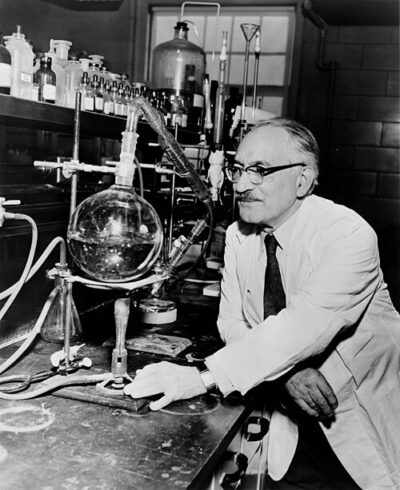
Selman Abraham Waksman
Selman Abraham Waksman was an American scientist, biochemist, microbiologist who discovered Streptomycin and many antibiotics. Born July 22, 1888, in Nova Pryluka. Died August 16, 1973, in Woods Hole. Educated at University of California, Berkeley and Rutgers University. Awards include Albert Lasker Award for Basic Medical Research, Leeuwenhoek Medal and John Scott Award.
Facts
40 facts · 2 confirmed by two sources · 11 cited · 27 from one source
Where this comes from
Papalocal keeps its own record. It started from these sources; what each one said is kept here as it was copied, so a change on their side never changes this page by itself. Tap one to read its version.
What Wikidata says · copied November 13, 2026 · revision 2568697520
- Described as
- American scientist, biochemist, microbiologist who discovered Streptomycin and many antibiotics
- Other names
- Waksman, Selman Waksman, Selman A. Waksman, Selman A Waksman, S. A. Waksman, S.A. Waksman, S A Waksman, SA Waksman
- Born
- July 22, 1888 · 6 references
- Died
- August 16, 1973 · 7 references
- Born in
- Nova Pryluka
- Died in
- Woods Hole · 1 reference
- Buried in
- Woods Hole Village Cemetery · 1 reference
- Citizen of
- United States (1916–); Russian Empire; Soviet Union
- Occupation
- biochemist; autobiographer; physician; microbiologist · 1 reference; university teacher; inventor · 1 reference; pharmacologist · 1 reference; chemist
- Worked for
- Rutgers University; New Jersey Agricultural Experiment Station
- Education
- University of California, Berkeley (–1918); Rutgers University (–1915)
- Member of
- National Academy of Sciences (1942–) · 1 reference; American Academy of Arts and Sciences; German Academy of Sciences Leopoldina; Serbian Academy of Sciences and Arts
- Awards
- Albert Lasker Award for Basic Medical Research (1948) · 1 reference; Leeuwenhoek Medal (1950); John Scott Award (1949) · 1 reference; honorary doctor of the University of Madrid Complutense (1950); honorary doctor of the University of Toulouse (1950) · 1 reference; Nobel Prize in Physiology or Medicine (1952) · 2 references; Grand Cross of the Order of Civil Health (1954) · 1 reference; honorary doctor of the Hebrew University of Jerusalem (1958) · 1 reference; honorary doctorate from the University of Strasbourg (1958) · 1 reference; honorary doctor of Caen University (1966) · 1 reference; National Inventors Hall of Fame (2005) · 1 reference; Amory Prize (1947)
- Field
- biochemistry; microbiology
- Children
- Byron H. Waksman
- Lived in
- United States · 1 reference
- Wikipedias with a page
- 71
Wikidata item Q232308 (wikidata.org/wiki/Q232308), public domain (CC0). Copied November 13, 2026.
What Wikipedia says · copied November 13, 2026 · revision 1383665701
Selman Abraham Waksman (22 July [O.S. 10 July] 1888 – August 16, 1973) was a Russian-born American inventor, biochemist and microbiologist, whose research into the decomposition of organisms that live in soil enabled the discovery of streptomycin and several other antibiotics. For his work he won the 1952 Nobel Prize in Physiology or Medicine.
Waksman emigrated to the United States in 1910 and became a naturalized U.S. citizen in 1916. A professor of biochemistry and microbiology at Rutgers University for four decades, he discovered several antibiotics (and introduced the modern sense of that word to name them), and he introduced procedures that have led to the development of many others. The proceeds earned from the licensing of his patents funded a foundation for microbiological research, which established the Waksman Institute of Microbiology located at the Rutgers University Busch Campus in Piscataway, New Jersey (USA). After receiving the Nobel Prize, Waksman and his foundation later were sued by Albert Schatz, one of his Ph.D. students and the discoverer of streptomycin, for minimizing Schatz's role in the discovery.
In 2005, Waksman was granted an ACS National Historic Chemical Landmark in recognition of the significant work of his lab in isolating more than 15 antibiotics, including streptomycin, which was the first effective treatment for tuberculosis.
- Born, in its opening lines
- July 22, 1888
- Died, in its opening lines
- August 16, 1973
From the Wikipedia article “Selman Waksman” (en.wikipedia.org/wiki/Selman_Waksman), by its contributors, under CC BY-SA 4.0 (creativecommons.org/licenses/by-sa/4.0/). Copied November 13, 2026; not changed.
Confirmed Two sources agree. Cited One source, and it names where it got it. One source One source, without a reference of its own. Sources disagree The sources disagree. We show the best-supported value and keep theirs below.
