
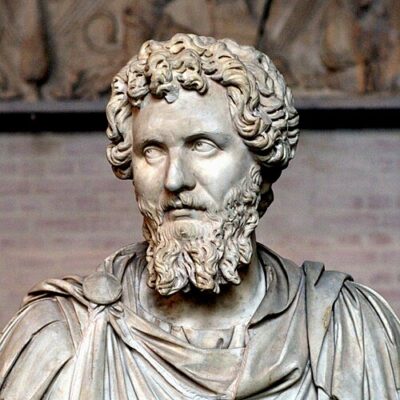
Septimius Severus
Septimius Severus was a Roman emperor from 193 to 211. Born 146, in Leptis Magna. Died February 4, 211, in Eboracum. Positions held include Roman emperor (193–211), quaestor (170) and tribune of the plebs.
Facts
30 facts · 1 confirmed by two sources · 5 cited · 23 from one source · 1 where the sources disagree
What’s different
- Born: we show 146 (Sources disagree). Wikipedia says April 11, 145
Where this comes from
Papalocal keeps its own record. It started from these sources; what each one said is kept here as it was copied, so a change on their side never changes this page by itself. Tap one to read its version.
What Wikidata says · copied November 16, 2026 · revision 2568841777
- Described as
- Roman emperor from 193 to 211
- Other names
- Septimius, Emperor of Rome Severus, Lucius Septimius Severus Emperor of Rome, Lucius Septimius, Emperor of Rome Severus, Lucius Septimius Severus Pertinax, Severus, Lucius Septimius Severus Pius Pertinax Augustus Arabicus Adiabenicus, L. Septimius Severus, Lucius Septimius Severus
- Born
- 146 · 6 references
- Died
- February 4, 211 · 2 references
- Born in
- Leptis Magna · 1 reference
- Died in
- Eboracum · 1 reference
- Buried in
- Castel Sant'Angelo
- Name at birth
- Lucius Septimius Severus
- Citizen of
- Ancient Rome
- Occupation
- politician; military personnel; emperor · 1 reference
- Positions held
- Roman emperor (193–211); quaestor (170); tribune of the plebs; praetors; legatus legionis IIII Scythicae; consul suffectus; ancient Roman senator (173–); legatus Augusti pro praetore Pannoniae superioris (191–); Roman consul (194)
- Spouse
- Paccia Marciana (175–186); Julia Domna (187–211) · 1 reference
- Children
- Septimia Major; Septimia Minor; Caracalla; Geta · 1 reference
- Father
- Publius Septimius Geta
- Mother
- Fulvia Pia
- Siblings
- Publius Septimius Geta; Septimia Octavilla
- Religion
- ancient Roman religion
- Wikipedias with a page
- 93
Wikidata item Q1442 (wikidata.org/wiki/Q1442), public domain (CC0). Copied November 16, 2026.
What Wikipedia says · copied November 16, 2026 · revision 1383417527
Lucius Septimius Severus (; Latin: [ˈluːkius sepˈtimius seˈweːrus]; 11 April 145 – 4 February 211) was Roman emperor from 193 to 211. He was born in Leptis Magna, Libya, in the Roman province of Africa. He is of Libyco-Punic descent on his father's side and Romano-Italian on his mother's side. As a young man, he advanced through the customary succession of offices during the reigns of Marcus Aurelius and Commodus. Severus was the final contender to seize power after the death of the emperor Pertinax in 193 during the Year of the Five Emperors.
After deposing and killing the incumbent emperor Didius Julianus, Severus fought his rival claimants, the Roman generals Pescennius Niger and Clodius Albinus. Niger was defeated in 194 at the Battle of Issus in Cilicia. Later that year Severus waged a short punitive campaign beyond the eastern frontier, annexing the Kingdom of Osroene as a new province. Severus defeated Albinus three years later at the Battle of Lugdunum in Gaul. Following the consolidation of his rule over the western provinces, Severus waged another brief, more successful war in the east against the Parthian Empire, sacking their capital Ctesiphon in 197 and expanding the eastern frontier to the Tigris. He then enlarged and fortified the Limes Arabicus in Arabia Petraea. In 202, he campaigned in Africa and Mauretania against the Garamantes, capturing their capital Garama, and expanding the Limes Tripolitanus along the southern desert frontier of the empire.
With his second wife, Julia Domna, Severus had two sons; the elder, Caracalla, was proclaimed Augustus, or co-emperor, in 198, and the younger, Geta, in 209. Severus travelled to Britain in 208, strengthening Hadrian's Wall and reoccupying the Antonine Wall. In 209, he invaded Caledonia (modern Scotland) with an army of 50,000 men but his ambitions were cut short when he died of an infectious disease in early 211, at Eboracum (modern York). His sons, advised by Julia Domna, succeeded him, thus founding the Severan dynasty. It was the last dynasty of the Roman Empire before the Crisis of the Third Century.
- Born, in its opening lines
- April 11, 145
- Died, in its opening lines
- February 4, 211
From the Wikipedia article “Septimius Severus” (en.wikipedia.org/wiki/Septimius_Severus), by its contributors, under CC BY-SA 4.0 (creativecommons.org/licenses/by-sa/4.0/). Copied November 16, 2026; not changed.
Confirmed Two sources agree. Cited One source, and it names where it got it. One source One source, without a reference of its own. Sources disagree The sources disagree. We show the best-supported value and keep theirs below.
