
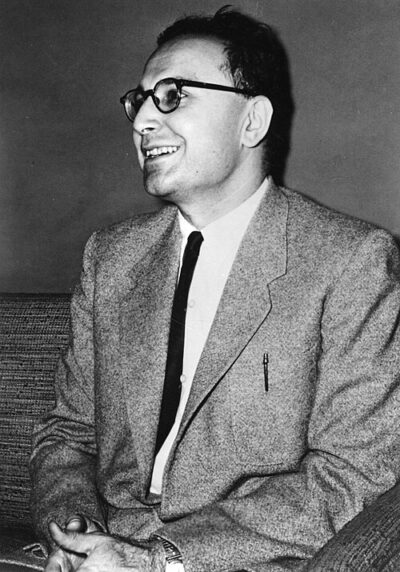
Seymour Martin Lipset
Seymour Martin Lipset was an American sociologist. Born March 18, 1922, in Harlem. Died December 31, 2006, in Arlington County. Positions held include President of the American Political Science Association (1981–1982) and President of the American Sociological Association (1993). Educated at Columbia University and City College of New York. Awards include Guggenheim Fellowship, Democracy Service Medal and W.E.B. Du Bois Career of Distinguished Scholarship award.
Facts
29 facts · 2 confirmed by two sources · 12 cited · 15 from one source
Where this comes from
Papalocal keeps its own record. It started from these sources; what each one said is kept here as it was copied, so a change on their side never changes this page by itself. Tap one to read its version.
What Wikidata says · copied November 15, 2026 · revision 2569713948
- Described as
- American sociologist (1922–2006)
- Born
- March 18, 1922 · 6 references
- Died
- December 31, 2006 · 6 references
- Born in
- Harlem · 1 reference
- Died in
- Arlington County · 1 reference
- Cause of death
- stroke
- Citizen of
- United States
- Occupation
- sociologist · 1 reference; political scientist · 1 reference; university teacher · 1 reference; writer · 1 reference; historian · 1 reference
- Positions held
- President of the American Political Science Association (1981–1982) · 1 reference; President of the American Sociological Association (1993) · 1 reference
- Political party
- Socialist Party of America
- Worked for
- Harvard University; University of Toronto; George Mason University; Columbia University; Stanford University · 1 reference; University of California, Berkeley · 1 reference
- Education
- Columbia University (–1949) · 1 reference; City College of New York · 1 reference
- Member of
- National Academy of Sciences · 1 reference; American Academy of Arts and Sciences
- Awards
- Guggenheim Fellowship · 1 reference; Democracy Service Medal; W.E.B. Du Bois Career of Distinguished Scholarship award (2000) · 1 reference; honorary doctorate of the Vrije Universiteit Brussel (1989) · 1 reference
- Field
- sociology
- Wikipedias with a page
- 34
Wikidata item Q352959 (wikidata.org/wiki/Q352959), public domain (CC0). Copied November 15, 2026.
What Wikipedia says · copied November 15, 2026 · revision 1379647384
Seymour Martin Lipset ( LIP-sit; March 18, 1922 – December 31, 2006) was an American sociologist and political scientist. His major work was in the fields of political sociology, trade union organization, social stratification, public opinion, and the sociology of intellectual life. He also wrote extensively about the conditions for democracy in comparative perspective. He was president of both the American Political Science Association (1979–1980) and the American Sociological Association (1992–1993). A socialist in his early life, Lipset later moved to the right, and was considered to be one of the first neoconservatives.
At his death in 2006, The Guardian called him "the leading theorist of democracy and American exceptionalism"; The New York Times labeled him "a pre-eminent sociologist, political scientist and incisive theorist of American uniqueness" and The Washington Post reported that he was "one of the most influential social scientists of the past half century."
- Born, in its opening lines
- March 18, 1922
- Died, in its opening lines
- December 31, 2006
From the Wikipedia article “Seymour Martin Lipset” (en.wikipedia.org/wiki/Seymour_Martin_Lipset), by its contributors, under CC BY-SA 4.0 (creativecommons.org/licenses/by-sa/4.0/). Copied November 15, 2026; not changed.
Confirmed Two sources agree. Cited One source, and it names where it got it. One source One source, without a reference of its own. Sources disagree The sources disagree. We show the best-supported value and keep theirs below.
