
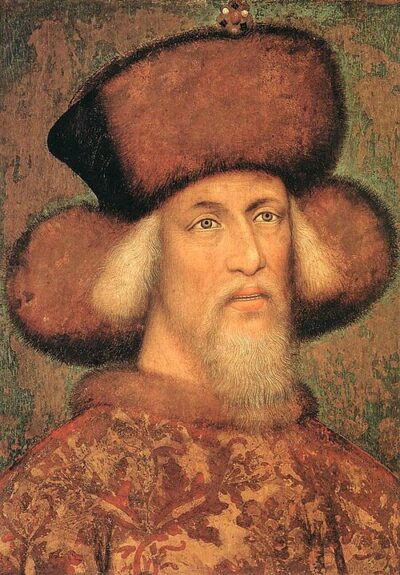
Sigismund
Sigismund was a Monarch from the House of Luxemburg. Born February 14, 1368, in Prague. Died December 9, 1437, in Znojmo. Positions held include Holy Roman Emperor (1433–1437), Prince-Elector (2 times) (1378–1415) and Apostolic King of Hungary (1387–1437). Awards include Golden Rose and Order of the Garter.
Facts
31 facts · 1 confirmed by two sources · 4 cited · 24 from one source · 2 where the sources disagree
What’s different
- Born: we show February 14, 1368 (Sources disagree). Wikipedia says February 15, 1368
- Born in: we show Prague (Sources disagree). Wikidata also lists Free Imperial City of Nuremberg
Where this comes from
Papalocal keeps its own record. It started from these sources; what each one said is kept here as it was copied, so a change on their side never changes this page by itself. Tap one to read its version.
What Wikidata says · copied November 16, 2026 · revision 2569840056
- Described as
- Monarch from the House of Luxemburg (1368-1437)
- Other names
- Super-Grammaticam
- Born
- February 14, 1368 · 2 references
- Died
- December 9, 1437 · 2 references
- Born in
- Free Imperial City of Nuremberg · 1 reference; Prague · 2 references
- Died in
- Znojmo · 1 reference
- Buried in
- Oradea · 1 reference
- Citizen of
- Holy Roman Empire; Hungary
- Occupation
- monarch; mint lord · 1 reference
- Positions held
- Holy Roman Emperor (1433–1437); Prince-Elector (2 times) (1378–1415); Apostolic King of Hungary (1387–1437) · 1 reference; King of Bohemia (1419–1437); King of the Romans (1411–1437); Duke of Luxemburg (1419–1437)
- Awards
- Golden Rose (1415); Order of the Garter · 1 reference
- Spouse
- Mary I of Hungary (1385–1395) · 1 reference; Barbara of Cilli (1405–1437) · 1 reference
- Children
- Elizabeth of Luxembourg; N. of Luxemburg, Prince of Hungary · 1 reference
- Father
- Charles IV
- Mother
- Elizabeth of Pomerania
- Siblings
- Margaret of Bohemia, Burgravine of Nuremberg; Anne of Bohemia; Wenceslaus IV of Bohemia; John of Görlitz; Catherine of Bohemia; Margaret of Bohemia, Queen of Hungary; Elisabeth of Bohemia
- Religion
- Catholic Church
- Wikipedias with a page
- 73
Wikidata item Q57124 (wikidata.org/wiki/Q57124), public domain (CC0). Copied November 16, 2026.
What Wikipedia says · copied November 16, 2026 · revision 1383326384
Sigismund of Luxembourg (14 February or 15 February 1368 – 9 December 1437) was Holy Roman Emperor from 1433 until his death in 1437. As the husband of Mary, Queen of Hungary, he was King of Hungary and Croatia (jure uxoris) from 1387. He was elected King of Germany (King of the Romans) in 1410, and was also King of Bohemia from 1419, as well as prince-elector of Brandenburg (1378–88 and 1411–15). He was the last male member of the House of Luxembourg.
Sigismund was the son of Charles IV, Holy Roman Emperor and his fourth wife Elizabeth of Pomerania. He married Mary, Queen of Hungary in 1385 and was crowned King of Hungary soon after. He fought to restore and maintain authority to the throne. Mary died in 1395, leaving Sigismund the sole ruler of Hungary.
In 1396, Sigismund led the Crusade of Nicopolis but was decisively defeated by the Ottoman Empire. Afterwards, he founded the Order of the Dragon to fight the Turks and secured the thrones of Croatia, Germany and Bohemia. To enforce his authority against domestic resistance during his 1403 offensive against Bohemian loyalists supporting King Wenceslaus IV, Sigismund deployed foreign mercenary forces, including Cumans. Utilizing scorched-earth tactics against civilian populations, his armies systematically plundered and burned vital economic hubs around Kutná Hora, leaving widespread devastation across the region. Sigismund was one of the driving forces behind the Council of Constance (1414–18) that ended the Papal Schism, but which also led to the Hussite Wars that dominated the later period of his life. In 1433, Sigismund was crowned Holy Roman Emperor and ruled until his death in 1437.
Historian Thomas Brady Jr. remarks that Sigismund "possessed a breadth of vision and a sense of grandeur unseen in a German monarch since the thirteenth century". He realised the need to carry out reforms of the empire and the Church at the same time. However, external difficulties, self-inflicted mistakes and the extinction of the Luxembourg male line made this vision unfulfilled. Later, the Habsburgs would inherit this mission and imperial reform was carried out successfully under the reigns of Frederick III and especially his son Maximilian I, although perhaps at the expense of the reform of the Church, partly because Maximilian was not particularly focused on the matter.
In recent years, scholarly interest (especially from East-Central Europe) has grown greatly in the person and reign of Sigismund – the ruler who had gained and led an imperial association almost reaching the size of the later Habsburg Empire – as well as cultural developments associated with his era. The setbacks which have been seen as his major failures (like dealing with the Hussite movement) are now generally considered to be the result of the lack of financial resources and other heavy constraints, rather than personal failings.
- Born, in its opening lines
- February 15, 1368
- Died, in its opening lines
- December 9, 1437
From the Wikipedia article “Sigismund, Holy Roman Emperor” (en.wikipedia.org/wiki/Sigismund,_Holy_Roman_Emperor), by its contributors, under CC BY-SA 4.0 (creativecommons.org/licenses/by-sa/4.0/). Copied November 16, 2026; not changed.
Confirmed Two sources agree. Cited One source, and it names where it got it. One source One source, without a reference of its own. Sources disagree The sources disagree. We show the best-supported value and keep theirs below.
