
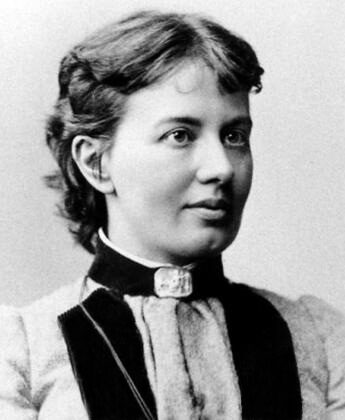
Sofia Kovalevskaya
Sofia Kovalevskaya was the 19th-century Russian mathematician. Born January 3, 1850, in Moscow. Died February 10, 1891, in Hedvig Eleonora parish. Known for Cauchy–Kowalevski theorem and integrable rigid body. Educated at University of Göttingen and Heidelberg University. Awards include Knight of the French Order of Academic Palms and Bordin Prize.
Facts
37 facts · 1 confirmed by two sources · 17 cited · 18 from one source · 1 where the sources disagree
What’s different
- Born: we show January 3, 1850 (Sources disagree). Wikipedia says January 15, 1850
Where this comes from
Papalocal keeps its own record. It started from these sources; what each one said is kept here as it was copied, so a change on their side never changes this page by itself. Tap one to read its version.
What Wikidata says · copied November 16, 2026 · revision 2568737026
- Described as
- 19th-century Russian mathematician
- Other names
- Sofya Kovalevskaya, Sofya Kovalevskaia, Sofya Kovalevskaja, Sofya Kovalevsky, Sofia Kovalevskaia, Sofia Kovalevskaja, Sofia Kovalevsky, Sofja Kovalevskaya, Sofja Kovalevskaja, Sofja Kovalevskaia, Sofja Kovalevsky, Sofya Vasilyevna Kovalevskaya
- Born
- January 3, 1850 · 1 reference
- Died
- February 10, 1891 · 10 references
- Born in
- Moscow · 8 references
- Died in
- Hedvig Eleonora parish · 3 references
- Buried in
- Norra begravningsplatsen · 5 references
- Cause of death
- viral pneumonia · 1 reference
- Name at birth
- Софья Васильевна Круковская · 1 reference
- Citizen of
- Russian Empire; Sweden
- Occupation
- mathematician · 2 references; physicist; novelist; university teacher; writer · 1 reference
- Worked for
- Stockholm University (1884–1891) · 2 references
- Education
- University of Göttingen (–1874) · 1 reference; Heidelberg University (1869–1870) · 2 references; Frederick William University Berlin (1871–1874) · 1 reference
- Member of
- Russian Academy of Sciences (1889–) · 2 references
- Known for
- Cauchy–Kowalevski theorem; integrable rigid body
- Awards
- Knight of the French Order of Academic Palms; Bordin Prize (1888) · 1 reference
- Field
- mathematics · 1 reference; mechanics · 1 reference; differential calculus; mathematical analysis; partial differential equation; literature · 1 reference
- Spouse
- Vladimir Kovalevsky (1868–1883) · 4 references
- Children
- Sofia Kovalevskaya · 1 reference
- Father
- Vasily Vasilyevich Korvin-Krukovsky · 1 reference
- Mother
- Yelizaveta Korvin-Krukovskaya
- Siblings
- Anne Jaclard · 1 reference
- Lived in
- Moscow · 1 reference; Stockholm; Paris
- Wikipedias with a page
- 92
Wikidata item Q184535 (wikidata.org/wiki/Q184535), public domain (CC0). Copied November 16, 2026.
What Wikipedia says · copied November 16, 2026 · revision 1375151593
Sofya Vasilyevna Kovalevskaya (Russian: Софья Васильевна Ковалевская; born Korvin-Krukovskaya; 15 January [O.S. 3 January] 1850 – 10 February 1891) was a Russian mathematician who made noteworthy contributions to analysis, partial differential equations and mechanics. She was a pioneer of equality for women in mathematics. Kovalevskaya was the first woman to earn a doctorate in mathematics, in the modern sense of that term, the first woman in Europe in modern times appointed to a full professorship in mathematics, as well as one of the first women to work for a scientific journal as an editor. According to historian of science Ann Hibner Koblitz, Kovalevskaya was "the greatest known woman scientist before the twentieth century".
Historian of mathematics Roger Cooke writes:... the more I reflect on her life and consider the magnitude of her achievements, set against the weight of the obstacles she had to overcome, the more I admire her. For me she has taken on a heroic stature achieved by very few other people in history. To venture, as she did, into academia, a world almost no woman had yet explored, and to be consequently the object of curious scrutiny, while a doubting society looked on, half-expecting her to fail, took tremendous courage and determination. To achieve, as she did, at least two major results of lasting value to scholarship, is evidence of a considerable talent, developed through iron discipline.
There are several alternative transliterations of her name. She herself used Sophie Kowalevski (or occasionally Kowalevsky) in her academic publications. In Sweden she was known as Sonja Kovalevsky; Sonja (Russian: Соня) is her Russian nickname.
- Born, in its opening lines
- January 15, 1850
- Died, in its opening lines
- February 10, 1891
From the Wikipedia article “Sofya Kovalevskaya” (en.wikipedia.org/wiki/Sofya_Kovalevskaya), by its contributors, under CC BY-SA 4.0 (creativecommons.org/licenses/by-sa/4.0/). Copied November 16, 2026; not changed.
Confirmed Two sources agree. Cited One source, and it names where it got it. One source One source, without a reference of its own. Sources disagree The sources disagree. We show the best-supported value and keep theirs below.
