
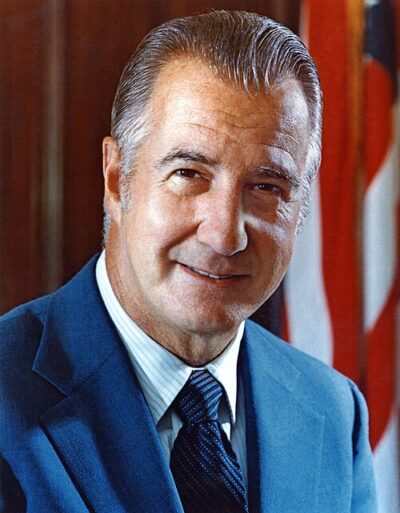
Spiro Agnew
Spiro Agnew was a vice president of the United States from 1969 to 1973. Born November 9, 1918, in Baltimore. Died September 17, 1996, in Berlin. Positions held include Vice President of the United States (1969–1973), Governor of Maryland (1967–1969) and Baltimore County Executive (1962–1966). Educated at Johns Hopkins University and Forest Park High School. Awards include Bronze Star Medal and anniversary medal at the occasion of the 2500th anniversary of the founding of the Iranian Empire.
Facts
25 facts · 2 confirmed by two sources · 7 cited · 16 from one source
Where this comes from
Papalocal keeps its own record. It started from these sources; what each one said is kept here as it was copied, so a change on their side never changes this page by itself. Tap one to read its version.
What Wikidata says · copied November 13, 2026 · revision 2555553786
- Described as
- vice president of the United States from 1969 to 1973
- Other names
- Spiro Theodore Agnew, Spiro T. Agnew
- Born
- November 9, 1918 · 7 references
- Died
- September 17, 1996 · 7 references
- Born in
- Baltimore · 1 reference
- Died in
- Berlin
- Buried in
- Dulaney Valley Memorial Gardens · 1 reference
- Cause of death
- leukemia
- Name at birth
- Spiro Theodore Agnew
- Citizen of
- United States
- Occupation
- politician · 1 reference; lawyer · 1 reference; governor · 1 reference; jurist · 1 reference; vice president · 1 reference
- Positions held
- Vice President of the United States (1969–1973); Governor of Maryland (1967–1969); Baltimore County Executive (1962–1966)
- Political party
- Republican Party
- Education
- Johns Hopkins University; Forest Park High School; University of Baltimore School of Law; University of Baltimore · 1 reference
- Awards
- Bronze Star Medal; anniversary medal at the occasion of the 2500th anniversary of the founding of the Iranian Empire
- Spouse
- Judy Agnew (1942–1996)
- Religion
- Episcopal Church
- Wikipedias with a page
- 73
Wikidata item Q203433 (wikidata.org/wiki/Q203433), public domain (CC0). Copied November 13, 2026.
What Wikipedia says · copied November 13, 2026 · revision 1381325139
Spiro Theodore Agnew (; November 9, 1918 – September 17, 1996) was the 39th vice president of the United States, serving from 1969 until his resignation in 1973 under President Richard Nixon. A member of the Republican Party, he served as the 3rd executive of Baltimore County from 1962 to 1966 and the 55th governor of Maryland from 1967 to 1969. He is the second of two vice presidents to resign, the first being John C. Calhoun in 1832.
Agnew was born in Baltimore to a Greek immigrant father and an American mother. He attended Johns Hopkins University and graduated from the University of Baltimore School of Law. He was a campaign aide for U.S. Representative James Devereux in the 1950s, and was appointed to the Baltimore County Board of Zoning Appeals in 1957. In 1962, he was elected Baltimore county executive. In 1966, Agnew was elected governor of Maryland, defeating his Democratic opponent George P. Mahoney and independent candidate Hyman A. Pressman.
At the 1968 Republican National Convention, Nixon asked Agnew to place his name in nomination, and named him as running mate. Agnew's centrist reputation interested Nixon; the law and order stance he had taken in the wake of civil unrest that year appealed to aides such as Pat Buchanan. Agnew made a number of gaffes during the campaign, but his rhetoric pleased many Republicans, and he may have made the difference in several key states. Nixon and Agnew defeated the Democratic ticket of incumbent vice president Hubert Humphrey and his running mate, Senator Edmund Muskie, and American Independent Party candidates George Wallace and Curtis LeMay. As vice president, Agnew was often called upon to attack the administration's enemies. In the years of his vice presidency, Agnew moved to the right, appealing to conservatives who were suspicious of moderate stances taken by Nixon. In the presidential election of 1972, Nixon and Agnew were re-elected for a second term, defeating Senator George McGovern and his running mate Sargent Shriver in one of the largest landslides in American history.
In 1973, Agnew was investigated by the United States Attorney for the District of Maryland on suspicion of criminal conspiracy, bribery, extortion, and tax fraud. Agnew took kickbacks from contractors during his time as Baltimore county executive and governor of Maryland. The payments had continued into his time as vice president, but had nothing to do with the Watergate scandal, in which he was not implicated. After months of maintaining his innocence, Agnew pleaded no contest to a single felony charge of tax evasion and resigned from office. Nixon replaced him with House Republican leader Gerald Ford. Agnew spent the remainder of his life quietly, rarely making public appearances and blaming Zionists for forcing him out of office. He wrote a novel and a memoir, both of which defended his actions. Agnew died at home in 1996 at age 77 of undiagnosed acute leukemia.
- Born, in its opening lines
- November 9, 1918
- Died, in its opening lines
- September 17, 1996
From the Wikipedia article “Spiro Agnew” (en.wikipedia.org/wiki/Spiro_Agnew), by its contributors, under CC BY-SA 4.0 (creativecommons.org/licenses/by-sa/4.0/). Copied November 13, 2026; not changed.
Confirmed Two sources agree. Cited One source, and it names where it got it. One source One source, without a reference of its own. Sources disagree The sources disagree. We show the best-supported value and keep theirs below.
