
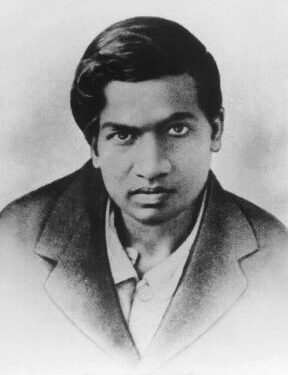
Srinivasa Ramanujan
Srinivasa Ramanujan was an Indian mathematician. Born December 22, 1887, in Erode. Died April 26, 1920, in Kudanthaiyan. Known for Landau–Ramanujan constant, Ramanujan theta function and Rogers–Ramanujan identities. Educated at Trinity College and Town Higher Secondary School. Awards include Fellow of the Royal Society and Fellow of Trinity College.
Facts
37 facts · 2 confirmed by two sources · 11 cited · 24 from one source
Where this comes from
Papalocal keeps its own record. It started from these sources; what each one said is kept here as it was copied, so a change on their side never changes this page by itself. Tap one to read its version.
What Wikidata says · copied November 16, 2026 · revision 2559623721
- Described as
- Indian mathematician (1887–1920)
- Other names
- Srinivasa Iyengar Ramanuja Iyengar, Srinivasa Ramanujan Aiyangar, শ্রীনিবাস রামানুজন, Srinivasa Aiyangar Ramanujan, சீனிவாச ராமானுஜன், ஸ்ரீனிவாஸ ஐயங்கார் ராமானுஜன், Ramanujan, Srinivasa Aaiyangar Ramanujan
- Born
- December 22, 1887 · 6 references
- Died
- April 26, 1920 · 5 references
- Born in
- Erode · 1 reference
- Died in
- Kudanthaiyan · 2 references
- Cause of death
- amoebic liver abscess · 1 reference
- Citizen of
- British Raj
- Occupation
- mathematician · 1 reference; accountant · 1 reference
- Worked for
- Trinity College (1916–1919) · 1 reference; Chennai Port (1912–1914) · 1 reference
- Education
- Trinity College (1914–1916) · 2 references; Town Higher Secondary School (1898–1904) · 1 reference; Government Arts College, Kumbakonam (1904–1905) · 1 reference; Pachaiyappa's College (1906–1907) · 1 reference; University of Cambridge · 1 reference
- Member of
- Royal Society of London
- Known for
- Landau–Ramanujan constant; Ramanujan theta function; Rogers–Ramanujan identities; Ramanujan–Soldner constant; taxicab number; Ramanujan's sum; Ramanujan–Nagell equation; Ramanujan prime; Ramanujan–Petersson conjecture; Ramanujan summation · 1 reference
- Awards
- Fellow of the Royal Society (1918); Fellow of Trinity College (1918)
- Field
- combinatorics; number theory; mathematician · 1 reference
- Spouse
- Janakiammal
- Religion
- Hinduism; Sanatan Dharma · 1 reference
- Lived in
- George Town · 1 reference; Triplicane · 1 reference; Karur district · 1 reference
- Wikipedias with a page
- 110
Wikidata item Q83163 (wikidata.org/wiki/Q83163), public domain (CC0). Copied November 16, 2026.
What Wikipedia says · copied November 16, 2026 · revision 1384615768
Srinivasa Ramanujan Iyengar (22 December 1887 – 26 April 1920) was an Indian mathematician who worked during the early 20th century. He made substantial contributions to mathematical analysis, number theory, infinite series, and continued fractions, including solutions to mathematical problems then considered unsolvable.
Ramanujan initially developed his own mathematical research in isolation. According to Hans Eysenck, "he tried to interest the leading professional mathematicians in his work, but failed for the most part. What he had to show them was too novel, too unfamiliar, and additionally presented in unusual ways; they could not be bothered." Seeking mathematicians who could better understand his work, in 1913 he began a mail correspondence with the English mathematician G. H. Hardy at the University of Cambridge. Recognising Ramanujan's work as extraordinary, Hardy arranged for him to travel to Cambridge. In his notes, Hardy commented that Ramanujan had produced groundbreaking new theorems, including some that "defeated me completely; I had never seen anything in the least like them before", and some recently proven but highly advanced results.
Throughout his life, Ramanujan independently compiled nearly 3,900 results (mostly identities and equations). Many were completely novel; his original and highly unconventional results, such as the Ramanujan prime, the Ramanujan theta function, partition formulae and mock theta functions, have opened entire new areas of work and inspired further research. Of his thousands of results, most have been proven correct. The Ramanujan Journal, a scientific journal, was established to publish work in all areas of mathematics influenced by Ramanujan, and his notebooks—containing summaries of his published and unpublished results—have been analysed and studied for decades since his death as a source of new mathematical ideas. As late as 2012, researchers continued to discover that mere comments in his writings about "simple properties" and "similar outputs" for certain findings were themselves profound and subtle number theory results that remained unsuspected until nearly a century after his death. He became one of the youngest Fellows of the Royal Society and only the second Indian member, and the first Indian to be elected a Fellow of Trinity College, Cambridge.
In 1919, ill health—now believed to have been hepatic amoebiasis (a complication from episodes of dysentery many years previously)—compelled Ramanujan's return to India, where he died in 1920 at the age of 32. His last letters to Hardy, written in January 1920, show that he was still continuing to produce new mathematical ideas and theorems. His "lost notebook", containing discoveries from the last year of his life, caused great excitement among mathematicians when it was rediscovered in 1976.
- Born, in its opening lines
- December 22, 1887
- Died, in its opening lines
- April 26, 1920
From the Wikipedia article “Srinivasa Ramanujan” (en.wikipedia.org/wiki/Srinivasa_Ramanujan), by its contributors, under CC BY-SA 4.0 (creativecommons.org/licenses/by-sa/4.0/). Copied November 16, 2026; not changed.
Confirmed Two sources agree. Cited One source, and it names where it got it. One source One source, without a reference of its own. Sources disagree The sources disagree. We show the best-supported value and keep theirs below.
