
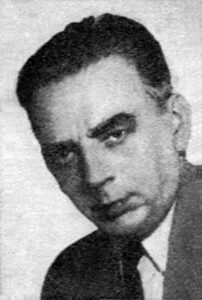
Stanisław Mazur
Stanisław Mazur was a Polish mathematician. Born January 1, 1905, in Lviv. Died November 5, 1981, in Warsaw. Positions held include member of the Sejm (1946–1954) and member of the Sejm of the Polish People's Republic. Known for Banach–Mazur theorem, Banach–Mazur compactum and Banach–Mazur game. Educated at Lviv University and Sorbonne. Awards include Officer of the Order of Polonia Restituta, Work Flag Order, 1st class and Work Flag Order, 2nd class.
Facts
35 facts · 2 confirmed by two sources · 14 cited · 19 from one source
Where this comes from
Papalocal keeps its own record. It started from these sources; what each one said is kept here as it was copied, so a change on their side never changes this page by itself. Tap one to read its version.
What Wikidata says · copied November 18, 2026 · revision 2566866899
- Described as
- Polish mathematician (1905–1981)
- Born
- January 1, 1905 · 3 references
- Died
- November 5, 1981 · 3 references
- Born in
- Lviv · 2 references
- Died in
- Warsaw · 1 reference
- Buried in
- Powązki Military Cemetery · 1 reference
- Name at birth
- Stanisław Meiczyslaw Mazur
- Citizen of
- Poland · 1 reference
- Occupation
- mathematician · 1 reference
- Positions held
- member of the Sejm (1946–1954) · 1 reference; member of the Sejm of the Polish People's Republic · 1 reference
- Political party
- Polish United Workers' Party; Communist Party of Western Ukraine · 1 reference
- Worked for
- University of Warsaw (1948–1978) · 1 reference; Lviv University (2 times) (1932–1941) · 2 references; Lviv Polytechnic (1935–1939) · 1 reference; University of Łódź (1946–1948) · 1 reference
- Education
- Lviv University (1923–1926) · 1 reference; Sorbonne · 1 reference
- Member of
- Polish Academy of Learning; Polish Academy of Sciences (1952–) · 2 references; Hungarian Academy of Sciences
- Known for
- Banach–Mazur theorem; Banach–Mazur compactum; Banach–Mazur game; Gelfand–Mazur theorem; Mazur–Ulam theorem; Mazur's lemma; Mazur's torsion theorem; Mazur manifold
- Awards
- Officer of the Order of Polonia Restituta (1946); Work Flag Order, 1st class (1954); Work Flag Order, 2nd class (1951); Stefan Banach Prize (1949)
- Field
- functional analysis
- Children
- Krystyna Mazurówna
- Wikipedias with a page
- 20
Wikidata item Q637176 (wikidata.org/wiki/Q637176), public domain (CC0). Copied November 18, 2026.
What Wikipedia says · copied November 18, 2026 · revision 1372491937
Stanisław Mieczysław Mazur (Polish: [ˈmazur]; 1 January 1905 – 5 November 1981) was a Polish mathematician, a member of the Polish Academy of Sciences and one of the leading representatives of the Lwów School of Mathematics
Mazur made important contributions to geometrical methods in linear and nonlinear functional analysis and to the study of Banach algebras. He was also interested in summability theory, infinite games and computable functions.
- Born, in its opening lines
- January 1, 1905
- Died, in its opening lines
- November 5, 1981
From the Wikipedia article “Stanisław Mazur” (en.wikipedia.org/wiki/Stanisław_Mazur), by its contributors, under CC BY-SA 4.0 (creativecommons.org/licenses/by-sa/4.0/). Copied November 18, 2026; not changed.
Confirmed Two sources agree. Cited One source, and it names where it got it. One source One source, without a reference of its own. Sources disagree The sources disagree. We show the best-supported value and keep theirs below.
