
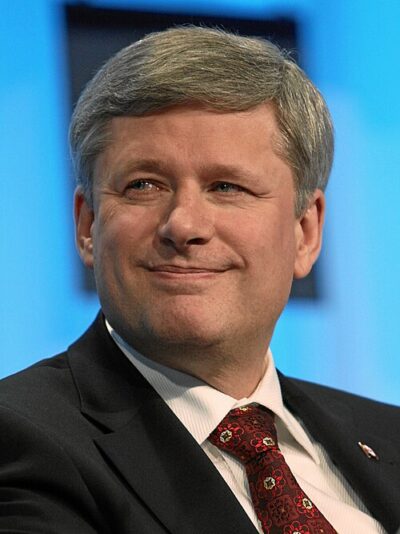
Stephen Harper
Stephen Harper is the 22nd prime minister of Canada from 2006 to 2015. Born April 30, 1959, in Leaside. Positions held include Prime Minister of Canada (2006–2015), Leader of the Official Opposition (2002–2006) and leader of the Conservative Party of Canada (2004–2015). Educated at University of Calgary and Richview Collegiate Institute. Awards include Woodrow Wilson Award for Public Service, Order of Liberty and Canadian Newsmaker of the Year.
Facts
35 facts · 1 confirmed by two sources · 19 cited · 15 from one source
Where this comes from
Papalocal keeps its own record. It started from these sources; what each one said is kept here as it was copied, so a change on their side never changes this page by itself. Tap one to read its version.
What Wikidata says · copied November 13, 2026 · revision 2562795109
- Described as
- 22nd prime minister of Canada from 2006 to 2015
- Other names
- The Right Hon. Stephen Harper, HE Stephen Harper, H.E. Stephen Harper, Stephen Joseph Harper
- Born
- April 30, 1959 · 6 references
- Born in
- Leaside · 1 reference
- Name at birth
- Stephen Joseph Harper · 2 references
- Citizen of
- Canada · 2 references
- Occupation
- politician · 2 references; economist · 3 references; pianist · 1 reference; lecturer · 1 reference; writer · 2 references
- Positions held
- Prime Minister of Canada (2006–2015); Leader of the Official Opposition (2002–2006); leader of the Conservative Party of Canada (2004–2015); member of the House of Commons of Canada (2 times) (1993–2016) · 1 reference
- Political party
- Conservative Party of Canada (2003–); Liberal Party of Canada (–1985); Progressive Conservative Party of Canada (1985–1987); Canadian Alliance (2002–2003)
- Education
- University of Calgary · 1 reference; Richview Collegiate Institute · 1 reference; John G. Althouse Middle School; The Royal Conservatory of Music
- Instrument
- piano · 1 reference
- Awards
- Woodrow Wilson Award for Public Service (2006) · 1 reference; Order of Liberty (2016) · 1 reference; Canadian Newsmaker of the Year (2006) · 1 reference; Queen Elizabeth II Golden Jubilee Medal (2002) · 1 reference; Queen Elizabeth II Diamond Jubilee Medal (2012) · 1 reference; honorary doctor of Tel Aviv University (2014) · 1 reference; Alberta Centennial Medal (2005) · 1 reference; Companion of the Order of Canada (2019) · 2 references
- Spouse
- Laureen Harper (1993–) · 2 references
- Religion
- Alliance World Fellowship
- Lived in
- Calgary
- Height
- 1.88 m (6 ft 2 in) · 1 reference
- Website
- https://stephenharper.com/ · 1 reference
- Wikipedias with a page
- 111
Wikidata item Q206 (wikidata.org/wiki/Q206), public domain (CC0). Copied November 13, 2026.
What Wikipedia says · copied November 13, 2026 · revision 1385466830
Stephen Joseph Harper (born April 30, 1959) is a Canadian politician who served as the 22nd prime minister of Canada from 2006 to 2015. He is the only prime minister to have belonged to the modern Conservative Party of Canada. He co-founded the party and served as its first leader from 2004 to 2015. Since 2018, he has been the chairman of the International Democracy Union.
Born in Leaside, now a neighbourhood of Toronto, Ontario, Harper studied economics, earning his bachelor's and master's degrees in 1985 and 1991, respectively, from the University of Calgary. He was a founder of the Reform Party of Canada and was first elected to the House of Commons in the 1993 federal election in the riding of Calgary West. He did not seek re-election in 1997 and instead joined and later led the National Citizens Coalition, a conservative lobbyist group. In 2002, Harper defeated Stockwell Day to become leader of the Canadian Alliance, the successor to the Reform Party, and returned to Parliament as the leader of the Opposition. In 2003, Harper and Progressive Conservative Party leader Peter MacKay agreed to merge the Canadian Alliance with the Progressive Conservatives to form the Conservative Party of Canada. Harper was elected as the party's first leader in 2004. He led the Conservatives in the 2004 federal election, in which they lost to Paul Martin's Liberal Party. Harper led the Conservatives to a minority government in the 2006 federal election.
During Harper's premiership, he faced the In and Out scandal, reduced the goods and services tax (GST) to 5%, and passed the Federal Accountability Act, the Québécois nation motion, and the Veterans' Bill of Rights. Harper led the Conservatives to a larger minority government in the 2008 federal election, after which he prorogued Parliament to avoid defeat by a proposed coalition of opposition parties, advanced the Economic Action Plan of personal income tax cuts and infrastructure investments in response to the Great Recession, introduced the tax-free savings account, and authorized military intervention during the First Libyan Civil War. In March 2011, Harper's government was found to be in contempt of Parliament in a vote of no confidence, triggering a federal election in which he led the Conservatives to a majority government. He subsequently repealed the long-gun registry, privatized the Canadian Wheat Board, enacted the Anti-terrorism Act, 2015, and reduced Canada's budget deficit from $55.6 billion in 2009 to $2.9 billion in 2015. In foreign policy, Harper withdrew Canada from the Kyoto Protocol, launched Canada's Global Markets Action Plan, negotiated free trade agreements, and authorized Operation Impact against ISIL and Operation Unifier following the Russian annexation of Crimea. Harper's Conservatives also faced controversies in the Robocall scandal and the Canadian Senate expenses scandal, and the Idle No More movement emerged during his premiership.
In the 2015 federal election, the Conservative Party was defeated by the Liberal Party led by Justin Trudeau. Harper officially stepped down as party leader in October 2015 and resigned his seat in August 2016. Since then, he has taken on several international business and leadership roles, including founding a global consulting firm, appearing in U.S. and British media, and being elected as chairman of the International Democracy Union, an international alliance of centre-right to right-wing political parties. Harper was the longest-serving conservative prime minister since John A. Macdonald.
- Born, in its opening lines
- April 30, 1959
From the Wikipedia article “Stephen Harper” (en.wikipedia.org/wiki/Stephen_Harper), by its contributors, under CC BY-SA 4.0 (creativecommons.org/licenses/by-sa/4.0/). Copied November 13, 2026; not changed.
Confirmed Two sources agree. Cited One source, and it names where it got it. One source One source, without a reference of its own. Sources disagree The sources disagree. We show the best-supported value and keep theirs below.
