
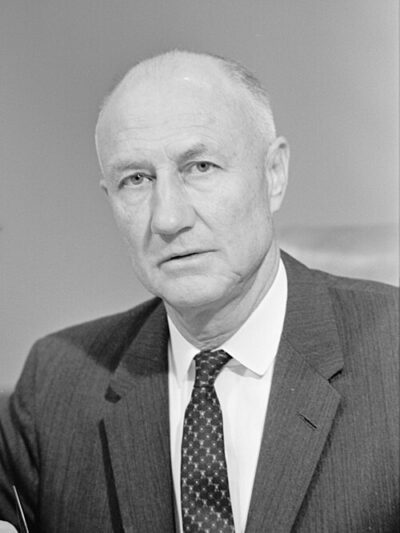
Strom Thurmond
Strom Thurmond was an American politician. Born December 5, 1902, in Edgefield. Died June 26, 2003, in Edgefield. Positions held include member of the State Senate of South Carolina (1933–1938), Governor of South Carolina (1947–1951) and judge. Educated at Clemson University. Awards include Bronze Star Medal, Legionnaire of Legion of Merit and Purple Heart.
Facts
50 facts · 2 confirmed by two sources · 14 cited · 34 from one source
Where this comes from
Papalocal keeps its own record. It started from these sources; what each one said is kept here as it was copied, so a change on their side never changes this page by itself. Tap one to read its version.
What Wikidata says · copied November 13, 2026 · revision 2558305398
- Described as
- American politician (1902–2003)
- Other names
- James Strom Thurmond, J. Strom Thurmond
- Born
- December 5, 1902 · 5 references
- Died
- June 26, 2003 · 5 references
- Born in
- Edgefield
- Died in
- Edgefield
- Buried in
- Edgefield
- Cause of death
- heart failure
- Name at birth
- James Strom Thurmond · 1 reference
- Citizen of
- United States
- Occupation
- politician · 2 references; teacher; judge; lawyer · 1 reference; governor · 1 reference; major general · 1 reference; jurist · 1 reference
- Positions held
- member of the State Senate of South Carolina (1933–1938); Governor of South Carolina (1947–1951); judge · 1 reference; United States senator (1954–2003) · 1 reference; President pro tempore of the United States Senate (2 times) (1981–2001) · 1 reference; senator · 1 reference
- Political party
- Republican Party (1964–); Democratic Party (–1964); States' Rights Democratic Party (1948)
- Education
- Clemson University (–1923) · 1 reference
- Awards
- Bronze Star Medal; Legionnaire of Legion of Merit; Purple Heart; Presidential Citizens Medal; Presidential Medal of Freedom (1993) · 1 reference; World War II Victory Medal; European-African-Middle Eastern Campaign Medal; Croix de guerre 1939–1945; Order of the Crown; Dank Medal; Legion of Merit · 2 references
- Spouse
- Jean Crouch Thurmond (1947–1960); Nancy Janice Moore (1968–1991); Nancy Moore
- Children
- Essie Mae Washington-Williams; Paul Thurmond; James Strom Thurmond Jr.; Nancy Moore Thurmond; Juliana Gertrude Thurmond Whitmer · 1 reference
- Father
- John William Thurmond
- Mother
- Eleanor Gertrude Strom Thurmond
- Religion
- Southern Baptist Convention
- Military branch
- United States Army (1942–1946)
- Military rank
- major general; general
- Wikipedias with a page
- 41
Wikidata item Q324719 (wikidata.org/wiki/Q324719), public domain (CC0). Copied November 13, 2026.
What Wikipedia says · copied November 13, 2026 · revision 1383807170
James Strom Thurmond (December 5, 1902 – June 26, 2003) was a United States Senator from South Carolina who served from 1954 to 1956 and from 1956 to 2003. An avid segregationist, he was the States' Rights Democratic Party ("Dixiecrat") candidate in the 1948 presidential election against Harry S. Truman and Thomas E. Dewey, finishing in third place with 2.4% of the popular vote. Thurmond was originally a Southern Democrat who turned to the Republican Party amid his support for presidential nominee Barry Goldwater and following the passage of the Civil Rights Act of 1964. Although he opposed civil rights legislation for most of his life, he moderated his stances starting from the 1970s.
A staunch opponent of civil rights legislation in the 1950s and 1960s, Thurmond completed the longest single-person Senate filibuster, at 24 hours and 18 minutes in length, in opposition to the Civil Rights Act of 1957. In the 1960s, Thurmond voted against both the Civil Rights Act of 1964 and the Voting Rights Act of 1965. Despite his support for Jim Crow laws, Thurmond denied the accusation that he was a racist by insisting he was a supporter of states' rights and an opponent of excessive federal authority. Thurmond switched parties ahead of the 1964 United States presidential election, saying that the Democratic Party no longer represented people like him, and endorsed Republican nominee Barry Goldwater, who also opposed the Civil Rights Act. With Thurmond's party switch, he became the first Republican U.S. Senator from South Carolina since John J. Patterson in 1879. By the 1970s, Thurmond started to moderate his stance on race, but continued to defend his prior support for segregation based on states' rights and Southern society at the time.
As a Republican, Thurmond served three times as President pro tempore of the United States Senate, and chaired the Senate Judiciary Committee from 1981 to 1987 and the Senate Armed Services Committee from 1995 to 1999. He retired in 2003 as the only member of either chamber of Congress to reach the age of 100 while still in office and the oldest-serving senator; he died less than six months later. His 47 years as a senator, a record at the time, is the fourth-longest in U.S. history behind Robert Byrd, Daniel Inouye, and Patrick Leahy. Thurmond was also, at 14 years, the longest-serving dean of the United States Senate.
- Born, in its opening lines
- December 5, 1902
- Died, in its opening lines
- June 26, 2003
From the Wikipedia article “Strom Thurmond” (en.wikipedia.org/wiki/Strom_Thurmond), by its contributors, under CC BY-SA 4.0 (creativecommons.org/licenses/by-sa/4.0/). Copied November 13, 2026; not changed.
Confirmed Two sources agree. Cited One source, and it names where it got it. One source One source, without a reference of its own. Sources disagree The sources disagree. We show the best-supported value and keep theirs below.
