
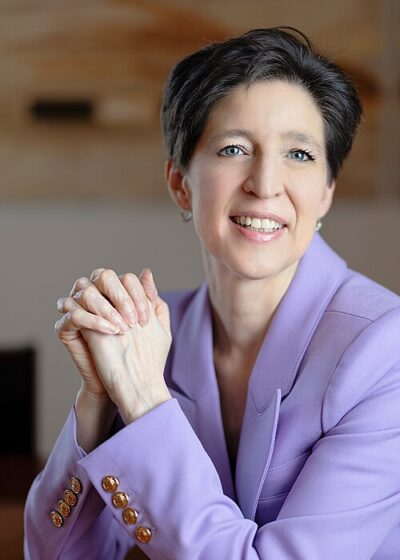
Susan Athey
Susan Athey is an American economist. Born November 29, 1970, in Boston. Educated at Duke University and Stanford Graduate School of Business. Awards include Sloan Fellowship, John Bates Clark Medal and Elaine Bennett Research Prize.
Facts
30 facts · 1 confirmed by two sources · 16 cited · 13 from one source
Where this comes from
Papalocal keeps its own record. It started from these sources; what each one said is kept here as it was copied, so a change on their side never changes this page by itself. Tap one to read its version.
What Wikidata says · copied November 16, 2026 · revision 2557314998
- Described as
- American economist
- Other names
- Susan Carleton Athey, Susan C. Athey
- Born
- November 29, 1970 · 2 references
- Born in
- Boston · 3 references
- Citizen of
- United States · 2 references
- Occupation
- economist · 2 references; university teacher · 1 reference; mathematician · 1 reference; computer scientist; academic · 1 reference; business administration scholar · 1 reference
- Worked for
- Harvard University; Massachusetts Institute of Technology; Stanford University · 2 references; National Bureau of Economic Research
- Education
- Duke University · 1 reference; Stanford Graduate School of Business (–1995) · 1 reference
- Member of
- American Academy of Arts and Sciences; National Academy of Sciences; Econometric Society (2004–) · 1 reference
- Awards
- Sloan Fellowship (2000); John Bates Clark Medal (2007) · 1 reference; Elaine Bennett Research Prize (2000) · 1 reference; Fellow of the Econometric Society (2004) · 1 reference; Fellow of the American Academy of Arts and Sciences; Fisher-Schultz Lecture
- Field
- business management · 1 reference; economics · 1 reference
- Lived in
- Boston; United States
- Website
- https://athey.people.stanford.edu/ · 1 reference; https://www.gsb.stanford.edu/faculty-research/faculty/susan-athey
- Wikipedias with a page
- 21
Wikidata item Q468053 (wikidata.org/wiki/Q468053), public domain (CC0). Copied November 16, 2026.
What Wikipedia says · copied November 16, 2026 · revision 1384687783
Susan Carleton Athey (born November 29, 1970) is an American economist. She is the Economics of Technology Professor in the School of Humanities and Sciences at the Stanford Graduate School of Business. Prior to joining Stanford, she has been a professor at Harvard University and the Massachusetts Institute of Technology.
Athey is the first female winner of the John Bates Clark Medal. She served as the consulting chief economist for Microsoft for six years and was a consulting researcher to Microsoft Research. She is currently on the boards of Expedia, Lending Club, Rover, Turo, Ripple, and non-profit Innovations for Poverty Action, and is a Scientific Advisor at Haus, a marketing science company. She also serves as the senior fellow at Stanford Institute for Economic Policy Research. She is an associate director for the Stanford Institute for Human-Centered Artificial Intelligence and the director of Golub Capital Social Impact Lab.
- Born, in its opening lines
- November 29, 1970
From the Wikipedia article “Susan Athey” (en.wikipedia.org/wiki/Susan_Athey), by its contributors, under CC BY-SA 4.0 (creativecommons.org/licenses/by-sa/4.0/). Copied November 16, 2026; not changed.
Confirmed Two sources agree. Cited One source, and it names where it got it. One source One source, without a reference of its own. Sources disagree The sources disagree. We show the best-supported value and keep theirs below.
