
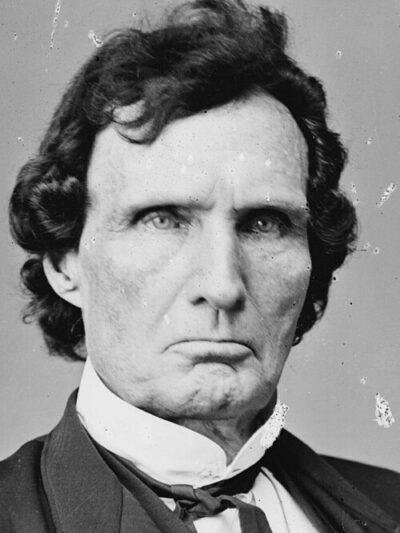
Thaddeus Stevens
Thaddeus Stevens was an American statesman. Born April 4, 1792, in Danville. Died August 11, 1868, in Washington, D.C.. Positions held include United States representative (2 times) (1849–1868) and member of the Pennsylvania House of Representatives. Educated at Dartmouth College.
Facts
15 facts · 2 confirmed by two sources · 3 cited · 10 from one source
Where this comes from
Papalocal keeps its own record. It started from these sources; what each one said is kept here as it was copied, so a change on their side never changes this page by itself. Tap one to read its version.
What Wikidata says · copied November 15, 2026 · revision 2551027303
- Described as
- American statesman (1792–1868)
- Born
- April 4, 1792 · 3 references
- Died
- August 11, 1868 · 3 references
- Born in
- Danville
- Died in
- Washington, D.C. · 2 references
- Buried in
- Shreiner's Cemetery · 1 reference
- Citizen of
- United States
- Occupation
- politician; lawyer; jurist · 1 reference
- Positions held
- United States representative (2 times) (1849–1868); member of the Pennsylvania House of Representatives
- Political party
- Federalist Party; Republican Party; Whig Party
- Education
- Dartmouth College
- Wikipedias with a page
- 28
Wikidata item Q1353767 (wikidata.org/wiki/Q1353767), public domain (CC0). Copied November 15, 2026.
What Wikipedia says · copied November 15, 2026 · revision 1385912353
Thaddeus Stevens (April 4, 1792 – August 11, 1868) was an American politician and lawyer who served as a member of the United States House of Representatives from Pennsylvania, being one of the leaders of the Radical Republican faction of the Republican Party during the 1860s. A fierce opponent of slavery and discrimination against Black Americans, Stevens sought to secure their rights during Reconstruction, leading the opposition to U.S. President Andrew Johnson. As chairman of the House Ways and Means Committee during the American Civil War, he played a leading role, focusing his attention on defeating the Confederacy, financing the war with new taxes and borrowing, crushing the power of slave owners, ending slavery, and securing equal rights for the freedmen.
Stevens was born in rural Vermont, in poverty, and with a club foot, which left him with a permanent limp. He moved to Pennsylvania as a young man and quickly became a successful lawyer in Gettysburg. He interested himself in municipal affairs and then in politics. He was an active leader of the Anti-Masonic Party, as a fervent believer that Freemasonry in the United States was an evil conspiracy to secretly control the republican system of government. He was elected to the Pennsylvania House of Representatives, where he became a strong advocate of free public education. Financial setbacks in 1842 caused him to move his home and practice to the larger city of Lancaster. There, he joined the Whig Party and was elected to Congress in 1848. His activities as a lawyer and politician in opposition to slavery cost him votes, and he did not seek reelection in 1852. After a brief flirtation with the Know-Nothing Party, Stevens joined the newly formed Republican Party and was elected to Congress again in 1858. There, with fellow radicals such as Massachusetts Senator Charles Sumner, he opposed the expansion of slavery and concessions to the South as the war came.
Stevens argued that slavery should not survive the war and was frustrated by the slowness of U.S. President Abraham Lincoln to support his position. He guided the government's financial legislation through the House as Ways and Means chairman. As the war progressed towards a Northern victory, Stevens came to believe that not only should slavery be abolished, but that black Americans should be given a stake in the South's future through the confiscation of land from planters to be distributed to the freedmen. His plans went too far for the Moderate Republicans and were not enacted. After the assassination of Abraham Lincoln in April 1865, Stevens came into conflict with the new president, Johnson, who sought rapid restoration of the seceded states without guarantees for freedmen. The difference in views caused an ongoing battle between Johnson and Congress, with Stevens leading the Radical Republicans. After gains in the 1866 election, the radicals took control of Reconstruction away from Johnson. Stevens's last great battle was to secure in the House articles of impeachment against Johnson, acting as a House manager in the impeachment trial, though the Senate did not convict the president.
Historians' views of Stevens have dramatically shifted. During the early 20th century, he was viewed as reckless and motivated by hatred of the white South. Since the 1950s, neoabolitionists have lauded his commitment to equality.
- Born, in its opening lines
- April 4, 1792
- Died, in its opening lines
- August 11, 1868
From the Wikipedia article “Thaddeus Stevens” (en.wikipedia.org/wiki/Thaddeus_Stevens), by its contributors, under CC BY-SA 4.0 (creativecommons.org/licenses/by-sa/4.0/). Copied November 15, 2026; not changed.
Confirmed Two sources agree. Cited One source, and it names where it got it. One source One source, without a reference of its own. Sources disagree The sources disagree. We show the best-supported value and keep theirs below.
