
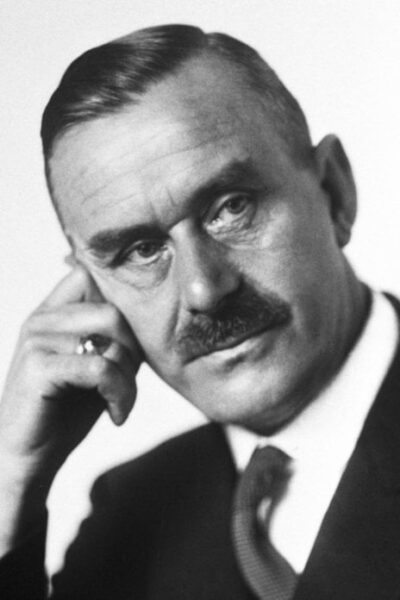
Thomas Mann
Thomas Mann was a German novelist and Nobel Prize laureate. Born June 6, 1875, in Lübeck. Died August 12, 1955, in Zurich. Known for Buddenbrooks, The Magic Mountain and Death in Venice. Educated at LMU Munich and Technical University of Munich. Awards include Nobel Prize in Literature, Goethe Prize of the City of Frankfurt and Pour le Mérite for Sciences and Arts order.
Facts
73 facts · 2 confirmed by two sources · 25 cited · 46 from one source
Where this comes from
Papalocal keeps its own record. It started from these sources; what each one said is kept here as it was copied, so a change on their side never changes this page by itself. Tap one to read its version.
What Wikidata says · copied November 13, 2026 · revision 2567012793
- Described as
- German novelist and Nobel Prize laureate (1875–1955)
- Other names
- 파울 토마스 만
- Born
- June 6, 1875 · 23 references
- Died
- August 12, 1955 · 23 references
- Born in
- Lübeck · 6 references
- Died in
- Zurich · 5 references
- Buried in
- Kilchberg cemetery · 1 reference
- Cause of death
- aneurysm
- Name at birth
- Paul Thomas Mann · 1 reference
- Citizen of
- German Reich (1875–1936); Czechoslovakia (1936–) · 1 reference; United States (1944–) · 1 reference
- Occupation
- novelist; essayist · 1 reference; autobiographer; short story writer; social critic; diarist; screenwriter; university teacher
- Political party
- German Democratic Party
- Worked for
- Princeton University; Simplicissimus
- Education
- LMU Munich; Technical University of Munich · 1 reference; Katharineum
- Member of
- American Academy of Arts and Letters; Academy of Arts of the GDR; American Academy of Arts and Sciences; Bavarian Academy of Fine Arts; American Philosophical Society (1942–); Accademia Nazionale dei Lincei (1947–) · 1 reference
- Known for
- Buddenbrooks; The Magic Mountain; Death in Venice; Joseph and His Brothers; Lotte in Weimar: The Beloved Returns; Royal Highness; Doctor Faustus; The Holy Sinner; Confessions of Felix Krull; Tristan
- Awards
- Nobel Prize in Literature (1929) · 2 references; Goethe Prize of the City of Frankfurt (1949); Pour le Mérite for Sciences and Arts order; Feltrinelli Prize (1952); Goethe Plaque of the City of Frankfurt (1932); honorary doctorate from Princeton University; honorary doctor of Harvard University; honorary doctorate from Columbia University; Honorary doctor of the University of Oxford; honorary doctorate from the University of Cambridge; Officer of the Legion of Honour; Commander of the Order of Orange-Nassau; honorary citizen of Lübeck (1955); honorary doctor of ETH Zürich; honorary doctorate of Lund University
- Field
- novel · 1 reference; creative and professional writing · 1 reference; prose · 1 reference; essay · 1 reference
- Spouse
- Katia Mann (–1955) · 1 reference
- Children
- Erika Mann · 2 references; Klaus Mann · 2 references; Golo Mann · 1 reference; Monika Mann · 1 reference; Elisabeth Mann Borgese · 2 references; Michael Mann · 1 reference
- Father
- Thomas Johann Heinrich Mann · 1 reference
- Mother
- Júlia da Silva Bruhns · 1 reference
- Siblings
- Carla Mann · 1 reference; Julia Löhr · 1 reference; Heinrich Mann · 2 references; Viktor Mann · 1 reference
- Religion
- Lutheranism
- Wikipedias with a page
- 167
Wikidata item Q37030 (wikidata.org/wiki/Q37030), public domain (CC0). Copied November 13, 2026.
What Wikipedia says · copied November 13, 2026 · revision 1384278299
Paul Thomas Mann (6 June 1875 – 12 August 1955) was a German novelist, short story writer, social critic, philanthropist, essayist, and the 1929 Nobel Prize in Literature laureate. His highly symbolic and ironic epic novels and novellas are noted for their insight into the psychology of the artist and the intellectual. His analysis and critique of the European and German soul used modern versions of German and Biblical stories, as well as the ideas of Johann Wolfgang von Goethe, Friedrich Nietzsche, and Arthur Schopenhauer.
The Mann family was part of the Hanseatic class. He portrayed both his family and the influential class in his first novel, Buddenbrooks (1901). Other major novels include The Magic Mountain (1924), the tetralogy Joseph and His Brothers (1933–1943), and Doctor Faustus (1947). He also wrote short stories and novellas, including Death in Venice (1912).
His older brother was novelist Heinrich Mann. Three of Mann's six children – Erika Mann, Klaus Mann and Golo Mann – also became significant German writers.
When Adolf Hitler came to power in 1933, Mann fled to Switzerland. When World War II broke out in 1939, he moved to the United States, returning to Switzerland after the war in 1952. Mann is one of the best-known exponents of the so-called Exilliteratur, German literature written in exile by those who opposed the Hitler regime.
- Born, in its opening lines
- June 6, 1875
- Died, in its opening lines
- August 12, 1955
From the Wikipedia article “Thomas Mann” (en.wikipedia.org/wiki/Thomas_Mann), by its contributors, under CC BY-SA 4.0 (creativecommons.org/licenses/by-sa/4.0/). Copied November 13, 2026; not changed.
Confirmed Two sources agree. Cited One source, and it names where it got it. One source One source, without a reference of its own. Sources disagree The sources disagree. We show the best-supported value and keep theirs below.
