
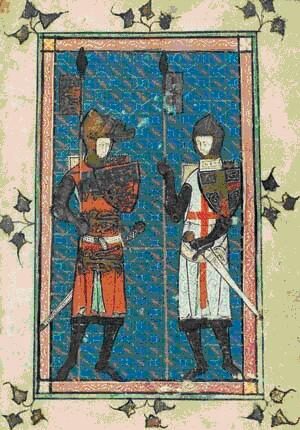
Thomas of Lancaster, 1st Duke of Clarence
Thomas of Lancaster, 1st Duke of Clarence was a Prince of England. Born September 29, 1387, in Kenilworth Castle. Died March 22, 1421, in Baugé. Positions held include Lord Lieutenant of Ireland (1402–1405), Lord High Admiral (1404–1405) and Lord High Steward (1399–1421). Awards include Knight of the Garter.
Facts
22 facts · 0 confirmed by two sources · 7 cited · 14 from one source · 1 where the sources disagree
What’s different
- Born: we show September 29, 1387 (Sources disagree). Wikidata also lists September 29, 1388
Where this comes from
Papalocal keeps its own record. It started from these sources; what each one said is kept here as it was copied, so a change on their side never changes this page by itself. Tap one to read its version.
What Wikidata says · copied November 18, 2026 · revision 2563596821
- Described as
- Prince of England
- Born
- September 29, 1387 · 1 reference; September 29, 1388 · 1 reference
- Died
- March 22, 1421 · 1 reference
- Born in
- Kenilworth Castle
- Died in
- Baugé
- Buried in
- Canterbury Cathedral
- Citizen of
- Kingdom of England
- Occupation
- military personnel
- Positions held
- Lord Lieutenant of Ireland (1402–1405); Lord High Admiral (1404–1405); Lord High Steward (1399–1421)
- Member of
- Order of the Garter (1400–)
- Awards
- Knight of the Garter (1400) · 1 reference
- Spouse
- Margaret Beaufort, Countess of Somerset · 2 references
- Children
- John de Clarence · 1 reference
- Father
- Henry IV of England · 2 references
- Mother
- Mary de Bohun · 2 references
- Siblings
- Blanche of England · 1 reference; Philippa of England; Humphrey of Lancaster, 1st Duke of Gloucester · 1 reference; Henry V of England · 1 reference; John of Lancaster, Duke of Bedford
- Military rank
- admiral
- Wikipedias with a page
- 21
Wikidata item Q511869 (wikidata.org/wiki/Q511869), public domain (CC0). Copied November 18, 2026.
What Wikipedia says · copied November 18, 2026 · revision 1384140665
Thomas of Lancaster, Duke of Clarence (c. autumn 1387 – 22 March 1421) was a medieval English prince and soldier, the second son of Henry IV of England, brother of Henry V, and heir to the throne in the event of his brother's death. He acted as counselor and aide to both.
His father appointed him Lord Lieutenant of Ireland in 1401. Thomas, who was only fourteen, landed in Dublin in November 1401 and spent much of the next eight years in Ireland. He was nearly killed in a skirmish near Dublin in 1406.
After his father's death, he participated in his brother's military campaigns in France during the Hundred Years' War. Left in charge of English forces in France when Henry returned temporarily to England after his marriage to Catherine of Valois, Thomas led the English in their disastrous defeat at the hands of a mainly Scottish force that came to the aid of the French at the Battle of Baugé. In a rash attack, he and his leading knights were surrounded, and Thomas was killed at the age of 33.
From the Wikipedia article “Thomas of Lancaster, Duke of Clarence” (en.wikipedia.org/wiki/Thomas_of_Lancaster,_Duke_of_Clarence), by its contributors, under CC BY-SA 4.0 (creativecommons.org/licenses/by-sa/4.0/). Copied November 18, 2026; not changed.
Confirmed Two sources agree. Cited One source, and it names where it got it. One source One source, without a reference of its own. Sources disagree The sources disagree. We show the best-supported value and keep theirs below.
