
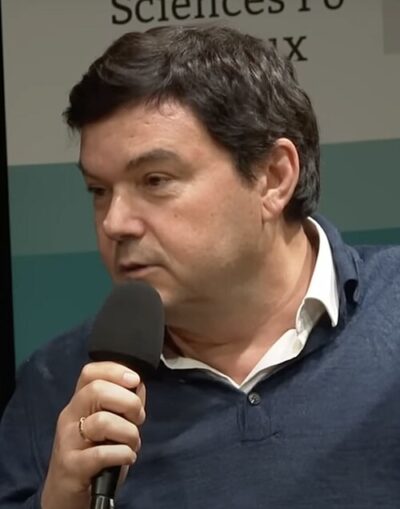
Thomas Piketty
Thomas Piketty is a French economist. Born May 7, 1971, in Clichy. Positions held include director of studies (2000–) and professor (2007–). Known for Capital in the Twenty-First Century and Capital and Ideology. Educated at London School of Economics and Political Science and École Normale Supérieure. Awards include Yrjö Jahnsson Award, Prix du meilleur jeune économiste de France and CNRS bronze medal.
Facts
35 facts · 1 confirmed by two sources · 20 cited · 14 from one source
Where this comes from
Papalocal keeps its own record. It started from these sources; what each one said is kept here as it was copied, so a change on their side never changes this page by itself. Tap one to read its version.
What Wikidata says · copied November 16, 2026 · revision 2567362018
- Described as
- French economist (born 1971)
- Other names
- Th. Piketty, T. Piketty, Piketty, Thomas
- Born
- May 7, 1971 · 5 references
- Born in
- Clichy · 1 reference
- Citizen of
- France
- Occupation
- economist · 1 reference; research fellow; writer; university teacher · 1 reference
- Positions held
- director of studies (2000–) · 1 reference; professor (2007–) · 1 reference
- Worked for
- Paris School of Economics (2007–) · 1 reference; School for Advanced Studies in the Social Sciences (2000–) · 1 reference; Massachusetts Institute of Technology (1993–1995) · 1 reference; National Center for Scientific Research (1995–2000) · 1 reference
- Education
- London School of Economics and Political Science (1991–1993) · 1 reference; École Normale Supérieure (1989–1993) · 2 references; School for Advanced Studies in the Social Sciences (1991–1993) · 3 references; Lycée Louis-le-Grand (1987–1989) · 1 reference; Lycée Descartes (1987) · 1 reference
- Member of
- Econometric Society (2013–) · 1 reference
- Known for
- Capital in the Twenty-First Century; Capital and Ideology
- Awards
- Yrjö Jahnsson Award (2013) · 1 reference; Prix du meilleur jeune économiste de France (2002) · 2 references; CNRS bronze medal (2000) · 1 reference; Lysenko Prize (2015) · 1 reference; prix Pétrarque de l'essai (2014); Fellow of the Econometric Society (2013) · 1 reference; Rossi Prize (1999); British Academy Medal (2014) · 1 reference; Clarivate Citation Laureates (2023) · 1 reference; Oskar Morgenstern medal (2023) · 1 reference
- Field
- public economics; economics
- Spouse
- Julia Cagé (2014–)
- Website
- http://piketty.pse.ens.fr/ · 1 reference
- Wikipedias with a page
- 57
Wikidata item Q984448 (wikidata.org/wiki/Q984448), public domain (CC0). Copied November 16, 2026.
What Wikipedia says · copied November 16, 2026 · revision 1385419824
Thomas Piketty (French: [tɔmɑ pikɛti]; born 7 May 1971) is a French economist who is a professor of economics at the School for Advanced Studies in the Social Sciences (EHESS), associate chair at the Paris School of Economics (PSE) and Centennial Professor of Economics in the International Inequalities Institute at the London School of Economics (LSE).
Piketty's work focuses on public economics, in particular income and wealth inequality. He is the author of the best-selling book Capital in the Twenty-First Century (2013), which emphasises the themes of his work on wealth concentrations and distribution over the past 250 years. The book argues that the rate of capital return in developed countries is persistently greater than the rate of economic growth, and that this will cause wealth inequality to increase in the future. Piketty proposes improving the education systems and considers diffusion of knowledge, diffusion of skills, diffusion of idea of productivity as the main mechanism that will lead to lower inequality. In 2019, his book Capital and Ideology was published, which focuses on income inequality in various societies in history. His 2022 A Brief History of Equality is a much shorter book about wealth redistribution intended for a target audience of citizens instead of economists.
- Born, in its opening lines
- May 7, 1971
From the Wikipedia article “Thomas Piketty” (en.wikipedia.org/wiki/Thomas_Piketty), by its contributors, under CC BY-SA 4.0 (creativecommons.org/licenses/by-sa/4.0/). Copied November 16, 2026; not changed.
Confirmed Two sources agree. Cited One source, and it names where it got it. One source One source, without a reference of its own. Sources disagree The sources disagree. We show the best-supported value and keep theirs below.
