
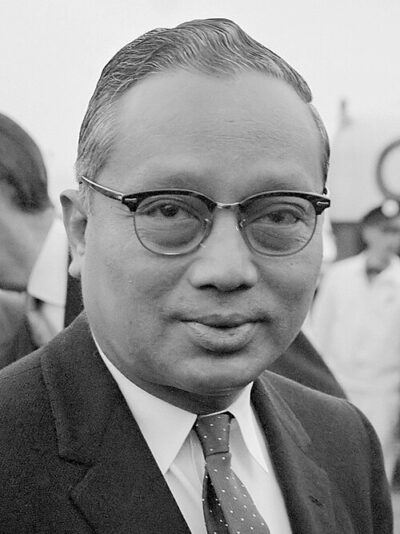
U Thant
U Thant was an UN Secretary-General from 1961 to 1971. Born January 22, 1909, in Pantanaw. Died November 25, 1974, in New York City. Positions held include United Nations Secretary-General (1961–1971) and ambassador. Educated at University of Yangon. Awards include Jawaharlal Nehru Award for International Understanding, United Nations Prize in the Field of Human Rights and Gandhi Peace Award.
Facts
26 facts · 2 confirmed by two sources · 5 cited · 19 from one source
Where this comes from
Papalocal keeps its own record. It started from these sources; what each one said is kept here as it was copied, so a change on their side never changes this page by itself. Tap one to read its version.
What Wikidata says · copied November 16, 2026 · revision 2569985759
- Described as
- UN Secretary-General from 1961 to 1971
- Other names
- Pantanaw U Thant, Thant, Thiripyanchi U Thant, SitPantanawu U Thant, Maha Thray Sithu U Thant
- Born
- January 22, 1909 · 6 references
- Died
- November 25, 1974 · 6 references
- Born in
- Pantanaw · 1 reference
- Died in
- New York City · 2 references
- Cause of death
- lung cancer
- Citizen of
- Myanmar
- Occupation
- politician; diplomat · 1 reference; writer; journalist · 1 reference
- Positions held
- United Nations Secretary-General (1961–1971); ambassador
- Political party
- Anti-Fascist People's Freedom League
- Worked for
- United Nations
- Education
- University of Yangon
- Member of
- American Academy of Arts and Sciences
- Awards
- Jawaharlal Nehru Award for International Understanding (1965) · 1 reference; United Nations Prize in the Field of Human Rights (1973); Gandhi Peace Award (1972); United Nations Peace Medal (1971); honorary doctorate at the Laval University (1969) · 1 reference
- Spouse
- Daw Thein Tin; Daw Thein Tin
- Father
- Po Hnit
- Mother
- Nan Thaung
- Religion
- Theravāda
- Wikipedias with a page
- 88
Wikidata item Q1264 (wikidata.org/wiki/Q1264), public domain (CC0). Copied November 16, 2026.
What Wikipedia says · copied November 16, 2026 · revision 1385303937
Thant (Burmese: သန့်, MLCTS: san., pronounced [θa̰ɰ̃]; 22 January 1909 – 25 November 1974), known honorifically as U Thant (), was a Burmese diplomat and the third secretary-general of the United Nations from 1961 to 1971, the first Asian to hold the position. He held the office for a record 10 years and one month.
A native of Pantanaw, Thant was educated at the National High School and at Rangoon University. In the days of tense political climate in Burma, he held moderate views positioning himself between fervent nationalists and British loyalists. He was a close friend of Burma's first Prime Minister U Nu and served in various positions in Nu's cabinet from 1948 to 1961. Thant had a calm and unassuming demeanour that won his colleagues' respect.
He succeeded James Barrington as Burma's Permanent Representative to the United Nations. He was appointed Secretary-General in 1961, six weeks after his predecessor, Dag Hammarskjöld, had died in an air crash. In his first term, Thant facilitated negotiations between U.S. president John F. Kennedy and Soviet premier Nikita Khrushchev during the Cuban Missile Crisis of 1962, helping to avert a global catastrophe. Later, in December that year, Thant ordered Operation Grandslam, which ended a secessionist insurgency in Congo. He was reappointed as Secretary-General on 2 December 1966, by a unanimous vote of the Security Council. During his second term Thant was well known for publicly criticizing U.S. conduct in the Vietnam War. He oversaw the entry of several newly independent African and Asian states into the UN. He refused to serve a third term, and retired in 1971.
Thant died of lung cancer in 1974.
- Born, in its opening lines
- January 22, 1909
- Died, in its opening lines
- November 25, 1974
From the Wikipedia article “U Thant” (en.wikipedia.org/wiki/U_Thant), by its contributors, under CC BY-SA 4.0 (creativecommons.org/licenses/by-sa/4.0/). Copied November 16, 2026; not changed.
Confirmed Two sources agree. Cited One source, and it names where it got it. One source One source, without a reference of its own. Sources disagree The sources disagree. We show the best-supported value and keep theirs below.
