
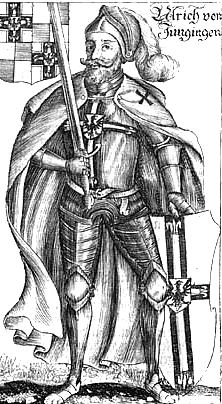
Ulrich von Jungingen
Ulrich von Jungingen was a German noble. Born 1360, in Hohenfels. Died July 15, 1410, in Stębark. Positions held include Grand Master of the Teutonic Knights (1407–1410) and superior general.
Facts
12 facts · 2 confirmed by two sources · 3 cited · 7 from one source
Where this comes from
Papalocal keeps its own record. It started from these sources; what each one said is kept here as it was copied, so a change on their side never changes this page by itself. Tap one to read its version.
What Wikidata says · copied November 16, 2026 · revision 2567395000
- Described as
- German noble (1360-1410)
- Born
- 1360
- Died
- July 15, 1410
- Born in
- Hohenfels
- Died in
- Stębark · 1 reference
- Buried in
- Malbork Castle
- Citizen of
- State of the Teutonic Order · 1 reference
- Occupation
- knight; military personnel · 1 reference
- Positions held
- Grand Master of the Teutonic Knights (1407–1410); superior general · 1 reference
- Siblings
- Konrad von Jungingen · 1 reference
- Religion
- Catholic Church
- Wikipedias with a page
- 28
Wikidata item Q330895 (wikidata.org/wiki/Q330895), public domain (CC0). Copied November 16, 2026.
What Wikipedia says · copied November 16, 2026 · revision 1370392933
Ulrich von Jungingen (1360 – 15 July 1410) was the 26th Grand Master of the Teutonic Knights, serving from 1407 to 1410. His policy of confrontation with the Grand Duchy of Lithuania and the Kingdom of Poland would spark the Polish–Lithuanian–Teutonic War and lead to disaster for his Order, and his own death, at the Battle of Grunwald.
- Born, in its opening lines
- 1360
- Died, in its opening lines
- July 15, 1410
From the Wikipedia article “Ulrich von Jungingen” (en.wikipedia.org/wiki/Ulrich_von_Jungingen), by its contributors, under CC BY-SA 4.0 (creativecommons.org/licenses/by-sa/4.0/). Copied November 16, 2026; not changed.
Confirmed Two sources agree. Cited One source, and it names where it got it. One source One source, without a reference of its own. Sources disagree The sources disagree. We show the best-supported value and keep theirs below.
