
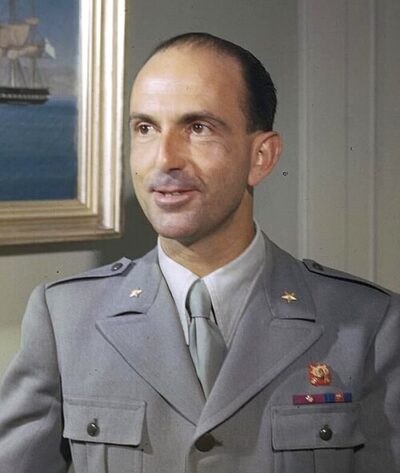
Umberto II of Italy
Umberto II of Italy was a lieutenant of the Kingdom of Italy and last king of Italy. Born September 15, 1904, in Racconigi. Died March 18, 1983, in Geneva. Positions held include Monarch of Italy (1946), steward (1943–1946) and Head of the House of Savoy. Awards include Knight of the Order of the Golden Fleece, Knight of the Order of St. Alexander Nevsky and Order of the White Eagle.
Facts
42 facts · 2 confirmed by two sources · 7 cited · 33 from one source
Where this comes from
Papalocal keeps its own record. It started from these sources; what each one said is kept here as it was copied, so a change on their side never changes this page by itself. Tap one to read its version.
What Wikidata says · copied November 16, 2026 · revision 2558266906
- Described as
- lieutenant of the Kingdom of Italy and last king of Italy
- Other names
- Humbert II of Italy, King Humbert, Umberto II
- Born
- September 15, 1904 · 8 references
- Died
- March 18, 1983 · 9 references
- Born in
- Racconigi · 2 references
- Died in
- Geneva · 2 references
- Buried in
- Royal Abbey of Hautecombe
- Citizen of
- Kingdom of Italy (–1946)
- Occupation
- military personnel; monarch; sovereign · 1 reference
- Positions held
- Monarch of Italy (1946); steward (1943–1946); Head of the House of Savoy
- Member of
- Umberto II of Italy and Queen Marie-José
- Awards
- Knight of the Order of the Golden Fleece (1923) · 1 reference; Knight of the Order of St. Alexander Nevsky; Order of the White Eagle; Knight Grand Cross in the Order of the Holy Sepulchre; Order of Saint Anna, 1st class; Order of Saint Stanislaus, 1st class; Order of Michael the Brave; Order of St. Andrew; Royal Victorian Chain (1935); Supreme Order of Christ; Grand Master of the Order of the Most Holy Annunciation · 1 reference; Civil Order of Savoy · 1 reference; Order of the Garter · 1 reference; Royal Order of the Seraphim · 1 reference; Knight of the Order of the Elephant (1922)
- Spouse
- Marie José of Belgium (1930–) · 1 reference
- Children
- Princess Maria Pia of Savoy · 1 reference; Vittorio Emanuele, Prince of Naples · 1 reference; Princess Maria Gabriella of Savoy · 1 reference; Princess Maria Beatrice of Savoy · 1 reference
- Father
- Victor Emmanuel III of Italy
- Mother
- Elena of Montenegro
- Siblings
- Giovanna of Savoy; Princess Mafalda of Savoy; Princess Maria Francesca of Savoy; Princess Iolanda, Countess of Bergolo
- Religion
- Catholic Church
- Military branch
- Italian Air Force
- Military rank
- Marshal of Italy (1942–)
- Wikipedias with a page
- 72
Wikidata item Q187149 (wikidata.org/wiki/Q187149), public domain (CC0). Copied November 16, 2026.
What Wikipedia says · copied November 16, 2026 · revision 1380367231
Umberto II (Italian: Umberto Nicola Tommaso Giovanni Maria di Savoia; 15 September 1904 – 18 March 1983) was the last King of Italy. Umberto's reign lasted for 34 days, from 9 May 1946 until his formal deposition on 12 June 1946, although he had been the de facto head of state since 1944. Due to his short reign, he was nicknamed the May King (Italian: Re di maggio).
Umberto was the third child and only son among the five children of Victor Emmanuel III and Elena of Montenegro. As heir apparent to the throne, he received a customary military education and pursued a military career afterwards. In 1940, he commanded an army group during the brief Italian invasion of France shortly before the French capitulation. In 1942, he was promoted to Marshal of Italy but was otherwise inactive as an army commander during much of World War II. Umberto turned against the war following Italian defeats at Stalingrad and El Alamein, and tacitly supported the ousting of Benito Mussolini.
In 1944, Victor Emmanuel, compromised by his association with Italian fascism and desperate to repair the monarchy's image, transferred most of his powers to Umberto. He transferred his remaining powers to Umberto later in 1944 and named him Lieutenant General (Luogotenente) of the Realm; while retaining the title of King. As the country prepared for the 1946 Italian institutional referendum on the continuation of the Italian monarchy, Victor Emmanuel abdicated his throne in favour of Umberto, aspiring to bolster the monarchy with his exit. The June 1946 referendum saw voters voting to abolish the monarchy, and Italy was declared a republic days later. Umberto departed the country; he and other male members of the House of Savoy were barred from returning. He lived out the rest of his life in exile in Cascais, on the Portuguese Riviera. He died in Geneva, Switzerland in 1983.
- Born, in its opening lines
- September 15, 1904
- Died, in its opening lines
- March 18, 1983
From the Wikipedia article “Umberto II of Italy” (en.wikipedia.org/wiki/Umberto_II_of_Italy), by its contributors, under CC BY-SA 4.0 (creativecommons.org/licenses/by-sa/4.0/). Copied November 16, 2026; not changed.
Confirmed Two sources agree. Cited One source, and it names where it got it. One source One source, without a reference of its own. Sources disagree The sources disagree. We show the best-supported value and keep theirs below.
