
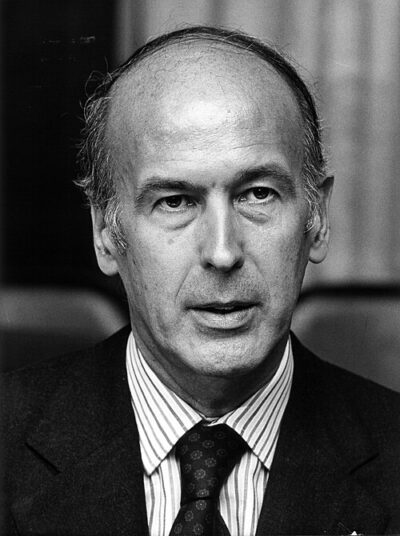
Valéry Giscard d'Estaing
Valéry Giscard d'Estaing was a French official and politician. Born February 2, 1926, in Koblenz. Died December 2, 2020, in Authon. Positions held include President of the French Republic (1974–1981), Mayor of Chamalières (1967–1974) and conseiller régional d'Auvergne. Educated at École polytechnique and Lycée Louis-le-Grand. Awards include Charlemagne Prize, Grand Cross of the Legion of Honour and Croix de guerre 1939–1945.
Facts
56 facts · 2 confirmed by two sources · 17 cited · 37 from one source
Where this comes from
Papalocal keeps its own record. It started from these sources; what each one said is kept here as it was copied, so a change on their side never changes this page by itself. Tap one to read its version.
What Wikidata says · copied November 16, 2026 · revision 2567355837
- Described as
- French official and politician (1926–2020)
- Other names
- VGE, Giscard, Giscard d'Estaing, Valery Giscard d'Estaing, Valéry René Marie Georges Giscard d'Estaing, Valery Rene Marie Georges Giscard d'Estaing
- Born
- February 2, 1926 · 10 references
- Died
- December 2, 2020 · 3 references
- Born in
- Koblenz · 1 reference
- Died in
- Authon · 3 references
- Buried in
- Authon
- Cause of death
- COVID-19 · 1 reference
- Name at birth
- Valéry René Marie Georges Giscard d'Estaing · 1 reference
- Citizen of
- France
- Occupation
- statesperson; official; politician · 2 references; author
- Positions held
- President of the French Republic (1974–1981); Mayor of Chamalières (1967–1974); conseiller régional d'Auvergne; member of the general council (2 times) (1958–1988); Minister of the Economy, Finances and Industry (2 times) (1962–1974); Member of the European Parliament (1989–1993) · 1 reference; French co-prince of Andorra (1974–1981); Member of the Académie française (2003–2020)
- Political party
- Union for French Democracy; Independent Republicans
- Worked for
- Inspection générale des finances
- Education
- École polytechnique; Lycée Louis-le-Grand; École nationale d'administration (1949–1951); Lycée Janson-de-Sailly
- Member of
- Académie Française (2003–2020); Royal Academy of Economic and Financial Sciences · 1 reference
- Awards
- Charlemagne Prize (2003) · 1 reference; Grand Cross of the Legion of Honour; Croix de guerre 1939–1945; Grand Cross of the National Order of Merit; Robert Schuman Medal (1993); Nansen Refugee Award (1979); Ewald von Kleist Prize (2014); prix Trop Virilo (2009); Grand Master of the Legion of Honour; Collar of the Order of Charles III (1978) · 1 reference; Collar of the Order of Isabella the Catholic (1976) · 1 reference; Grand Cross of the Order of Isabella the Catholic (1963) · 1 reference; Grand Cross Special Class of the Order of Merit of the Federal Republic of Germany (1975); Knight of the Order of the Elephant (1978) · 2 references; Royal Order of the Seraphim
- Field
- politics · 1 reference; literary activity · 1 reference
- Spouse
- Anne-Aymone Sauvage de Brantes (1952–) · 1 reference
- Children
- Louis Giscard d'Estaing · 1 reference; Valérie-Anne Giscard d'Estaing · 1 reference; Henri Giscard d'Estaing; Jacinte Giscard d'Estaing
- Father
- Edmond Giscard d'Estaing · 1 reference
- Mother
- May Bardoux · 1 reference
- Siblings
- Olivier Giscard d'Estaing · 1 reference; Sylvie Giscard d'Estaing
- Religion
- Catholic Church
- Wikipedias with a page
- 116
Wikidata item Q2124 (wikidata.org/wiki/Q2124), public domain (CC0). Copied November 16, 2026.
What Wikipedia says · copied November 16, 2026 · revision 1379566911
Valéry René Marie Georges Giscard d'Estaing (UK: , US: ; French: [valeʁi ʁəne maʁi ʒɔʁʒ ʒiskaʁ dɛstɛ̃] ; 2 February 1926 – 2 December 2020), also known as simply Giscard or VGE, was President of France from 1974 to 1981.
After serving as Minister of Finance under prime ministers Jacques Chaban-Delmas and Pierre Messmer, Giscard d'Estaing won the presidential election of 1974 with 50.8% of the vote against François Mitterrand of the Socialist Party. His tenure was marked by a more liberal attitude on social issues—such as divorce, contraception and abortion—and by attempts to modernise the country and the office of the presidency, notably overseeing such far-reaching infrastructure projects as the TGV and the turn towards reliance on nuclear power as France's main energy source. Giscard d'Estaing launched the Grande Arche, Musée d'Orsay, Arab World Institute and Cité des Sciences et de l'Industrie projects in the Paris region, later included in the Grands Projets of François Mitterrand. He promoted liberalisation of trade; however, his popularity suffered from the economic downturn that followed the 1973 energy crisis, marking the end of the Trente Glorieuses (the "Thirty Glorious Years" of prosperity after 1945). He imposed austerity budgets, and allowed unemployment to rise in order to avoid deficits. Giscard d'Estaing in the centre faced political opposition from both sides of the spectrum: from the newly unified left under Mitterrand and a rising Jacques Chirac, who resurrected Gaullism on a right-wing opposition line. In 1981, despite a high approval rating, he was defeated in a runoff against Mitterrand, with 48.2% of the vote.
As president, Giscard d'Estaing promoted cooperation among the European nations, especially in tandem with West Germany under Chancellor Helmut Schmidt (SPD).
As a former president, Giscard d'Estaing was a member of the Constitutional Council. He also served as president of the Regional Council of Auvergne from 1986 to 2004. Involved with the process of European integration, he notably presided over the Convention on the Future of Europe that drafted the ill-fated Treaty establishing a Constitution for Europe. In 2003, he was elected to the Académie Française, taking the seat that his friend and former president of Senegal Léopold Sédar Senghor had held. He died at the age of 94, and is the longest-lived French president in history.
- Born, in its opening lines
- February 2, 1926
- Died, in its opening lines
- December 2, 2020
From the Wikipedia article “Valéry Giscard d'Estaing” (en.wikipedia.org/wiki/Valéry_Giscard_d'Estaing), by its contributors, under CC BY-SA 4.0 (creativecommons.org/licenses/by-sa/4.0/). Copied November 16, 2026; not changed.
Confirmed Two sources agree. Cited One source, and it names where it got it. One source One source, without a reference of its own. Sources disagree The sources disagree. We show the best-supported value and keep theirs below.
