
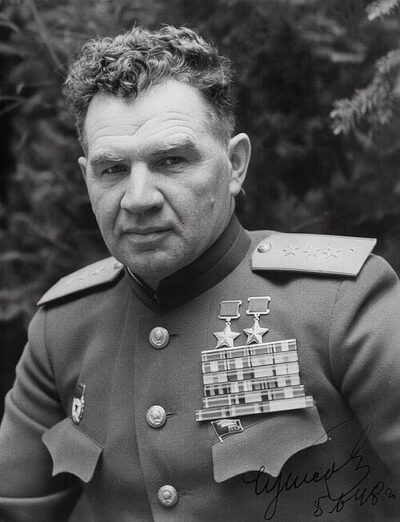
Vasily Chuikov
Vasily Chuikov was a Soviet marshal. Born January 31, 1900, in Serebryanye Prudy. Died March 18, 1982, in Moscow. Positions held include deputy of the Supreme Soviet of the Soviet Union. Educated at M.V. Frunze Military Academy and Special Faculty of the Frunze Military Academy. Awards include Order of Lenin (9 times), Medal "For the Victory over Japan" and Medal "For the Victory over Germany in the Great Patriotic War 1941–1945".
Facts
36 facts · 1 confirmed by two sources · 5 cited · 29 from one source · 1 where the sources disagree
What’s different
- Born: we show January 31, 1900 (Sources disagree). Wikipedia says February 12, 1900
Where this comes from
Papalocal keeps its own record. It started from these sources; what each one said is kept here as it was copied, so a change on their side never changes this page by itself. Tap one to read its version.
What Wikidata says · copied November 16, 2026 · revision 2565051855
- Described as
- Soviet marshal (1900–1982)
- Other names
- Vasilij Ivanovič Čujkov, Vasily Ivanovich Chuikov
- Born
- January 31, 1900 · 5 references
- Died
- March 18, 1982 · 8 references
- Born in
- Serebryanye Prudy · 1 reference
- Died in
- Moscow · 1 reference
- Buried in
- Mamayev Kurgan
- Citizen of
- Soviet Union
- Occupation
- politician; military officer; memoirist; writer · 1 reference; marshal · 1 reference; soldier · 1 reference
- Positions held
- deputy of the Supreme Soviet of the Soviet Union
- Political party
- Communist Party of the Soviet Union (1919–)
- Education
- M.V. Frunze Military Academy (–1925); Special Faculty of the Frunze Military Academy (–1927)
- Member of
- Central Committee of the Communist Party of the Soviet Union
- Awards
- Order of Lenin (9 times) (1943, 1944, 1945, 1950, 1960, 1970, 1975, 1978, 1980); Medal "For the Victory over Japan"; Medal "For the Victory over Germany in the Great Patriotic War 1941–1945"; Order of the Red Banner (4 times) (1920, 1925, 1944, 1948); Hero of the Soviet Union (2 times) (1944, 1945); Order of the October Revolution (1968); Gold Star medal (2 times) (1944, 1945); Jubilee Medal "XX Years of the Workers' and Peasants' Red Army"; Order of Suvorov, 1st class (3 times) (1943, 1944, 1945); Order of the Red Star (1940); Medal "For the Defence of Moscow"; Medal "For the Defence of Stalingrad"; Medal "For the Liberation of Warsaw"; Medal "For the Capture of Berlin"; Medal "For Strengthening of Brotherhood in Arms"
- Military branch
- Red Army (1918–)
- Military rank
- Marshal of the Soviet Union (1955–); kombrig (1935–); komdiv (1938–)
- Wikipedias with a page
- 59
Wikidata item Q157594 (wikidata.org/wiki/Q157594), public domain (CC0). Copied November 16, 2026.
What Wikipedia says · copied November 16, 2026 · revision 1379817782
Vasily Ivanovich Chuikov (Russian: Василий Иванович Чуйков, Russian: [vɐˈsʲilʲɪj t͡ɕʉjkof]; 12 February [O.S. 31 January] 1900 – 18 March 1982) was a Soviet military commander and Marshal of the Soviet Union. He is best known for commanding the 62nd Army which saw heavy combat during the Battle of Stalingrad in the Second World War and for being the commanding general to receive the surrender of the German troops defending Berlin.
Born to a peasant family near Tula, Chuikov earned his living as a factory worker from the age of 12. After the Russian Revolution of 1917, he joined the Red Army and distinguished himself during the Russian Civil War. After graduating from the Frunze Military Academy, Chuikov worked as a military attaché and intelligence officer in China and the Russian Far East. At the outbreak of the Second World War, Chuikov commanded the 4th Army during the Soviet invasion of Poland, and the 9th Army during the Winter War against Finland. In December 1940, he was again appointed military attaché to China in support of Chiang Kai-shek and the Nationalists in the war against Japan.
In March 1942, Chuikov was recalled from China to defend against the German invasion of the Soviet Union. By September, he was assigned command of the 62nd Army in defense of Stalingrad. Tasked with holding the city at all costs, Chuikov adopted keeping the Soviet front-line positions as close to the Germans as physically possible. This served as an effective countermeasure against the Wehrmacht's combined-arms tactics, but by mid-November 1942 the Germans had captured most of the city after months of slow advance. In late November Chuikov's 62nd Army joined the rest of the Soviet forces in a counter-offensive, which led to the surrender of the German 6th Army in early 1943. After Stalingrad, Chuikov led his forces into Poland during Operation Bagration and the Vistula–Oder Offensive before advancing on Berlin. He personally accepted the unconditional surrender of German forces in Berlin on 2 May 1945.
After the war, Chuikov served as Commander-in-Chief of the Group of Soviet Forces in Germany (1949–53), commander of the Kiev Military District (1953–60), Chief of the Soviet Armed Forces and Deputy Minister of Defense (1960–64), and head of the Soviet Civil Defense Forces (1961–72). Chuikov was twice awarded the titles Hero of the Soviet Union (1944 and 1945) and was awarded the Distinguished Service Cross by the United States for his actions during the Battle of Stalingrad. In 1955, he was named a Marshal of the Soviet Union. Following his death in 1982, Chuikov was interred at the Stalingrad memorial at Mamayev Kurgan, which had been the site of heavy fighting.
- Born, in its opening lines
- February 12, 1900
- Died, in its opening lines
- March 18, 1982
From the Wikipedia article “Vasily Chuikov” (en.wikipedia.org/wiki/Vasily_Chuikov), by its contributors, under CC BY-SA 4.0 (creativecommons.org/licenses/by-sa/4.0/). Copied November 16, 2026; not changed.
Confirmed Two sources agree. Cited One source, and it names where it got it. One source One source, without a reference of its own. Sources disagree The sources disagree. We show the best-supported value and keep theirs below.
