
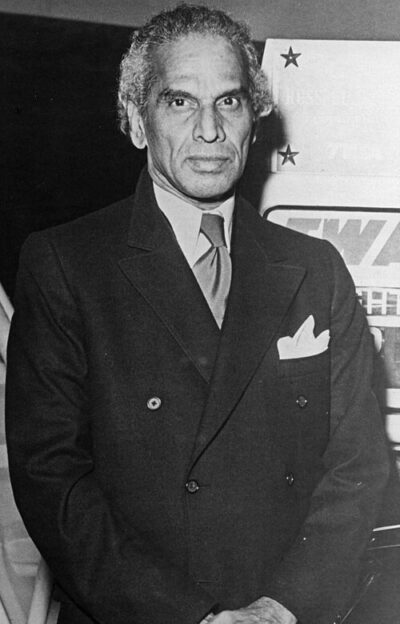
Vengalil Krishnan Krishna Menon
Vengalil Krishnan Krishna Menon was an Indian politician. Born May 3, 1896, in Thalassery. Died October 6, 1974, in Delhi. Positions held include Minister of Defence (1957–1962), Member of the 5th Lok Sabha (1971–1974) and member of Rajya Sabha. Educated at Presidency College and London School of Economics and Political Science. Awards include Padma Vibhushan in Public Affairs.
Facts
22 facts · 2 confirmed by two sources · 0 cited · 20 from one source
Where this comes from
Papalocal keeps its own record. It started from these sources; what each one said is kept here as it was copied, so a change on their side never changes this page by itself. Tap one to read its version.
What Wikidata says · copied November 16, 2026 · revision 2563974762
- Described as
- Indian politician (1896-1974)
- Other names
- V. K. Krishna Menon, Vengalil Krishna Kurup Krishna Menon
- Born
- May 3, 1896 · 3 references
- Died
- October 6, 1974 · 3 references
- Born in
- Thalassery
- Died in
- Delhi
- Citizen of
- India (1950–); British Raj (–1947); Dominion of India (1947–1950)
- Occupation
- lawyer; politician
- Positions held
- Minister of Defence (1957–1962); Member of the 5th Lok Sabha (1971–1974); member of Rajya Sabha; Member of the 4th Lok Sabha (1969–1971)
- Political party
- Indian National Congress
- Education
- Presidency College; London School of Economics and Political Science; University College London; Zamorin's Guruvayurappan College; University of Madras; University of London · 1 reference
- Awards
- Padma Vibhushan in Public Affairs (1954)
- Religion
- Hinduism
- Wikipedias with a page
- 28
Wikidata item Q3595860 (wikidata.org/wiki/Q3595860), public domain (CC0). Copied November 16, 2026.
What Wikipedia says · copied November 16, 2026 · revision 1380792157
Vengalil Krishnan Krishna Menon (Malayalam: [ʋeŋːaːlil krʂɳɐn krʂɳɐ menoːn]) (3 May 1896 – 6 October 1974) was an Indian academic, independence activist, politician, lawyer, and statesman. Menon contributed to the Indian independence movement and India's foreign relations. He was among the major architects of Indian foreign policy, was India's first High Commissioner to the United Kingdom and later India's Defence Minister.
In 1928, Menon founded the India League in London to demand total independence from the British rule in the Indian subcontinent. Whilst in Britain he worked as an editor and helped found Pelican Books. Towards the end of the 1940s, he presided Indo-British matters and caused the selection of the last British Viceroy of India, Louis Mountbatten. He worked with Nehru, Mountbatten, Sardar Patel, and V.P. Menon to work out the mechanics of Indian independence.
After the independence of India, he facilitated international diplomacy and resolutions in situations such as the Suez Crisis, Korean War, invasion of Hungary, Cyprus, Indochina, Taiwan, and the Chinese capture of American airmen, while supporting the anti-colonial ethos of what he would eventually name the Non-Aligned Movement. Since the independence of India, he served as High Commissioner to the United Kingdom, Ambassador to the United Nations, and Defence minister. As a Defence minister, he played a role in military conflicts such as Congo Crisis, Annexation of Goa, and Sino-Indian War. During his tenure as defence minister, India saw establishment of domestic military-industrial complex and educational systems, the Sainik Schools, the Defence Research and Development Organization (DRDO), and other defence and military institutions, while professionalizing the National Cadet Corps and similar entities.
He was elected to both houses of the Indian parliament from constituencies such as Mumbai, Bengal, and Trivandrum in his native state of Kerala. He remained a member of the Lok Sabha until his death.
- Born, in its opening lines
- May 3, 1896
- Died, in its opening lines
- October 6, 1974
From the Wikipedia article “V. K. Krishna Menon” (en.wikipedia.org/wiki/V._K._Krishna_Menon), by its contributors, under CC BY-SA 4.0 (creativecommons.org/licenses/by-sa/4.0/). Copied November 16, 2026; not changed.
Confirmed Two sources agree. Cited One source, and it names where it got it. One source One source, without a reference of its own. Sources disagree The sources disagree. We show the best-supported value and keep theirs below.
