
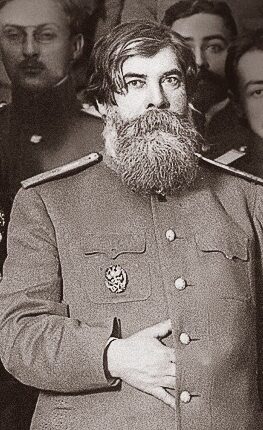
Vladimir Bekhterev
Vladimir Bekhterev was a Russian neurologist. Born January 20, 1857, in Saralı. Died December 24, 1927, in Moscow. Positions held include professor. Known for Kollektivnaya refleksologiya. Educated at Imperial Academy of Medical Surgery and S. M. Kirov Military Medical Academy. Awards include scientific prize from Russian Academy of Science, Order of St. Vladimir and Order of Saint Anna, 1st class.
Facts
29 facts · 2 confirmed by two sources · 6 cited · 21 from one source
What’s different
- Born: we show January 20, 1857 (Confirmed). Wikidata also lists February 1, 1857
Where this comes from
Papalocal keeps its own record. It started from these sources; what each one said is kept here as it was copied, so a change on their side never changes this page by itself. Tap one to read its version.
What Wikidata says · copied November 16, 2026 · revision 2568680932
- Described as
- Russian neurologist
- Other names
- Wladimir Bechterew, V. M. Bekhterev, Vladimir Mikhailovich Bekhterev
- Born
- January 20, 1857 · 2 references; February 1, 1857 · 1 reference
- Died
- December 24, 1927 · 3 references
- Born in
- Saralı
- Died in
- Moscow · 1 reference
- Buried in
- Volkovo Cemetery Writer's Walkways
- Citizen of
- Russian Empire; Russian Soviet Federative Socialist Republic; Soviet Union
- Occupation
- physician; psychiatrist · 1 reference; university teacher; neurologist · 1 reference; psychologist; physiologist · 1 reference
- Positions held
- professor
- Worked for
- Kazan Federal University (1893) · 1 reference; S. M. Kirov Military Medical Academy (1883–) · 1 reference
- Education
- Imperial Academy of Medical Surgery; S. M. Kirov Military Medical Academy
- Known for
- Kollektivnaya refleksologiya
- Awards
- scientific prize from Russian Academy of Science (1900) · 1 reference; Order of St. Vladimir · 1 reference; Order of Saint Anna, 1st class · 1 reference; Order of Saint Stanislaus · 1 reference; Honoured Scientist of the RSFSR · 1 reference
- Field
- psychiatry; neurology
- Children
- Peter Bechterev
- Lived in
- Russian Empire · 1 reference
- Wikipedias with a page
- 50
Wikidata item Q221723 (wikidata.org/wiki/Q221723), public domain (CC0). Copied November 16, 2026.
What Wikipedia says · copied November 16, 2026 · revision 1372005263
Vladimir Mikhailovich Bekhterev (Russian: Влади́мир Миха́йлович Бе́хтерев, IPA: [ˈbʲextʲɪrʲɪf]; 20 January 1857 – 24 December 1927) was a Russian neurologist and the father of objective psychology. He is best known for noting the role of the hippocampus in memory, his study of reflexes, and Bekhterev's disease. Moreover, he is known for his competition with Ivan Pavlov regarding the study of conditioned reflexes.
The sudden circumstances of his death has led to rumours that he died on the orders of Joseph Stalin. This is because Bekhterev performed a medical diagnosis of Stalin shortly before his death which was considered to be politically damaging to the position of the Soviet dictator. This remains disputed among scholars due to the lack of direct evidence.
- Born, in its opening lines
- January 20, 1857
- Died, in its opening lines
- December 24, 1927
From the Wikipedia article “Vladimir Bekhterev” (en.wikipedia.org/wiki/Vladimir_Bekhterev), by its contributors, under CC BY-SA 4.0 (creativecommons.org/licenses/by-sa/4.0/). Copied November 16, 2026; not changed.
Confirmed Two sources agree. Cited One source, and it names where it got it. One source One source, without a reference of its own. Sources disagree The sources disagree. We show the best-supported value and keep theirs below.
