
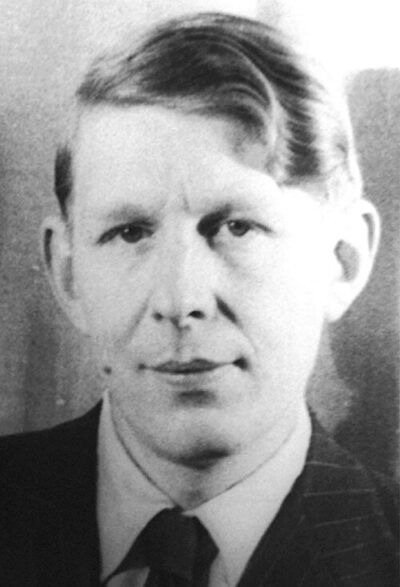
W. H. Auden
W. H. Auden was a British-American poet. Born February 21, 1907, in York. Died September 29, 1973, in Vienna. Known for The Orators. Educated at Christ Church and University of Oxford. Awards include Guggenheim Fellowship, Bollingen Prize and King’s / Queen’s Gold Medal for Poetry.
Facts
45 facts · 2 confirmed by two sources · 26 cited · 17 from one source
Where this comes from
Papalocal keeps its own record. It started from these sources; what each one said is kept here as it was copied, so a change on their side never changes this page by itself. Tap one to read its version.
What Wikidata says · copied November 13, 2026 · revision 2567311181
- Described as
- British-American poet (1907–1973)
- Other names
- Wystan Hugh Auden, Wystan H Auden, W. H. Wystan Hugh Auden, Wystan Auden
- Born
- February 21, 1907 · 17 references
- Died
- September 29, 1973 · 3 references
- Born in
- York · 4 references
- Died in
- Vienna · 4 references
- Buried in
- Kirchstetten
- Name at birth
- Wystan Hugh Auden · 1 reference
- Citizen of
- United Kingdom · 1 reference; United States · 3 references
- Occupation
- poet · 5 references; screenwriter · 1 reference; literary historian; playwright · 1 reference; writer · 4 references; librettist · 3 references; university teacher · 2 references; literary critic
- Worked for
- University of Michigan · 1 reference; The New School · 1 reference
- Education
- Christ Church; University of Oxford (–1928) · 2 references; Gresham's School; St Edmund's School
- Member of
- American Academy of Arts and Letters; Bavarian Academy of Fine Arts
- Genre
- lyric poetry · 1 reference
- Known for
- The Orators · 1 reference
- Awards
- Guggenheim Fellowship (1942) · 1 reference; Bollingen Prize (1954) · 1 reference; King’s / Queen’s Gold Medal for Poetry; Feltrinelli Prize; Pulitzer Prize for Poetry (1948) · 1 reference; National Book Award (1956) · 1 reference; St. Louis Literary Award (1970); United Nations Peace Medal (1971); Austrian State Prize for European Literature (1966) · 1 reference; Golden Wreath (1971)
- Spouse
- Erika Mann (1935–1969) · 1 reference; Chester Kallman · 1 reference
- Father
- George Augustus Auden · 1 reference
- Mother
- Constance Rosalie Bicknell · 2 references
- Siblings
- [George] Bernard Auden · 1 reference; John Bicknell Auden · 1 reference
- Religion
- Anglicanism
- Lived in
- Oxford (1972–1973); Austria (–1973)
- Wikipedias with a page
- 101
Wikidata item Q178698 (wikidata.org/wiki/Q178698), public domain (CC0). Copied November 13, 2026.
What Wikipedia says · copied November 13, 2026 · revision 1372622384
Wystan Hugh Auden ( WIST-ən HYOO AWD-ən; 21 February 1907 – 29 September 1973) was a British-American poet. Auden's poetry is noted for its stylistic and technical achievement, its engagement with politics, morals, love, and religion, and its variety in tone, form, and content. Some of his best known poems are about love, such as "Funeral Blues"; on political and social themes, such as "September 1, 1939" and "The Shield of Achilles"; on cultural and psychological themes, such as The Age of Anxiety; and on religious themes, such as "For the Time Being" and "Horae Canonicae".
Auden was born in York and grew up in and near Birmingham in a professional, middle-class family. He attended various English independent (or public) schools and studied English at Christ Church, Oxford. After a few months in Berlin in 1928–29, he spent five years (1930–1935) teaching in British private preparatory schools. In 1939, he moved to the United States; he became an American citizen in 1946, retaining his British citizenship. Auden taught from 1941 to 1945 in American universities, followed by occasional visiting professorships in the 1950s.
Auden came to wide public attention in 1930 with his first book, Poems; it was followed in 1932 by The Orators. Three plays written in collaboration with Christopher Isherwood between 1935 and 1938 built his reputation as a left-wing political writer. Auden moved to the United States partly to escape this reputation, and his work in the 1940s, including the long poems "For the Time Being" and "The Sea and the Mirror", focused on religious themes. He won the Pulitzer Prize for Poetry for his 1947 long poem The Age of Anxiety, the title of which became a popular phrase describing the modern era. From 1956 to 1961, he was Professor of Poetry at Oxford; his lectures were popular with students and faculty and served as the basis for his 1962 prose collection The Dyer's Hand.
Auden was a prolific writer of prose essays and reviews on literary, political, psychological, and religious subjects, and he worked at various times on documentary films, poetic plays, and other forms of performance. Throughout his career he was both controversial and influential. Critical views on his work ranged from sharply dismissive (treating him as a lesser figure than W. B. Yeats and T. S. Eliot) to strongly affirmative (as in Joseph Brodsky's statement that he had "the greatest mind of the twentieth century"). After his death, his poems became known to a much wider public through films, broadcasts, and popular media.
- Born, in its opening lines
- February 21, 1907
- Died, in its opening lines
- September 29, 1973
From the Wikipedia article “W. H. Auden” (en.wikipedia.org/wiki/W._H._Auden), by its contributors, under CC BY-SA 4.0 (creativecommons.org/licenses/by-sa/4.0/). Copied November 13, 2026; not changed.
Confirmed Two sources agree. Cited One source, and it names where it got it. One source One source, without a reference of its own. Sources disagree The sources disagree. We show the best-supported value and keep theirs below.
