
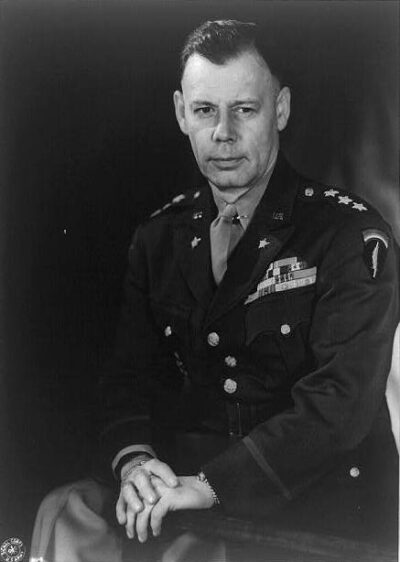
Walter Bedell Smith
Walter Bedell Smith was an United States Army general and Director of Central Intelligence. Born October 5, 1895, in Indianapolis. Died August 9, 1961, in Washington, D.C.. Positions held include Director of Central Intelligence (1950–1953) and United States Ambassador to the Soviet Union (1946–1948). Educated at United States Army Command and General Staff College and United States Army War College. Awards include Bronze Star Medal, Grand Cross of the Order of the Oak Crown and Knight Commander of the Order of the Bath.
Facts
37 facts · 2 confirmed by two sources · 7 cited · 28 from one source
Where this comes from
Papalocal keeps its own record. It started from these sources; what each one said is kept here as it was copied, so a change on their side never changes this page by itself. Tap one to read its version.
What Wikidata says · copied November 15, 2026 · revision 2567379758
- Described as
- United States Army general and Director of Central Intelligence (1895-1961)
- Other names
- Walter Bedell "Beetle" Smith
- Born
- October 5, 1895 · 3 references
- Died
- August 9, 1961 · 3 references
- Born in
- Indianapolis · 1 reference
- Died in
- Washington, D.C. · 1 reference
- Buried in
- Arlington National Cemetery (1961) · 1 reference
- Cause of death
- myocardial infarction
- Citizen of
- United States
- Occupation
- diplomat; military personnel · 1 reference; writer · 1 reference; ambassador · 1 reference
- Positions held
- Director of Central Intelligence (1950–1953); United States Ambassador to the Soviet Union (1946–1948)
- Political party
- independent politician · 1 reference
- Worked for
- Central Intelligence Agency
- Education
- United States Army Command and General Staff College; United States Army War College; Emmerich Manual High School
- Awards
- Bronze Star Medal; Grand Cross of the Order of the Oak Crown; Knight Commander of the Order of the Bath; Knight Commander of the Order of the British Empire; Grand Cross of the Order of Wissam Alaouite; Grand Cross of the Order of the Crown; Legionnaire of Legion of Merit; Order of Kutuzov, 1st class; Commander with Star of the Order of Polonia Restituta; Croix de guerre 1940–1945 (Belgium); Grand Officer of the Legion of Honour; Knight Grand Cross in the Order of the Netherlands Lion; Silver Cross of the Virtuti Militari; Grand Cordon of the order of Nichan Iftikhar; Croix de guerre 1914–1918
- Religion
- Catholicism
- Military branch
- United States Army
- Military rank
- general; general · 1 reference
- Wikipedias with a page
- 26
Wikidata item Q333365 (wikidata.org/wiki/Q333365), public domain (CC0). Copied November 15, 2026.
What Wikipedia says · copied November 15, 2026 · revision 1379339291
General Walter Bedell "Beetle" Smith (5 October 1895 – 9 August 1961) was a senior officer of the United States Army who served as General Dwight D. Eisenhower's chief of staff at Allied Forces Headquarters (AFHQ) during the Tunisia Campaign and the Allied invasion of Italy in 1943 during World War II. He was Eisenhower's chief of staff at the Supreme Headquarters Allied Expeditionary Force (SHAEF) in the campaign in Western Europe from 1944 to 1945.
Smith enlisted as a private in the Indiana Army National Guard in 1911. During World War I, he served with the American Expeditionary Forces and was commissioned to second lieutenant in 1917. He was wounded in the Aisne-Marne Offensive in 1918. After the war, he was a staff officer and instructor at the U.S. Army Infantry School. In 1941, he became secretary of the General Staff, and in 1942 he became the secretary to the Combined Chiefs of Staff. His duties involved taking part in discussions of war plans at the highest level, and Smith often briefed President Franklin D. Roosevelt on strategic matters.
Smith became chief of staff to Eisenhower at AFHQ in September 1942 and acquired a reputation as Eisenhower's "hatchet man" for his brusque and demanding manner. However, he also successfully represented Eisenhower in sensitive missions requiring diplomatic skill. Smith was involved in negotiating the armistice between Italy and the Allies, which he signed on behalf of Eisenhower. In 1944, he became the chief of staff of SHAEF, again under Eisenhower. In that position, Smith also negotiated successfully for food and fuel aid to be sent through German lines for the cold and starving Dutch civilian population, and he opened discussions for the peaceful and complete German capitulation to the First Canadian Army in the Netherlands. In May 1945, Smith met representatives of the German High Command in Reims, France, to conduct the surrender of the German Armed Forces, and he signed the German Instrument of Surrender on behalf of Eisenhower.
After the war, he served as the U.S. Ambassador to the Soviet Union from 1946 to 1948. In 1950, Smith became the Director of Central Intelligence, the head of the Central Intelligence Agency (CIA) and the other intelligence agencies in the United States. Smith reorganized the CIA, redefined its structure and its mission, and gave it a new sense of purpose. He made the CIA the arm of government that is primarily responsible for covert operations. He left the CIA in 1953 to become Under Secretary of State. After retiring from the State Department in 1954, Smith continued to serve the Eisenhower administration in various posts for several years until he retired shortly before he died in 1961.
- Born, in its opening lines
- October 5, 1895
- Died, in its opening lines
- August 9, 1961
From the Wikipedia article “Walter Bedell Smith” (en.wikipedia.org/wiki/Walter_Bedell_Smith), by its contributors, under CC BY-SA 4.0 (creativecommons.org/licenses/by-sa/4.0/). Copied November 15, 2026; not changed.
Confirmed Two sources agree. Cited One source, and it names where it got it. One source One source, without a reference of its own. Sources disagree The sources disagree. We show the best-supported value and keep theirs below.
