
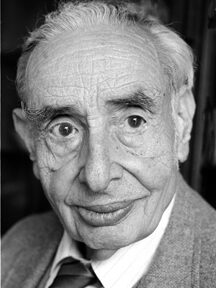
Walter M. Elsasser
Walter M. Elsasser was a German-American physicist. Born March 20, 1904, in Mannheim. Died October 14, 1991, in Baltimore. Educated at University of Göttingen and LMU Munich. Awards include Arthur L. Day Medal, National Medal of Science and Carl Friedrich Gauss Medal.
Facts
25 facts · 2 confirmed by two sources · 11 cited · 12 from one source
What’s different
- Born: we show March 20, 1904 (Confirmed). Wikidata also lists April 20, 1904
Where this comes from
Papalocal keeps its own record. It started from these sources; what each one said is kept here as it was copied, so a change on their side never changes this page by itself. Tap one to read its version.
What Wikidata says · copied November 18, 2026 · revision 2568922349
- Described as
- German-American physicist
- Other names
- Walter Maurice Elsasser
- Born
- March 20, 1904 · 2 references; April 20, 1904 · 1 reference
- Died
- October 14, 1991 · 5 references
- Born in
- Mannheim · 1 reference
- Died in
- Baltimore · 1 reference
- Citizen of
- Germany; United States
- Occupation
- physicist · 1 reference; university teacher · 1 reference; biologist · 1 reference; geophysicist · 1 reference; meteorologist · 1 reference
- Worked for
- University of Utah; University of California, San Diego · 1 reference
- Education
- University of Göttingen; LMU Munich; Heidelberg University
- Member of
- American Academy of Arts and Sciences; National Academy of Sciences
- Awards
- Arthur L. Day Medal (1979) · 1 reference; National Medal of Science (1987); Carl Friedrich Gauss Medal (1977); William Bowie Medal (1959) · 1 reference; Fellow of the American Physical Society; John Adam Fleming Medal (1971) · 1 reference; Fellow of the American Geophysical Union (1962) · 1 reference
- Wikipedias with a page
- 17
Wikidata item Q64550 (wikidata.org/wiki/Q64550), public domain (CC0). Copied November 18, 2026.
What Wikipedia says · copied November 18, 2026 · revision 1376343268
Walter Maurice Elsasser (March 20, 1904 – October 14, 1991) was a German-born American physicist who developed the presently accepted dynamo theory to explain Earth's magnetic field. He proposed that this field results from electric currents induced in the fluid outer core. He demonstrated that the history of Earth's magnetic field is revealed by the magnetic orientation of minerals in rocks. He is also noted for his unpublished proposal that the diffraction of electrons sent through a crystal would demonstrate their wavelike nature. The subsequent Davisson–Germer experiment showing this effect led to a Nobel Prize in Physics.
Between 1962 and 1968 he was a Professor of Geophysics at Princeton University. Between 1975 and 1991 he was an adjunct Professor of Geophysics at Johns Hopkins University
The Olin Hall at the Johns Hopkins University has a Walter Elsasser Memorial in the lobby.
- Born, in its opening lines
- March 20, 1904
- Died, in its opening lines
- October 14, 1991
From the Wikipedia article “Walter M. Elsasser” (en.wikipedia.org/wiki/Walter_M._Elsasser), by its contributors, under CC BY-SA 4.0 (creativecommons.org/licenses/by-sa/4.0/). Copied November 18, 2026; not changed.
Confirmed Two sources agree. Cited One source, and it names where it got it. One source One source, without a reference of its own. Sources disagree The sources disagree. We show the best-supported value and keep theirs below.
