
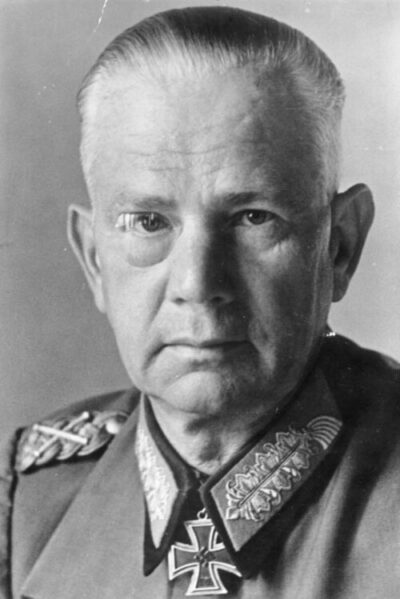
Walter von Reichenau
Walter von Reichenau was a German field marshal. Born October 8, 1884, in Karlsruhe. Died January 17, 1942, in Lviv. Awards include Knight's Cross of the Iron Cross, Order of the Crown and House Order of Hohenzollern.
Facts
29 facts · 2 confirmed by two sources · 5 cited · 22 from one source
Where this comes from
Papalocal keeps its own record. It started from these sources; what each one said is kept here as it was copied, so a change on their side never changes this page by itself. Tap one to read its version.
What Wikidata says · copied November 16, 2026 · revision 2569028598
- Described as
- German field marshal (1884–1942)
- Other names
- Walter Karl Ernst August von Reichenau
- Born
- October 8, 1884 · 4 references
- Died
- January 17, 1942 · 5 references
- Born in
- Karlsruhe · 1 reference
- Died in
- Lviv · 1 reference
- Buried in
- Invalids' Cemetery
- Cause of death
- cerebral hemorrhage
- Citizen of
- Kingdom of Prussia; Weimar Republic
- Occupation
- military officer; Generalfeldmarschall · 1 reference
- Political party
- Nazi Party
- Member of
- International Olympic Committee
- Sport
- athletics · 1 reference
- Awards
- Knight's Cross of the Iron Cross; Order of the Crown; House Order of Hohenzollern; Friedrich Order; Hanseatic Cross; Military Merit Cross; Sudetenland Medal; Honour Cross of the World War 1914/1918; Wehrmacht Long Service Award; Iron Cross, 1st class; Iron Cross, 2nd class; Iron Cross · 1 reference
- Spouse
- Alexandrine* (Alix*) Charlotte von Reichenau
- Father
- Ernst von Reichenau · 1 reference
- Military branch
- army
- Military rank
- Generalfeldmarschall (1940–)
- Wikipedias with a page
- 48
Wikidata item Q57144 (wikidata.org/wiki/Q57144), public domain (CC0). Copied November 16, 2026.
What Wikipedia says · copied November 16, 2026 · revision 1383434792
Walter Karl Gustav August Ernst von Reichenau (8 October 1884 – 17 January 1942) was a German Generalfeldmarschall (field marshal) in the Heer (army) of Nazi Germany during World War II. He was nicknamed "The Bull" (German: Der Bulle). Reichenau commanded the 6th Army during the invasions of Belgium and France. During Operation Barbarossa, the invasion of the Soviet Union (USSR) in 1941, he continued to command the 6th Army as part of Army Group South as it captured Ukraine and advanced deep into the USSR.
While in command of the 6th Army, Reichenau issued the notorious Severity Order which encouraged German soldiers to murder Jewish civilians on the Eastern Front. His troops cooperated with the Schutzstaffel (SS) Einsatzgruppen units in the commission of the massacre of over 33,000 Jews at Babi Yar, and assisted with other crimes against humanity that occurred in areas under his command during the Holocaust.
- Born, in its opening lines
- October 8, 1884
- Died, in its opening lines
- January 17, 1942
From the Wikipedia article “Walter von Reichenau” (en.wikipedia.org/wiki/Walter_von_Reichenau), by its contributors, under CC BY-SA 4.0 (creativecommons.org/licenses/by-sa/4.0/). Copied November 16, 2026; not changed.
Confirmed Two sources agree. Cited One source, and it names where it got it. One source One source, without a reference of its own. Sources disagree The sources disagree. We show the best-supported value and keep theirs below.
