
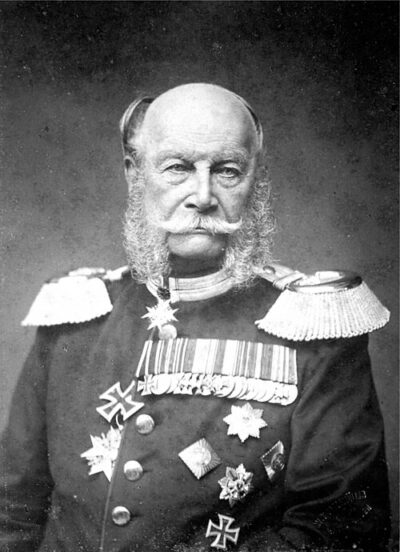
Wilhelm I
Wilhelm I was the 19th-century German Emperor and King of Prussia. Born March 22, 1797, in Kronprinzenpalais. Died March 9, 1888, in Berlin. Positions held include German Emperor (1871–1888) and King of Prussia (1861–1888). Awards include Knight of the Order of the Golden Fleece, Order of the Black Eagle and Order of the White Eagle.
Facts
43 facts · 2 confirmed by two sources · 9 cited · 32 from one source
Where this comes from
Papalocal keeps its own record. It started from these sources; what each one said is kept here as it was copied, so a change on their side never changes this page by itself. Tap one to read its version.
What Wikidata says · copied November 16, 2026 · revision 2568744197
- Described as
- 19th-century German Emperor and King of Prussia (1797–1888)
- Other names
- Wilhelm I of Germany, William I of Germany, William I, German Emperor, Wilhelm I, German Emperor, King William I of Prussia
- Born
- March 22, 1797 · 7 references
- Died
- March 9, 1888 · 7 references
- Born in
- Kronprinzenpalais · 1 reference
- Died in
- Berlin · 2 references
- Buried in
- mausoleum of Charlottenburg Park · 1 reference
- Name at birth
- Wilhelm Friedrich Ludwig von Preußen · 1 reference
- Citizen of
- Kingdom of Prussia; German Empire
- Occupation
- monarch; politician · 1 reference
- Positions held
- German Emperor (1871–1888); King of Prussia (1861–1888)
- Member of
- Russian Academy of Sciences
- Awards
- Knight of the Order of the Golden Fleece; Order of the Black Eagle; Order of the White Eagle; Order of Saint Alexander Nevsky; Order of St. Andrew; Order of St. George, 4th class; Order of the Red Eagle 1st Class; Knight of the Order of the Crown of Italy; Knight of the Order of Saints Maurice and Lazarus; Order of St. Vladimir, 1st class; Knight of the Order of the Elephant (1841); Order of St. George · 1 reference; Order of St. Vladimir · 1 reference; Order of the Golden Fleece · 1 reference; Order of the Elephant · 1 reference
- Spouse
- Augusta of Saxe-Weimar-Eisenach (1829–1888) · 1 reference
- Children
- Frederick III, German Emperor · 1 reference; Princess Louise of Prussia
- Father
- Frederick William III of Prussia · 1 reference
- Mother
- Louise of Mecklenburg-Strelitz · 1 reference
- Siblings
- Prince Charles of Prussia; Prince Albert of Prussia; Frederick William IV of Prussia · 1 reference; Princess Alexandrine of Prussia; Alexandra Feodorovna; Princess Louise of Prussia; Princess Frederica of Prussia; Prince Ferdinand of Prussia
- Religion
- Prussian Union of Churches
- Military rank
- colonel general
- Wikipedias with a page
- 92
Wikidata item Q150652 (wikidata.org/wiki/Q150652), public domain (CC0). Copied November 16, 2026.
What Wikipedia says · copied November 16, 2026 · revision 1383557196
Wilhelm I (also known in English as William I; German: Wilhelm Friedrich Ludwig; 22 March 1797 – 9 March 1888) was King of Prussia from 1861 and German Emperor from 1871 until his death in 1888. A member of the House of Hohenzollern, he was the first head of state of a united Germany. He was regent of Prussia from 1858 to 1861 for his elder brother, King Frederick William IV. During the reign of his grandson Wilhelm II, he was known as Emperor Wilhelm the Great (German: Kaiser Wilhelm der Große).
The second son of Prince Frederick William and Louise of Mecklenburg-Strelitz, Wilhelm was not expected to ascend to the throne. His grandfather, King Frederick William II, died the year he was born, and his father was crowned Frederick William III. Wilhelm fought with distinction during the War of the Sixth Coalition, and afterwards became a prominent figure within the Prussian Army. In 1840, his childless elder brother became King of Prussia, making him heir presumptive. Wilhelm played a major role in crushing the Revolutions of 1848 in Germany, although he was briefly forced into exile in England. Frederick William IV suffered a stroke in 1857 and was left incapacitated, and Wilhelm was formally named Prince Regent a year later. In 1861, Wilhelm ascended to the Prussian throne on his elder brother's death.
Upon ascension, Wilhelm immediately came into conflict with the liberal Landtag over his proposed military budget. In response, he appointed Otto von Bismarck to the post of Minister President in order to force through his proposals, beginning a partnership that would last for the rest of his life. On the foreign front, Wilhelm oversaw Prussian victories in the Second Schleswig War and the Austro-Prussian War, establishing Prussia as the leading German power. In 1871, through Bismarck's maneuvers, the unification of Germany was achieved following the Franco-Prussian War. The German Empire was proclaimed and Wilhelm was granted the title of German Emperor. Even though he had considerable power as Kaiser, Wilhelm largely left the affairs of governance to Bismarck. Later in life he was the target of multiple failed assassination attempts, which enabled Bismarck to push through the Anti-Socialist Laws. In 1888, which came to be known as the Year of the Three Emperors, Wilhelm died at the age of 90 after a short illness and was succeeded by his son Frederick. Frederick, already suffering from cancer, died 99 days later and the throne passed to Wilhelm II.
- Born, in its opening lines
- March 22, 1797
- Died, in its opening lines
- March 9, 1888
From the Wikipedia article “Wilhelm I” (en.wikipedia.org/wiki/Wilhelm_I), by its contributors, under CC BY-SA 4.0 (creativecommons.org/licenses/by-sa/4.0/). Copied November 16, 2026; not changed.
Confirmed Two sources agree. Cited One source, and it names where it got it. One source One source, without a reference of its own. Sources disagree The sources disagree. We show the best-supported value and keep theirs below.
