
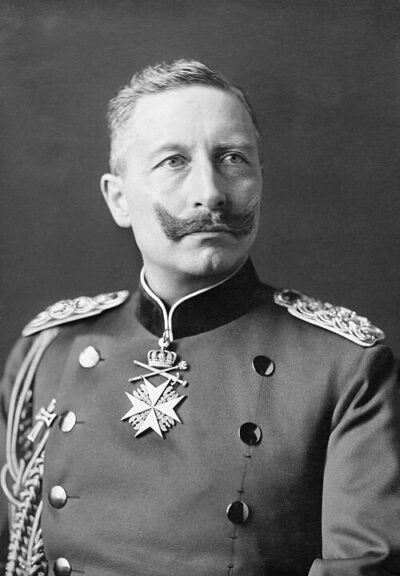
Wilhelm II
Wilhelm II was an as King of Prussia last German Emperor from 1888 to 1918. Born January 27, 1859, in Kronprinzenpalais. Died June 4, 1941, in Huis Doorn. Positions held include German Emperor (1888–1918) and King of Prussia (1888–1918). Educated at University of Bonn and Friedrichsgymnasium Kassel. Awards include Pour le Mérite, Knight of the Order of the Golden Fleece and Grand Cross of the Military Order of Maria Theresa.
Facts
59 facts · 2 confirmed by two sources · 21 cited · 36 from one source
Where this comes from
Papalocal keeps its own record. It started from these sources; what each one said is kept here as it was copied, so a change on their side never changes this page by itself. Tap one to read its version.
What Wikidata says · copied November 16, 2026 · revision 2563986822
- Described as
- as King of Prussia last German Emperor from 1888 to 1918 (1859–1941)
- Other names
- Wilhelm II of Germany, Wilhelm II, German Emperor, Friedrich Wilhelm Emperor William II, German Emperor Wilhelm II, Friedrich Wilhelm Viktor Albert von Hohenzollern, Kaiser Wilhelm II, Emperor Willlam, Friedrich Wilhelm Viktor Albrecht von Preußen, Frederick William Victor Albert of Prussia, Wilhelm II., William II
- Born
- January 27, 1859 · 11 references
- Died
- June 4, 1941 · 10 references
- Born in
- Kronprinzenpalais · 1 reference
- Died in
- Huis Doorn · 2 references
- Buried in
- Huis Doorn
- Cause of death
- cardiovascular disease
- Name at birth
- Friedrich Wilhelm Viktor Albert von Preußen · 1 reference
- Citizen of
- Kingdom of Prussia; German Empire; Germany · 1 reference
- Occupation
- monarch; painter · 2 references; art collector; author · 2 references; ruler · 2 references
- Positions held
- German Emperor (1888–1918) · 1 reference; King of Prussia (1888–1918)
- Education
- University of Bonn; Friedrichsgymnasium Kassel
- Member of
- Corps Borussia Bonn · 1 reference; Wilhelm II of Germany and Empress Auguste Viktoria
- Awards
- Pour le Mérite; Knight of the Order of the Golden Fleece; Grand Cross of the Military Order of Maria Theresa; Order of the Black Eagle; Knight Grand Cross of the Order of St. Olav; Knight Grand Cross in the Order of the Netherlands Lion (1876) · 1 reference; Knight Grand Cross of the Order of Saints Maurice and Lazarus; Knight grand cross of the order of the crown of Italy; Order of St. Andrew; Royal Victorian Chain (1902); Knight Grand Cross of the Military Order of William (1889) · 1 reference; Grand Cross of the Iron Cross (1914) (1916) · 2 references; Order of the Crown; Royal House Order of Hohenzollern; Order of Saint Hubert
- Spouse
- Augusta Victoria of Schleswig-Holstein (1881–1921) · 3 references; Princess Hermine Reuss of Greiz (1922–1941) · 2 references
- Children
- Wilhelm, German Crown Prince · 1 reference; Prince Eitel Friedrich of Prussia · 1 reference; Prince Adalbert of Prussia · 1 reference; Prince August Wilhelm of Prussia · 1 reference; Prince Oskar of Prussia · 1 reference; Prince Joachim of Prussia; Princess Viktoria Luise of Prussia · 1 reference
- Father
- Frederick III, German Emperor · 2 references
- Mother
- Victoria, Princess Royal · 2 references
- Siblings
- Prince Waldemar of Prussia; Prince Henry of Prussia; Sophia of Prussia; Princess Charlotte of Prussia; Princess Viktoria of Prussia; Princess Margaret of Prussia; Prince Sigismund of Prussia
- Religion
- Prussian Union of Churches
- Military rank
- general; Großadmiral · 1 reference; Generalfeldmarschall (1900) · 1 reference
- Lived in
- Huis Doorn (1920–1941) · 1 reference
- Wikipedias with a page
- 130
Wikidata item Q2677 (wikidata.org/wiki/Q2677), public domain (CC0). Copied November 16, 2026.
What Wikipedia says · copied November 16, 2026 · revision 1385873211
Wilhelm II (Friedrich Wilhelm Viktor Albert; 27 January 1859 – 4 June 1941) was the last German Emperor from 1888 until his abdication in 1918. His fall from power marked the end of the German Empire as well as the Hohenzollern dynasty's 400-year rule over Prussia.
Born during the reign of his granduncle Frederick William IV of Prussia, Wilhelm was the son of Prince Frederick William and Victoria, Princess Royal. Through his mother, he was the eldest of the 42 grandchildren of Queen Victoria of the United Kingdom. In March 1888, Wilhelm's father, Frederick William, ascended the German and Prussian thrones as Frederick III. Frederick died just 99 days later, and his son succeeded him as Kaiser Wilhelm II.
In March 1890, the young Kaiser dismissed longtime Chancellor Otto von Bismarck and assumed direct control over his nation's policies, embarking on a "New Course" to cement Germany's status as a leading world power. Over the course of his reign, Germany acquired new territories in China and the Pacific and became Europe's largest manufacturer. However, Wilhelm often undermined such progress by making tactless and threatening statements towards other countries without first consulting his ministers. Likewise, he and his government did much to alienate the German Empire from most of Europe by initiating a massive naval build-up, contesting French control of Morocco, backing Austria-Hungary's annexation of Bosnia and threatening Britain's access to the Persian Gulf by building a railway through Baghdad. By the second decade of the 20th century, Germany could rely only on significantly weaker nations such as Austria-Hungary and the declining Ottoman Empire as allies.
Despite strengthening Germany's position as a great power in the short term by building a powerful navy and promoting scientific innovation within its borders, Wilhelm II's erratic foreign policy greatly antagonized the international community and is considered by many to have led to the fall of the German Empire. In 1914, his diplomatic brinksmanship culminated in the guarantee of his country's military support to Austria-Hungary during the July Crisis which ultimately plunged all of Europe into World War I. A lax wartime leader, Wilhelm left virtually all decisions regarding strategy and organisation of the war effort to the German Supreme Army Command. By August 1916, his broad delegation of power gave rise to a de facto military dictatorship that dominated the country's policies in his place for the rest of the conflict. Despite emerging victorious over Russia and obtaining significant territorial gains in Eastern Europe, Germany relinquished all its conquests after its forces were decisively defeated on the Western Front in the autumn of 1918.
Losing the support of his country's military and many of his subjects, Wilhelm was forced to abdicate during the German Revolution of 1918–1919 which converted Germany into an unstable democratic state known as the Weimar Republic. The Treaty of Versailles stated he would face trial for the war. Wilhelm fled to exile in the Netherlands, where he remained during its occupation by Nazi Germany in 1940 before dying there in 1941.
- Born, in its opening lines
- January 27, 1859
- Died, in its opening lines
- June 4, 1941
From the Wikipedia article “Wilhelm II” (en.wikipedia.org/wiki/Wilhelm_II), by its contributors, under CC BY-SA 4.0 (creativecommons.org/licenses/by-sa/4.0/). Copied November 16, 2026; not changed.
Confirmed Two sources agree. Cited One source, and it names where it got it. One source One source, without a reference of its own. Sources disagree The sources disagree. We show the best-supported value and keep theirs below.
