
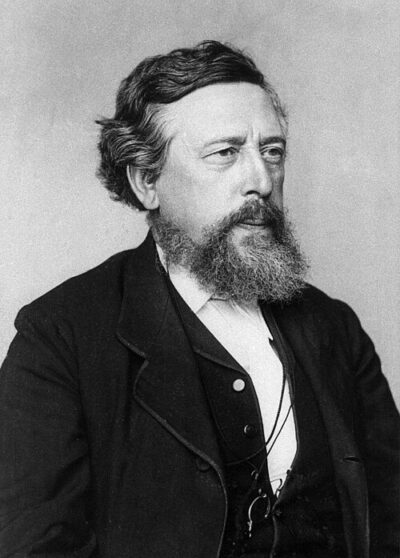
Wilhelm Liebknecht
Wilhelm Liebknecht was a German journalist, writer and socialist politician. Born March 29, 1826, in Giessen. Died August 7, 1900, in Charlottenburg. Positions held include member of the Reichstag of the German Empire (1874–), member of the Reichstag of the North German Confederation (1867–) and editing staff (1862–). Educated at University of Giessen and Frederick William University Berlin.
Facts
33 facts · 2 confirmed by two sources · 29 cited · 2 from one source
Where this comes from
Papalocal keeps its own record. It started from these sources; what each one said is kept here as it was copied, so a change on their side never changes this page by itself. Tap one to read its version.
What Wikidata says · copied November 16, 2026 · revision 2569119870
- Described as
- German journalist, writer and socialist politician (1826–1900)
- Other names
- Wilhelm Martin Philipp Christian Ludwig Liebknecht
- Born
- March 29, 1826 · 12 references
- Died
- August 7, 1900 · 11 references
- Born in
- Giessen · 6 references
- Died in
- Charlottenburg · 4 references
- Buried in
- The Socialists' Memorial · 1 reference
- Cause of death
- cerebrovascular disease
- Citizen of
- Grand Duchy of Hesse · 1 reference; German Reich · 2 references
- Occupation
- politician · 4 references; journalist · 4 references; writer · 4 references; opinion journalist · 1 reference
- Positions held
- member of the Reichstag of the German Empire (1874–) · 1 reference; member of the Reichstag of the North German Confederation (1867–) · 2 references; editing staff (1862–) · 1 reference; member of the Landtag of Saxony · 1 reference
- Political party
- Social Democratic Party of Germany (1875–) · 2 references; Social Democratic Workers' Party of Germany (1869–1875) · 1 reference; Saxon People's Party (1866–1869) · 1 reference; Communist League
- Education
- University of Giessen · 1 reference; Frederick William University Berlin · 1 reference; University of Marburg · 1 reference
- Member of
- International Workingmen's Association · 1 reference
- Spouse
- Natalie Liebknecht · 3 references; Ernestine Liebknecht · 3 references
- Children
- Karl Liebknecht · 2 references; Otto Liebknecht · 1 reference; Theodor Liebknecht · 1 reference
- Father
- Ludwig Christian Liebknecht · 1 reference
- Lived in
- London (1850–1862) · 1 reference; Berlin (1862–1865) · 1 reference; Leipzig (1865–) · 1 reference
- Wikipedias with a page
- 51
Wikidata item Q20127 (wikidata.org/wiki/Q20127), public domain (CC0). Copied November 16, 2026.
What Wikipedia says · copied November 16, 2026 · revision 1348709575
Wilhelm Martin Philipp Christian Ludwig Liebknecht (German: [ˈvɪlhɛlm ˈliːpknɛçt] ; 29 March 1826 – 7 August 1900) was a German social democratic politician and journalist. A principal founder of the Social Democratic Party of Germany (SPD), his political career was a pioneering project in steering a Marxist-inspired workers' party to electoral success and mass membership. Liebknecht served as a member of the North German Reichstag from 1867 to 1871, and of the German Reichstag from 1874 until his death in 1900.
Born in Giessen, Liebknecht was radicalized as a student and became an active participant in the 1848 Revolutions. After the defeat of the uprisings, he spent thirteen years in exile, first in Switzerland and then in London. In London, he became a close associate and student of Karl Marx and Friedrich Engels. After returning to Germany in 1862, he co-founded the Social Democratic Workers' Party of Germany (SDAP) in 1869 with his long-time political collaborator August Bebel. The party, known as the "Eisenachers", was established as a mass-based political party committed to a Marxist program.
Liebknecht was a prominent opponent of the Franco-Prussian War. His refusal to vote for war credits and his outspoken criticism of the annexation of Alsace–Lorraine led to his arrest and a two-year prison sentence for treason in 1872. He was the main architect of the 1875 Gotha unity congress, which merged the SDAP with the Lassallean General German Workers' Association to form the party that would become the SPD. During the period of the Anti-Socialist Laws from 1878 to 1890, he used his position in the Reichstag to maintain the party's public voice and was instrumental in guiding it through the years of persecution.
As a leader of the largest socialist party in Europe, Liebknecht was a major figure in the Second International, which he helped found in 1889. He served as the editor-in-chief of the SPD's central organ, Vorwärts, and became an elder statesman of the party, defending orthodox Marxism against the rise of revisionism in his later years. A committed democrat, he advocated for a socialist republic achieved through parliamentary means. His son, Karl Liebknecht, also became a prominent socialist leader.
- Born, in its opening lines
- March 29, 1826
- Died, in its opening lines
- August 7, 1900
From the Wikipedia article “Wilhelm Liebknecht” (en.wikipedia.org/wiki/Wilhelm_Liebknecht), by its contributors, under CC BY-SA 4.0 (creativecommons.org/licenses/by-sa/4.0/). Copied November 16, 2026; not changed.
Confirmed Two sources agree. Cited One source, and it names where it got it. One source One source, without a reference of its own. Sources disagree The sources disagree. We show the best-supported value and keep theirs below.
