
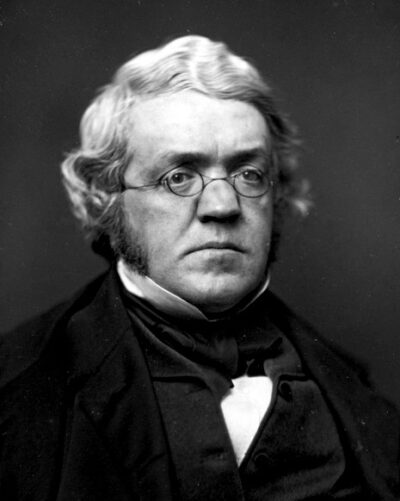
William Makepeace Thackeray
William Makepeace Thackeray was a British novelist. Born July 18, 1811, in Kolkata. Died December 24, 1863, in London. Known for Vanity Fair and The Luck of Barry Lyndon. Educated at Trinity College and Charterhouse School.
Facts
25 facts · 2 confirmed by two sources · 11 cited · 12 from one source
Where this comes from
Papalocal keeps its own record. It started from these sources; what each one said is kept here as it was copied, so a change on their side never changes this page by itself. Tap one to read its version.
What Wikidata says · copied November 16, 2026 · revision 2562743999
- Described as
- British novelist (1811–1863)
- Other names
- Michael Angelo Titmarsh, George Fitz-Boodle
- Born
- July 18, 1811 · 19 references
- Died
- December 24, 1863 · 22 references
- Born in
- Kolkata · 3 references
- Died in
- London · 2 references
- Buried in
- Kensal Green Cemetery · 2 references
- Citizen of
- United Kingdom of Great Britain and Ireland
- Occupation
- writer · 3 references; novelist; prose writer; illustrator · 1 reference
- Education
- Trinity College · 1 reference; Charterhouse School · 1 reference; University of Cambridge
- Genre
- satire; essay
- Known for
- Vanity Fair; The Luck of Barry Lyndon
- Spouse
- Isabella Gethen Creagh Shawe (1837–) · 2 references
- Children
- Anne Isabella Thackeray Ritchie · 2 references; Harriet Stephen · 2 references; Jane Thackeray · 3 references
- Father
- Richmond Thackeray · 1 reference
- Mother
- Anne Becher · 1 reference
- Siblings
- Thomas Thackeray
- Religion
- Anglicanism
- Wikipedias with a page
- 98
Wikidata item Q167768 (wikidata.org/wiki/Q167768), public domain (CC0). Copied November 16, 2026.
What Wikipedia says · copied November 16, 2026 · revision 1385884039
William Makepeace Thackeray ( THAK-ər-ee; 18 July 1811 – 24 December 1863) was an English novelist and illustrator. He is known for his satirical works, particularly his 1847–1848 novel Vanity Fair, a panoramic portrait of British society, and the 1844 novel The Luck of Barry Lyndon, which was adapted for a 1975 film by Stanley Kubrick.
Thackeray was born in Calcutta, British India, and was sent to England after his father's death in 1815. He studied at various schools and briefly attended Trinity College, Cambridge, before leaving to travel Europe. Thackeray squandered much of his inheritance on gambling and unsuccessful newspapers. He turned to journalism to support his family, primarily working for Fraser's Magazine, The Times, and Punch. His wife Isabella suffered from mental illness. Thackeray gained fame with his novel Vanity Fair and produced several other notable works. He unsuccessfully ran for Parliament in 1857 and edited the Cornhill Magazine in 1860. Thackeray's health declined from excessive eating, drinking, and lack of exercise. He died from a stroke at the age of fifty-two.
Thackeray began as a satirist and parodist, gaining popularity through works that showcased his fondness for roguish characters. Thackeray's early works were marked by savage attacks on high society, military prowess, marriage, and hypocrisy, often written under various pseudonyms. His writing career began with satirical sketches like The Yellowplush Papers. Thackeray's later novels, such as Pendennis and The Newcomes, reflected a mellowing in his tone, focusing on the coming of age of characters and critical portrayals of society. During the Victorian era, Thackeray was ranked second to Charles Dickens, but he is now primarily known for Vanity Fair.
- Born, in its opening lines
- July 18, 1811
- Died, in its opening lines
- December 24, 1863
From the Wikipedia article “William Makepeace Thackeray” (en.wikipedia.org/wiki/William_Makepeace_Thackeray), by its contributors, under CC BY-SA 4.0 (creativecommons.org/licenses/by-sa/4.0/). Copied November 16, 2026; not changed.
Confirmed Two sources agree. Cited One source, and it names where it got it. One source One source, without a reference of its own. Sources disagree The sources disagree. We show the best-supported value and keep theirs below.
