
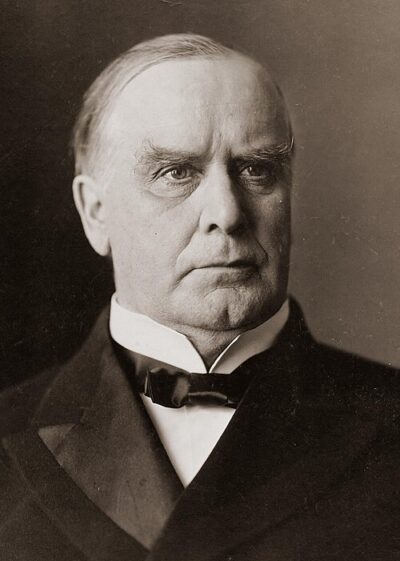
William McKinley
William McKinley was a president of the United States from 1897 to 1901. Born January 29, 1843, in Niles. Died September 14, 1901, in Buffalo. Positions held include President of the United States (1897–1901), United States representative (1887–1891) and Governor of Ohio (1892–1896). Educated at Allegheny College and Albany Law School.
Facts
37 facts · 2 confirmed by two sources · 7 cited · 28 from one source
Where this comes from
Papalocal keeps its own record. It started from these sources; what each one said is kept here as it was copied, so a change on their side never changes this page by itself. Tap one to read its version.
What Wikidata says · copied November 13, 2026 · revision 2567579858
- Described as
- president of the United States from 1897 to 1901 (1843–1901)
- Other names
- William McKinley, Jr., W. McKinley, Jr., W. McKinley, President William McKinley, President McKinley, William M'Kinley
- Born
- January 29, 1843 · 13 references
- Died
- September 14, 1901 · 12 references
- Born in
- Niles · 2 references
- Died in
- Buffalo · 4 references
- Buried in
- McKinley National Memorial
- Cause of death
- gunshot wound
- Citizen of
- United States
- Occupation
- politician · 1 reference; lawyer; statesperson; governor · 1 reference
- Positions held
- President of the United States (1897–1901) · 1 reference; United States representative (1887–1891); Governor of Ohio (1892–1896); Governor-General of the Philippines; President-elect of the United States (1896–1897)
- Political party
- Republican Party
- Education
- Allegheny College; Albany Law School; University of Mount Union · 1 reference; Poland Seminary High School · 1 reference
- Spouse
- Ida Saxton McKinley (1871–1901) · 1 reference
- Children
- Katherine McKinley · 1 reference; Ida McKinley · 1 reference
- Father
- William McKinley Sr.
- Mother
- Nancy Campbell Allison · 1 reference
- Siblings
- David Allison McKinley; James Rose McKinley; Annie McKinley; Helen McKinley; Mary McKinley; Abbie Celia McKinley; Sarah Elizabeth McKinley; Abner Osborn McKinley
- Religion
- Methodism
- Military branch
- United States Army
- Height
- 1.70 m (5 ft 7 in) · 1 reference
- Wikipedias with a page
- 142
Wikidata item Q35041 (wikidata.org/wiki/Q35041), public domain (CC0). Copied November 13, 2026.
What Wikipedia says · copied November 13, 2026 · revision 1384160075
William McKinley (January 29, 1843 – September 14, 1901) was the 25th president of the United States, serving from 1897 until his assassination in 1901. A member of the Republican Party, he led a realignment that made Republicans largely dominant in the industrial states and nationwide for decades. McKinley successfully led the U.S. in the Spanish–American War and oversaw a period of American expansionism, with the annexations of Hawaii, Puerto Rico, Guam, the Philippines, and American Samoa.
McKinley was the last president to have served in the American Civil War; he was the only one to begin his service as an enlisted man and end it as a brevet major. After the war, he settled in Canton, Ohio, where he practiced law and married Ida Saxton. In 1876, McKinley was elected to Congress, where he became the Republican expert on the protective tariff, believing protectionism would bring prosperity. His 1890 McKinley Tariff was highly controversial and, together with a Democratic Party redistricting aimed at gerrymandering him out of office, led to his defeat in the Democratic landslide of 1890. He was elected governor of Ohio in 1891 and 1893, steering a moderate course between capital and labor interests.
McKinley secured the Republican nomination for president in 1896 amid a deep economic depression and defeated his Democratic rival William Jennings Bryan after a front porch campaign in which he advocated "sound money" (the gold standard unless altered by international agreement) and promised that high tariffs would restore prosperity. McKinley's presidency saw rapid economic growth. He rejected free silver in favor of keeping the nation on the gold standard, and raised protective tariffs, signing the Dingley Tariff of 1897 to protect manufacturers and factory workers from foreign competition and securing the passage of the Gold Standard Act of 1900.
McKinley's foreign policy emulated the era's overseas imperialism of the great powers in Oceania, Asia, and the Caribbean Sea. The United States annexed the independent Republic of Hawaii in 1898, and it became the Territory of Hawaii in 1900. McKinley hoped to persuade Spain to grant independence to rebellious Cuba without conflict. Still, when negotiations failed, he requested and signed Congress's declaration of war to begin the Spanish–American War of 1898, in which the United States saw a quick and decisive victory. As part of the peace settlement, Spain turned over to the United States its main overseas colonies of Puerto Rico, Guam, and the Philippines, while Cuba was promised independence but remained under American control until 1902, after McKinley's death. In the Philippines, a pro-independence rebellion began; it was eventually suppressed. McKinley acquired what is now American Samoa when his administration partitioned the Samoan Islands with the empires of Britain and Germany in the Tripartite Convention, during a period of warming ties between the UK and US known as the Great Rapprochement.
McKinley defeated Bryan again in the 1900 presidential election in a campaign focused on imperialism, protectionism, and free silver. His second term ended early when he was shot on September 6, 1901, by anarchist Leon Czolgosz. McKinley died eight days later and was succeeded by Vice President Theodore Roosevelt, whose popularity overshadowed McKinley's legacy. Historians regard McKinley's 1896 victory as a realigning election in which the political stalemate of the post-Civil War era gave way to the Republican-dominated Fourth Party System, beginning with the Progressive Era. The United States retains control over the major territories McKinley annexed, aside from the Philippines which became independent in 1946. McKinley is generally ranked among the middle tier of presidents.
- Born, in its opening lines
- January 29, 1843
- Died, in its opening lines
- September 14, 1901
From the Wikipedia article “William McKinley” (en.wikipedia.org/wiki/William_McKinley), by its contributors, under CC BY-SA 4.0 (creativecommons.org/licenses/by-sa/4.0/). Copied November 13, 2026; not changed.
Confirmed Two sources agree. Cited One source, and it names where it got it. One source One source, without a reference of its own. Sources disagree The sources disagree. We show the best-supported value and keep theirs below.
