
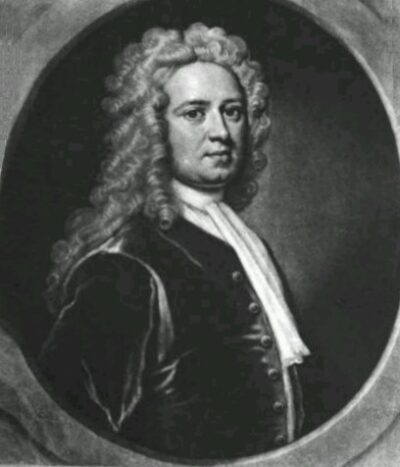
William Stukeley
William Stukeley was an English antiquarian. Born November 7, 1687, in Holbeach. Died March 3, 1765, in Kentish Town. Educated at Corpus Christi College. Awards include Fellow of the Royal Society, Fellow of the Society of Antiquaries and Fellow of the Royal College of Physicians of London.
Facts
20 facts · 2 confirmed by two sources · 2 cited · 16 from one source
Where this comes from
Papalocal keeps its own record. It started from these sources; what each one said is kept here as it was copied, so a change on their side never changes this page by itself. Tap one to read its version.
What Wikidata says · copied November 17, 2026 · revision 2564293564
- Described as
- English antiquarian (1687–1765)
- Other names
- Rev. William Stukeley
- Born
- November 7, 1687 · 8 references
- Died
- March 3, 1765 · 8 references
- Born in
- Holbeach
- Died in
- Kentish Town
- Citizen of
- Kingdom of Great Britain; Kingdom of England
- Occupation
- anthropologist; archaeologist; prehistorian; physician · 2 references; antiquarian bookseller · 1 reference
- Education
- Corpus Christi College
- Member of
- Royal Society of London; Royal College of Physicians, London; Society of Antiquaries of London
- Awards
- Fellow of the Royal Society; Fellow of the Society of Antiquaries; Fellow of the Royal College of Physicians of London; Goulstonian Lectures (1722)
- Religion
- Anglicanism
- Wikipedias with a page
- 27
Wikidata item Q1381018 (wikidata.org/wiki/Q1381018), public domain (CC0). Copied November 17, 2026.
What Wikipedia says · copied November 17, 2026 · revision 1372637685
William Stukeley (7 November 1687 – 3 March 1765) was an English antiquarian, physician, and Anglican clergyman. A significant influence on the later development of archaeology, he pioneered the scholarly investigation of the prehistoric monuments of Stonehenge and Avebury in Wiltshire. He published over twenty books on archaeology and other subjects during his lifetime.
Born in Holbeach, Lincolnshire as the son of a lawyer, Stukeley worked in his father's law business before attending Bene't College, Cambridge. In 1709 he began studying medicine at St Thomas' Hospital, Southwark, before working as a general practitioner in Boston, Lincolnshire. From 1710 till 1725 he embarked on annual tours of the countryside, seeking out archaeological monuments and other features that interested him; he wrote up and published several accounts of his travels. In 1717, he returned to London and established himself within the city's antiquarian circles. In 1718 he was elected a Fellow of the Royal Society and became the first secretary of the Society of Antiquaries of London. In 1721 he became a Freemason and in 1722 co-founded the Society of Roman Knights, an organisation devoted to the study of Roman Britain. In the early 1720s, Stukeley developed a particular interest in Stonehenge and Avebury, two prehistoric stone circles in Wiltshire. He visited them repeatedly, undertaking fieldwork to determine their dimensions.
In 1726 Stukeley relocated to Grantham, Lincolnshire, where he married. In 1729 he was ordained as a cleric in the Church of England and appointed vicar of All Saints' Church in Stamford, Lincolnshire. He was a friend of the Archbishop of Canterbury William Wake, who encouraged him to use his antiquarian studies to combat the growth of deism and freethought in Britain. To this end, Stukeley developed the belief that Britain's ancient druids had followed a monotheistic religion inherited from the Biblical Patriarchs; he called this druidic religion "Patriarchal Christianity". He further argued that the druids had erected the stone circles as part of serpentine monuments symbolising the Trinity. In 1747 he returned to London as rector of St George the Martyr, Holborn. In the last part of his life, he became instrumental in British scholarship's acceptance of Charles Bertram's forged Description of Britain and wrote one of the earliest biographies of his friend, Isaac Newton.
Stukeley's ideas influenced various antiquaries throughout the eighteenth and early nineteenth centuries, in addition to artists like William Blake, although had been largely rejected by archaeologists by the second half of the nineteenth century. He is nevertheless regarded as an important forerunner of archaeology for his emphasis on methodically measuring and documenting ancient sites. He has since become the subject of multiple biographies and academic studies by scholars like Stuart Piggott, David Boyd Haycock, and Ronald Hutton.
- Born, in its opening lines
- November 7, 1687
- Died, in its opening lines
- March 3, 1765
From the Wikipedia article “William Stukeley” (en.wikipedia.org/wiki/William_Stukeley), by its contributors, under CC BY-SA 4.0 (creativecommons.org/licenses/by-sa/4.0/). Copied November 17, 2026; not changed.
Confirmed Two sources agree. Cited One source, and it names where it got it. One source One source, without a reference of its own. Sources disagree The sources disagree. We show the best-supported value and keep theirs below.
