
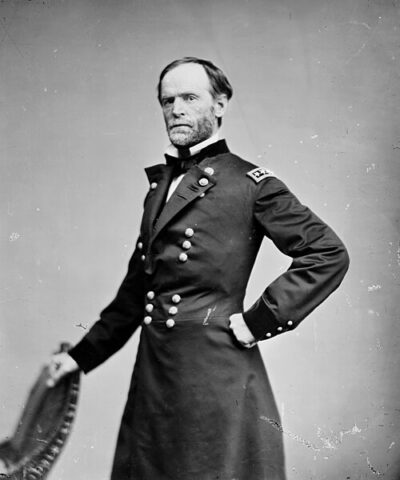
William Tecumseh Sherman
William Tecumseh Sherman was an United States Army general. Born February 8, 1820, in John Sherman Birthplace. Died February 14, 1891, in New York City. Positions held include United States Secretary of War and board member (2 times) (1871–1885). Educated at United States Military Academy.
Facts
30 facts · 2 confirmed by two sources · 5 cited · 23 from one source
Where this comes from
Papalocal keeps its own record. It started from these sources; what each one said is kept here as it was copied, so a change on their side never changes this page by itself. Tap one to read its version.
What Wikidata says · copied November 13, 2026 · revision 2565811137
- Described as
- United States Army general (1820–1891)
- Other names
- William T. Sherman, General Sherman, General William Tecumseh Sherman
- Born
- February 8, 1820 · 10 references
- Died
- February 14, 1891 · 9 references
- Born in
- John Sherman Birthplace
- Died in
- New York City · 2 references
- Buried in
- Calvary Cemetery · 1 reference
- Cause of death
- pneumonia
- Citizen of
- United States
- Occupation
- military officer; lawyer; banker; writer · 1 reference; military personnel · 1 reference
- Positions held
- United States Secretary of War; board member (2 times) (1871–1885)
- Political party
- Republican Party · 1 reference
- Worked for
- Louisiana State University
- Education
- United States Military Academy
- Spouse
- Eleanor Boyle Ewing Sherman
- Children
- Eleanor Sherman Thackara; Thomas Ewing Sherman; William Tecumseh Sherman · 1 reference
- Father
- Charles Robert Sherman
- Mother
- Mary Hoyt
- Siblings
- Charles Taylor Sherman; Hoyt Sherman; John Sherman
- Religion
- Catholic Church
- Military branch
- Union Army
- Military rank
- major general · 1 reference; general · 1 reference
- Wikipedias with a page
- 69
Wikidata item Q188936 (wikidata.org/wiki/Q188936), public domain (CC0). Copied November 13, 2026.
What Wikipedia says · copied November 14, 2026 · revision 1385628420
William Tecumseh Sherman ( tih-KUM-sə; February 8, 1820 – February 14, 1891) was an American businessman, author, and military officer, who served as a general in the Union army during the American Civil War (1861–1865). Sherman's service during that conflict earned him both recognition for his command of military strategy and criticism for the harshness of his scorched-earth policies that he implemented in his campaigns against the Confederate States.
Born in Lancaster, Ohio, into a politically prominent family, Sherman graduated in 1840 from the United States Military Academy at West Point. In 1853, he interrupted his military career to pursue private business ventures, without much success. In 1859, he became superintendent of the Louisiana State Seminary of Learning & Military Academy, now Louisiana State University. When Louisiana seceded from the United States in January 1861, Sherman resigned that position and moved to Missouri before accepting a commission as a colonel in the Union army. Sherman commanded a brigade of volunteers at the First Battle of Bull Run before he was transferred to the western theater. Whle stationed in Kentucky, his pessimism about the outlook of the war led to a nervous breakdown that required him to be briefly put on leave. He recovered and forged a close partnership with General Ulysses S. Grant. Sherman served under Grant in 1862 in the Battles of Fort Henry, Fort Donelson, and Shiloh. Sherman continued to serve under Grant in 1863, distinguishing himself in the campaigns that led to the fall of the Confederate stronghold of Vicksburg on the Mississippi River, and then in the Chattanooga campaign, which culminated with the routing of the Confederate armies in the state of Tennessee.
In 1864, when Grant went east to serve as the General-in-Chief of the Union Armies, Sherman succeeded him as the commander in the western theater. He led the capture of the strategic city of Atlanta, a military success that contributed to the re-election of President Abraham Lincoln. Sherman's subsequent "March to the Sea" through Georgia and the Carolinas involved little fighting but caused large-scale destruction of military and civilian infrastructure, a systematic policy intended to undermine the ability and willingness of the Confederacy to continue fighting. Sherman accepted the surrender of all the Confederate armies in the Carolinas, Georgia, and Florida in April 1865, but the terms that he negotiated were considered too generous by U.S. Secretary of War Edwin Stanton, who ordered General Grant to modify them.
When Grant became President of the United States in March 1869, Sherman succeeded him as Commanding General of the Army. Sherman served in that capacity from 1869 until 1883 and was responsible for the U.S. Army's engagement in the Indian Wars, in which he used "hard-war" tactics similar to those he had employed in the Civil War. He steadfastly refused to be drawn into party politics. In 1875, he published his memoirs, which became one of the best-known first-hand accounts of the Civil War.
- Born, in its opening lines
- February 8, 1820
- Died, in its opening lines
- February 14, 1891
From the Wikipedia article “William Tecumseh Sherman” (en.wikipedia.org/wiki/William_Tecumseh_Sherman), by its contributors, under CC BY-SA 4.0 (creativecommons.org/licenses/by-sa/4.0/). Copied November 14, 2026; not changed.
Confirmed Two sources agree. Cited One source, and it names where it got it. One source One source, without a reference of its own. Sources disagree The sources disagree. We show the best-supported value and keep theirs below.
