
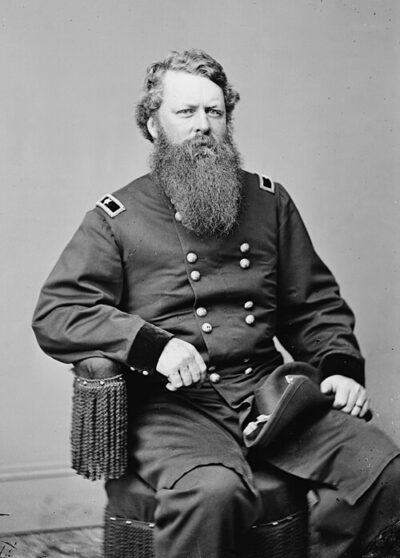
William W. Belknap
William W. Belknap was an Union Army general. Born September 22, 1829, in Hudson. Died October 12, 1890, in Washington, D.C.. Positions held include United States Secretary of War (1869–1876) and member of the Iowa House of Representatives. Educated at Princeton University and Georgetown University Law Center.
Facts
23 facts · 2 confirmed by two sources · 2 cited · 17 from one source · 2 where the sources disagree
What’s different
- Died: we show October 12, 1890 (Confirmed). Wikidata also lists October 13, 1890
- Born in: we show Hudson (Sources disagree). Wikidata also lists New York City
- Cause of death: we show myocardial infarction (Sources disagree). Wikidata also lists cardioplegia
Where this comes from
Papalocal keeps its own record. It started from these sources; what each one said is kept here as it was copied, so a change on their side never changes this page by itself. Tap one to read its version.
What Wikidata says · copied November 18, 2026 · revision 2562736435
- Described as
- Union Army general (1829-1890)
- Other names
- William Worth Belknap, William Belknap
- Born
- September 22, 1829 · 4 references
- Died
- October 12, 1890; October 13, 1890 · 1 reference
- Born in
- Hudson; New York City
- Died in
- Washington, D.C.
- Buried in
- Arlington National Cemetery
- Cause of death
- myocardial infarction; cardioplegia
- Citizen of
- United States
- Occupation
- military officer; lawyer; politician
- Positions held
- United States Secretary of War (1869–1876); member of the Iowa House of Representatives
- Political party
- Republican Party; Democratic Party
- Education
- Princeton University; Georgetown University Law Center; Georgetown University · 1 reference
- Children
- Alice Henry Van Kaathoven · 1 reference; Hugh Reid Belknap · 1 reference
- Father
- William G. Belknap
- Military branch
- Union Army; United States Army
- Military rank
- major general
- Wikipedias with a page
- 16
Wikidata item Q706248 (wikidata.org/wiki/Q706248), public domain (CC0). Copied November 18, 2026.
What Wikipedia says · copied November 18, 2026 · revision 1384878622
William Worth Belknap (September 22, 1829 – October 12, 1890) was an American lawyer, Union Army officer, government administrator in Iowa, and the 30th United States secretary of war, serving under President Ulysses S. Grant. Belknap was impeached on March 2, 1876, for his role in the trader post scandal but was acquitted by the Senate. Belknap was the first cabinet secretary in U.S. history to be impeached.
A native of New York, Belknap graduated from the College of New Jersey, now Princeton University, in 1848, studied law with a Georgetown attorney, and passed the bar in 1851. He moved to Iowa, where he practiced law in partnership with Ralph P. Lowe. Belknap entered politics as a Democrat and served one term in the Iowa House of Representatives. When the American Civil War broke out in 1861, Belknap joined the Union Army. A tall burly man, Belknap was a natural Union Army leader and recruiter. A veteran of the Iowa Home Guard who had attained the rank of captain, he was commissioned as a major in the 15th Iowa Volunteer Infantry. He took part in numerous engagements, including Shiloh, where he was wounded, and Corinth. He served as a regimental, brigade, division, and corps commander, and served in high-level staff positions. By the end of the war, Belknap had been promoted to brigadier general and received a brevet promotion to major general of volunteers.
After declining a regular Army commission, Belknap was appointed Iowa's Collector of Internal Revenue by President Andrew Johnson; he served with distinction for four years. In 1869, President Ulysses S. Grant appointed Belknap as Secretary of War. During his tenure, Belknap ordered portraits of all the previous secretaries, intending to create a complete collection in honor of the United States Centennial. In 1871, Belknap was investigated by Congress, after he was directly involved in the sale of arms and munitions to France, while the United States was ostensibly neutral during the Franco-Prussian War. The same year, Belknap had arranged aid for victims of the catastrophic Chicago Fire.
During the Reconstruction era, Belknap's War Department and the U.S. military worked under the supervision of President Ulysses S. Grant and the United States Attorney General's office to occupy the former Confederacy and attempt to implement changes in government and the economy, while protecting freedmen from an increasingly violent insurgency. Belknap supported Grant's Reconstruction policy, which most Democrats opposed.
In 1875, Grant, Belknap, and other members of Grant's administration secretly agreed to remove troops from the Black Hills after gold was discovered. The US had protected the area from white settlers as part of a US treaty with the Lakota. The withdrawal of troops allowed a gold rush of white settlers to take place, and the US took de facto possession after the Lakota refused to sell their sacred lands. In 1876, the trader post scandal at Fort Sill led to Belknap's sudden resignation, impeachment by the Democratic-controlled House, and trial by the Senate. While a majority of senators voted to convict, they lacked the two-thirds required, and Belknap was acquitted. Judge Arthur MacArthur Sr. dismissed Belknap's Washington D. C. federal trial. Belknap resumed practicing law in Washington; he continued to be popular among Iowa Civil War veterans and was active until he died of a heart attack in 1890. One historian described Belknap as a man of both virtues and flaws, a talented lawyer, administrator, and military officer, but whose personal corruption overshadowed his positive qualities.
- Born, in its opening lines
- September 22, 1829
- Died, in its opening lines
- October 12, 1890
From the Wikipedia article “William W. Belknap” (en.wikipedia.org/wiki/William_W._Belknap), by its contributors, under CC BY-SA 4.0 (creativecommons.org/licenses/by-sa/4.0/). Copied November 18, 2026; not changed.
Confirmed Two sources agree. Cited One source, and it names where it got it. One source One source, without a reference of its own. Sources disagree The sources disagree. We show the best-supported value and keep theirs below.
