
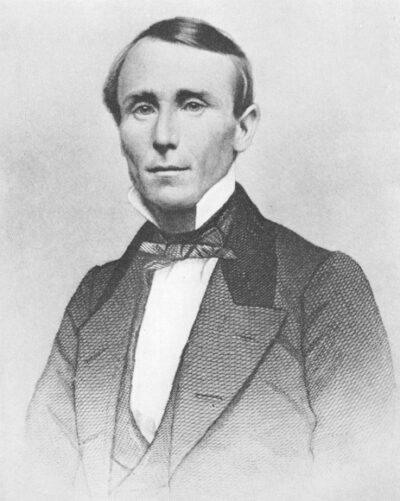
William Walker
William Walker was an American filibuster, physician, lawyer, journalist and mercenary. Born May 8, 1824, in Nashville. Died September 12, 1860, in Trujillo. Positions held include President of Nicaragua (1856–1857) and editor-in-chief (–1849). Educated at University of Edinburgh and Perelman School of Medicine at the University of Pennsylvania.
Facts
22 facts · 2 confirmed by two sources · 11 cited · 9 from one source
Where this comes from
Papalocal keeps its own record. It started from these sources; what each one said is kept here as it was copied, so a change on their side never changes this page by itself. Tap one to read its version.
What Wikidata says · copied November 15, 2026 · revision 2567360455
- Described as
- American filibuster, physician, lawyer, journalist and mercenary (1824-1860)
- Born
- May 8, 1824 · 6 references
- Died
- September 12, 1860 · 6 references
- Born in
- Nashville · 1 reference
- Died in
- Trujillo · 1 reference
- Cause of death
- Herida por arma de fuego
- Citizen of
- United States
- Occupation
- journalist · 1 reference; lawyer · 1 reference; adventurer · 1 reference; filibuster · 1 reference; physician · 1 reference; politician · 2 references; writer · 1 reference
- Positions held
- President of Nicaragua (1856–1857) · 1 reference; editor-in-chief (–1849) · 1 reference
- Political party
- Democratic Party · 1 reference
- Worked for
- University of California, Los Angeles
- Education
- University of Edinburgh; Perelman School of Medicine at the University of Pennsylvania (–1843); University of Nashville (–1838); Heidelberg University
- Mother
- Mary Walker · 1 reference
- Wikipedias with a page
- 34
Wikidata item Q196401 (wikidata.org/wiki/Q196401), public domain (CC0). Copied November 15, 2026.
What Wikipedia says · copied November 15, 2026 · revision 1378203481
William Walker (May 8, 1824 – September 12, 1860) was an American journalist and mercenary. In the era of the expansion of the United States, driven by the doctrine of manifest destiny, Walker organized unauthorized military expeditions into Mexico and Central America with the intention of establishing colonies. Such an enterprise was known at the time as "filibustering".
After settling in California, motivated by an earlier filibustering project of Gaston de Raousset-Boulbon, Walker attempted in 1853–54 to take Baja California and Sonora. He declared those territories to be an independent Republic of Sonora, but he was soon driven back to California by the Mexican forces. Walker then went to Nicaragua in 1855 as leader of a mercenary army employed by the Nicaraguan Democratic Party in its civil war against the Legitimists. He took control of the Nicaraguan government and in July 1856 set himself up as the country's president.
Walker's regime was recognized as the legitimate government of Nicaragua by US President Franklin Pierce, and it initially enjoyed the support of some important sectors within Nicaraguan society. As ruler of Nicaragua, Walker relegalized slavery, with the goal of creating a new society of dominant White people and subordinate Black and Indigenous laborers. However, he never succeeded in implementing slavery. He also threatened the independence of neighboring Central American republics. Walker antagonized the powerful Wall Street tycoon Cornelius Vanderbilt by expropriating Vanderbilt's Accessory Transit Company, which operated one of the main routes for the transport of passengers going from New York City to San Francisco. The British Empire saw Walker as a threat to its interests in the possible construction of a Nicaragua Canal. A military coalition led by the allied forces of Central America defeated Walker and forced him to resign the presidency of Nicaragua on May 1, 1857.
Walker tried to relaunch his filibustering project and sought renewed support from pro-slavery forces in the Southern United States on the eve of the American Civil War. In 1860, he published a book titled The War in Nicaragua, which promoted his efforts to conquer Central America in order to expand slavery geographically. That year, he returned to Central America, where the British Royal Navy arrested him and handed him to the government of Honduras, which executed him.
- Born, in its opening lines
- May 8, 1824
- Died, in its opening lines
- September 12, 1860
From the Wikipedia article “William Walker (filibuster)” (en.wikipedia.org/wiki/William_Walker_(filibuster)), by its contributors, under CC BY-SA 4.0 (creativecommons.org/licenses/by-sa/4.0/). Copied November 15, 2026; not changed.
Confirmed Two sources agree. Cited One source, and it names where it got it. One source One source, without a reference of its own. Sources disagree The sources disagree. We show the best-supported value and keep theirs below.
