
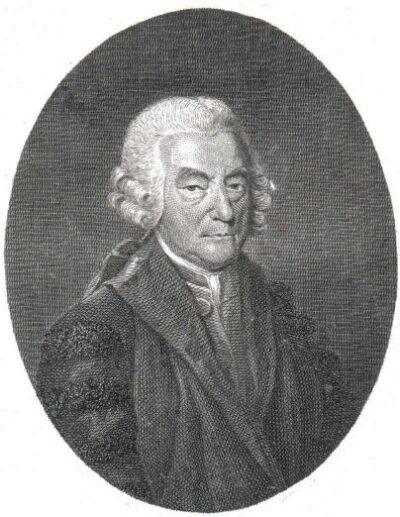
William Watson
William Watson was an English physician and scientist. Born April 3, 1715, in London. Died May 10, 1787, in London. Awards include Fellow of the Royal Society, Copley Medal and Knight Bachelor.
Facts
18 facts · 2 confirmed by two sources · 6 cited · 10 from one source
Where this comes from
Papalocal keeps its own record. It started from these sources; what each one said is kept here as it was copied, so a change on their side never changes this page by itself. Tap one to read its version.
What Wikidata says · copied November 16, 2026 · revision 2564347530
- Described as
- English physician and scientist (1715–1787)
- Other names
- Sir William Watson
- Born
- April 3, 1715 · 1 reference
- Died
- May 10, 1787 · 1 reference
- Born in
- London
- Died in
- London
- Buried in
- St Giles in the Fields, Holborn · 1 reference
- Citizen of
- Kingdom of Great Britain
- Occupation
- botanist; physician · 2 references; physicist; pharmacist · 2 references; writer
- Member of
- Royal Society of London
- Awards
- Fellow of the Royal Society; Copley Medal (1745) · 1 reference; Knight Bachelor
- Children
- William Watson · 1 reference; Mary Watson · 1 reference
- Lived in
- England · 1 reference
- Wikipedias with a page
- 29
Wikidata item Q462269 (wikidata.org/wiki/Q462269), public domain (CC0). Copied November 16, 2026.
What Wikipedia says · copied November 16, 2026 · revision 1372064049
Sir William Watson, FRS (3 April 1715 – 10 May 1787) was a British physician and scientist who was born and died in London. His early work was in botany, and he helped to introduce the work of Carl Linnaeus into England. He became a Fellow of the Royal Society in 1741 and vice president in 1772. He was knighted in 1786.
In 1746, he showed that the capacity of the Leyden jar could be increased by coating it inside and out with lead foil. In the same year, he proposed that the two types of electricity—vitreous and resinous—posited by DuFay were actually a surplus (a positive charge) and a deficiency (a negative charge) of a single fluid which he called electrical ether, and that the quantity of electrical charge was conserved. He acknowledged that the same theory had been independently developed at the same time by Benjamin Franklin—the two men later became allies in both scientific and political matters. He also suggested that electricity is more akin to magnetism and light than to a fluid, since it passes through glass and cloth, and can be concentrated as a spark to light up flammable materials.
On 14 August 1747 he made an experiment to conduct electricity through a 6,732 foot long wire at Shooter's Hill in London. At another experiment he made, the wire was 12,276 feet. Previous experiments in France had tried only shorter distances.
- Born, in its opening lines
- April 3, 1715
- Died, in its opening lines
- May 10, 1787
From the Wikipedia article “William Watson (scientist)” (en.wikipedia.org/wiki/William_Watson_(scientist)), by its contributors, under CC BY-SA 4.0 (creativecommons.org/licenses/by-sa/4.0/). Copied November 16, 2026; not changed.
Confirmed Two sources agree. Cited One source, and it names where it got it. One source One source, without a reference of its own. Sources disagree The sources disagree. We show the best-supported value and keep theirs below.
