
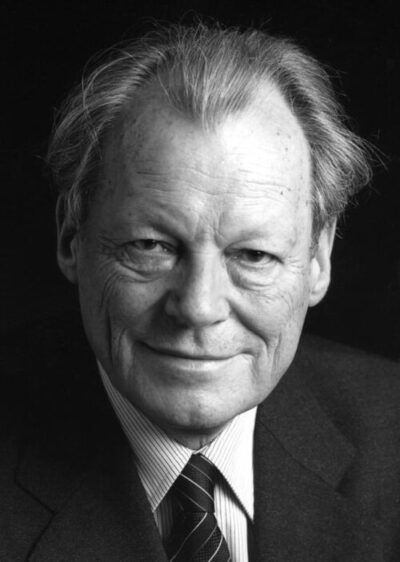
Willy Brandt
Willy Brandt was a German politician (SPD), chancellor of West Germany (1969–1974) and Nobel Peace Prize laureate. Born December 18, 1913, in Meierstraße. Died October 8, 1992, in Unkel. Positions held include Federal Chancellor of Germany (1969–1974), Governing Mayor of Berlin (1957–1966) and Berlin member of the Bundestag (2 times) (1949–1961). Educated at University of Oslo. Awards include Nobel Peace Prize, Knight Grand Cross of the Order of St. Olav and Knight Grand Cross of the Order of the Falcon.
Facts
59 facts · 2 confirmed by two sources · 24 cited · 33 from one source
Where this comes from
Papalocal keeps its own record. It started from these sources; what each one said is kept here as it was copied, so a change on their side never changes this page by itself. Tap one to read its version.
What Wikidata says · copied November 16, 2026 · revision 2567934231
- Described as
- German politician (SPD), chancellor of West Germany (1969–1974) and Nobel Peace Prize laureate
- Other names
- Gaasland, Gunnar, Gunnar Gaasland, Herbert Ernst Karl Frahm, Frahm, Herbert Ernst Karl, Brandt, Willy
- Born
- December 18, 1913 · 12 references
- Died
- October 8, 1992 · 12 references
- Born in
- Meierstraße · 1 reference
- Died in
- Unkel · 3 references
- Buried in
- Zehlendorf Forest Cemetery
- Cause of death
- colorectal cancer
- Name at birth
- Herbert Ernst Karl Frahm
- Citizen of
- German Empire (–1938); Norway (1940–1948) · 3 references; Germany (1948–) · 1 reference
- Occupation
- journalist · 1 reference; politician · 3 references; autobiographer · 1 reference; Chancellor of Germany · 1 reference; social democrat · 1 reference; mayor · 1 reference; foreign minister · 1 reference; chancellor · 1 reference
- Positions held
- Federal Chancellor of Germany (1969–1974); Governing Mayor of Berlin (1957–1966); Berlin member of the Bundestag (2 times) (1949–1961) · 1 reference; member of the Abgeordnetenhaus of Berlin (1951–1971) · 1 reference; Vice-Chancellor of Germany (1966–1969); Federal Minister for Foreign Affairs (1966–1969); President of the Bundesrat of Germany (1957–1958) · 1 reference; president of the Abgeordnetenhaus of Berlin (1955–1957) · 1 reference; chairman of the Social Democratic Party (1964–1987) · 1 reference; Member of the European Parliament (1979–1983) · 1 reference; member of the German Bundestag (1969–1992) · 1 reference
- Political party
- Socialist Workers' Party of Germany (1931–1946); Social Democratic Party of Germany (2 times) (1930–1992)
- Worked for
- Berlin
- Education
- University of Oslo
- Awards
- Nobel Peace Prize (1971) · 2 references; Knight Grand Cross of the Order of St. Olav (1960); Knight Grand Cross of the Order of the Falcon (1968); Grand Cross of the Order of Orange-Nassau (1969); Grand Cross of the Order of the Dannebrog (1970); Order pro Merito Melitensi; Time Person of the Year (1970); Grand Cross of the Order of the Crown (1971); Order of the Rising Sun, 1st class (1971); Knight Grand Cross of the Order of Vasa (1972); Grand Cross of the Legion of Honour (1973); B'nai B'rith; Albert Einstein Peace Prize; Grand Cross of the Order of the Sun of Peru (1986); Grand Cross 1st class of the Order of Merit of the Federal Republic of Germany (1959)
- Field
- politics
- Spouse
- Brigitte Seebacher (1983–1992) · 1 reference; Rut Brandt (1948–1980) · 1 reference; Anna Carlotta Thorkildsen (1941–1948)
- Children
- Peter Brandt · 1 reference; Lars Brandt · 1 reference; Matthias Brandt · 1 reference; Ninja Frahm
- Mother
- Martha Frahm · 1 reference
- Religion
- Protestant Church in Germany
- Military branch
- International Brigades
- Wikipedias with a page
- 124
Wikidata item Q2514 (wikidata.org/wiki/Q2514), public domain (CC0). Copied November 16, 2026.
What Wikipedia says · copied November 16, 2026 · revision 1385776587
Willy Brandt (German: [ˈvɪliː ˈbʁant] ; born Herbert Ernst Karl Frahm; 18 December 1913 – 8 October 1992) was a German politician and statesman who was leader of the Social Democratic Party of Germany (SPD) from 1964 to 1987 and concurrently served as the chancellor of West Germany from 1969 to 1974. He was awarded the Nobel Peace Prize in 1971 for his efforts to strengthen cooperation in Western Europe through the EEC and to achieve reconciliation between West Germany and the countries of Eastern Europe. He was the first Social Democratic chancellor since 1930.
Fleeing to Norway and then Sweden during the Nazi regime and working as a left-wing journalist, he took the name Willy Brandt as a pseudonym to avoid detection by Nazi agents, and then formally adopted the name in 1948. Brandt earned initial fame as governing mayor of West Berlin. He served as the foreign minister and as the vice chancellor in Kurt Georg Kiesinger's cabinet, and became chancellor in 1969.
As chancellor, he maintained West Germany's close alignment with the United States and focused on strengthening European integration in Western Europe, while launching the new policy of Ostpolitik aimed at improving relations with Eastern Europe. Brandt was controversial on both the right wing, for his Ostpolitik, and on the left wing, for his support of American policies, including his silence on the Vietnam War that he broke only in 1973, and right-wing authoritarian regimes. The Brandt Report became a recognised measure for describing the general North–South divide in world economics and politics between an affluent North and a poor South. Brandt was also known for his fierce anti-communist policies at the domestic level, culminating in the Radikalenerlass (Anti-Radical Decree) in 1972. In 1970, while visiting a memorial to the Warsaw Ghetto Uprising crushed by the Germans, Brandt unexpectedly knelt and meditated in silence, a moment remembered as the Kniefall von Warschau.
Brandt resigned as chancellor in 1974, after Günter Guillaume, one of his closest aides, was exposed as an agent of the Stasi, the East German secret service. Brandt died from colon cancer in 1992, aged 78.
- Born, in its opening lines
- December 18, 1913
- Died, in its opening lines
- October 8, 1992
From the Wikipedia article “Willy Brandt” (en.wikipedia.org/wiki/Willy_Brandt), by its contributors, under CC BY-SA 4.0 (creativecommons.org/licenses/by-sa/4.0/). Copied November 16, 2026; not changed.
Confirmed Two sources agree. Cited One source, and it names where it got it. One source One source, without a reference of its own. Sources disagree The sources disagree. We show the best-supported value and keep theirs below.
