
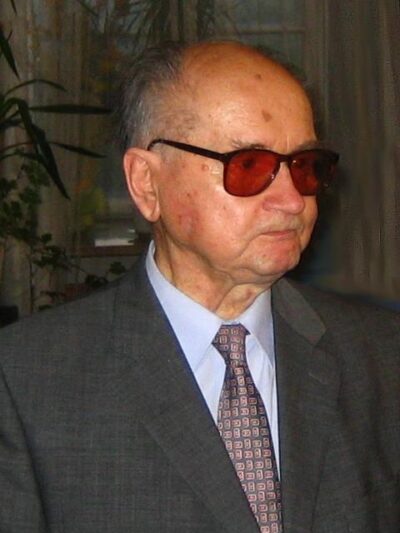
Wojciech Jaruzelski
Wojciech Jaruzelski was a Polish military and political official, leader of the Polish People's Republic from 1981 to 1989. Born July 6, 1923, in Kurów. Died May 25, 2014, in Warsaw. Positions held include President of the Republic of Poland (1989–1990), Prime Minister of Poland (1981–1985) and member of the Sejm of the Polish People's Republic. Educated at General Staff Academy. Awards include Knight of the Order of Polonia Restituta, Order of Lenin and Zhukov Medal.
Facts
42 facts · 2 confirmed by two sources · 10 cited · 30 from one source
Where this comes from
Papalocal keeps its own record. It started from these sources; what each one said is kept here as it was copied, so a change on their side never changes this page by itself. Tap one to read its version.
What Wikidata says · copied November 16, 2026 · revision 2567339728
- Described as
- Polish military and political official, leader of the Polish People's Republic from 1981 to 1989
- Other names
- Wojciech Witold Jaruzelski
- Born
- July 6, 1923 · 16 references
- Died
- May 25, 2014 · 12 references
- Born in
- Kurów · 2 references
- Died in
- Warsaw · 2 references
- Buried in
- Powązki Military Cemetery
- Cause of death
- stroke
- Citizen of
- Poland
- Occupation
- politician · 1 reference; military personnel; head of government · 1 reference; soldier · 1 reference
- Positions held
- President of the Republic of Poland (1989–1990); Prime Minister of Poland (1981–1985); member of the Sejm of the Polish People's Republic · 1 reference; First Secretary of the Polish United Workers' Party (1981–1989)
- Political party
- Polish United Workers' Party · 1 reference; Polish Workers' Party
- Education
- General Staff Academy
- Member of
- Society of Fighters for Freedom and Democracy · 1 reference
- Awards
- Knight of the Order of Polonia Restituta; Order of Lenin; Zhukov Medal; Medal "For the Victory over Germany in the Great Patriotic War 1941–1945"; Order of the Red Banner; Commander of the Order of the Crown; Order of the October Revolution; Collar of the Order of Isabella the Catholic (1989) · 1 reference; Order of Karl Marx; Medal of the National Education Commission; Order of Klement Gottwald; Medal of the 10th Anniversary of People's Poland; Scharnhorst Order; Order of Friendship of Peoples; Medal "For the Liberation of Warsaw"
- Spouse
- Barbara Jaruzelska (1960–2014) · 1 reference
- Children
- Monika Jaruzelska · 1 reference
- Father
- Władysław Jaruzelski
- Mother
- Wanda Jaruzelska
- Siblings
- Teresa Starnawska
- Military branch
- Red Army · 1 reference
- Military rank
- general · 1 reference
- Website
- http://www.wojciech-jaruzelski.pl/
- Wikipedias with a page
- 88
Wikidata item Q55834 (wikidata.org/wiki/Q55834), public domain (CC0). Copied November 16, 2026.
What Wikipedia says · copied November 16, 2026 · revision 1383685890
Wojciech Witold Jaruzelski (6 July 1923 – 25 May 2014) was a Polish military general, politician and de facto leader of the Polish People's Republic from 1981 until 1989, serving as a military dictator from 13 December 1981 until 22 July 1983. He was the First Secretary of the Polish United Workers' Party between 1981 and 1989, making him the last leader of the Polish People's Republic. Jaruzelski served as Prime Minister from 1981 to 1985, the Chairman of the Council of State from 1985 to 1989 and briefly as President of Poland from 1989 to 1990, when the office of President was restored after 37 years. He was also the last commander-in-chief of the Polish People's Army, which in 1990 became the Polish Armed Forces.
Born to Polish nobility in Kurów in eastern (then-central) Poland, Jaruzelski was deported with his family to Siberia by the NKVD after the invasion of Poland. Assigned to forced labour in the Siberian wilderness, he developed photokeratitis, which forced him to wear protective sunglasses for the rest of his life. In 1943, Jaruzelski joined the newly created First Polish Army and fought alongside the Soviets against Nazi Germany in the Eastern Front, most notably in the liberation of Warsaw and in the Battle of Berlin. Following the Polish October and the expatriation of Marshal Konstantin Rokossovsky back to the Soviet Union, Jaruzelski became the chief political officer of the Polish People's Army and eventually Polish Minister of Defence in 1968.
Jaruzelski became the First Secretary of the Polish United Workers' Party and leader of Poland after the brief one-year term of Stanisław Kania. Kania's predecessor, Edward Gierek, left Poland indebted by accepting loans from foreign creditors and the country's economy, rocked by strikes, was unstable by the time Jaruzelski became head of state. As Poland headed towards insolvency, rationing was enforced due to shortages of basic goods, which only contributed to the tense social and political situation. The declining living and working conditions triggered anger among the masses and strengthened anti-Communist sentiment; the Solidarity union was also gaining support, which worried the Polish Central Committee and the Soviet Union, which viewed Solidarity as a threat to the Warsaw Pact. After his request for a joint Soviet-Polish operation was denied by the Soviets, who were already deeply embroiled in the Soviet-Afghan war, Jaruzelski imposed martial law in Poland on 13 December 1981 to crush the anti-communist opposition. The military junta, curfew and travel restrictions lasted until 22 July 1983.
With the Brezhnev doctrine now effectively rendered forceless due to deepening Soviet entanglement in Afghanistan and their own economic crisis, the Polish United Workers' Party (PZPR)'s two unsuccessful reform attempts in 1982 and 1987, resulting in the complete collapse of the party's legitimacy and support, as highlighted by the 1988 Polish strikes and a resurgent Solidarity, Jaruzelski began negotiations with the still-banned movement's leaders in late 1988. Acquiescing to their demands, the Polish Round Table Talks were held in early 1989, transforming the system to a multi-party one, with the first semi-free election in the Communist bloc scheduled for 4 June 1989. Solidarity scored an unexpectedly overwhelming victory in the election, starting the chain reaction that resulted in the Fall of Communism in Central and Eastern Europe. Prices were fully freed on 1 August 1989, with Poland becoming only the second Communist country to do so after China in 1985. Facing hyperinflation and increasing strike pressure, Jaruzelski's Prime Minister-designate Czesław Kiszczak failed to clear the vote as PZPR's satellite parties shifted their support to Solidarity's candidate Tadeusz Mazowiecki, who formed the first non-communist government in the Eastern Bloc. Left with only a ceremonial post from July 1989 as President of the Polish People's Republic, he exercised no real power; the PZPR dissolved itself in January 1990 and Jaruzelski retired, with the Solidarity leader Lech Wałęsa succeeding him in the 1990 Polish presidential election as the first President elected in a popular vote.
Having served as the country's leader during its turbulent final years of Communist rule, Jaruzelski remains a controversial figure in Poland to this day. He was praised for allowing the country's peaceful transition into democracy, but was also fiercely criticised by contemporaries for his imposition of martial law, including his government's violent suppression of protests and imprisonment of thousands of opposition activists without definite charges, among other human rights violations.
- Born, in its opening lines
- July 6, 1923
- Died, in its opening lines
- May 25, 2014
From the Wikipedia article “Wojciech Jaruzelski” (en.wikipedia.org/wiki/Wojciech_Jaruzelski), by its contributors, under CC BY-SA 4.0 (creativecommons.org/licenses/by-sa/4.0/). Copied November 16, 2026; not changed.
Confirmed Two sources agree. Cited One source, and it names where it got it. One source One source, without a reference of its own. Sources disagree The sources disagree. We show the best-supported value and keep theirs below.
