
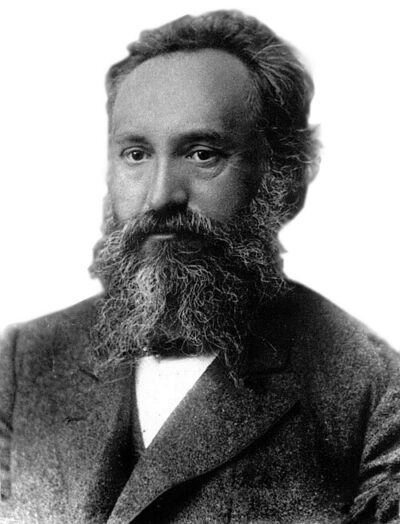
Yevgraf Fyodorov
Yevgraf Fyodorov was a Russian mathematician, crystallographer, and mineralogist. Born December 10, 1853, in Orenburg. Died May 21, 1919, in Saint Petersburg. Educated at Military Engineering-Technical University and S. M. Kirov Military Medical Academy. Awards include Order of Saint Stanislaus, 3rd class.
Facts
31 facts · 1 confirmed by two sources · 12 cited · 17 from one source · 1 where the sources disagree
What’s different
- Born: we show December 10, 1853 (Sources disagree). Wikipedia says December 22, 1853
Where this comes from
Papalocal keeps its own record. It started from these sources; what each one said is kept here as it was copied, so a change on their side never changes this page by itself. Tap one to read its version.
What Wikidata says · copied November 17, 2026 · revision 2556595425
- Described as
- Russian mathematician, crystallographer, and mineralogist
- Other names
- Evgraf Stepanovich Fedorov
- Born
- December 10, 1853 · 1 reference
- Died
- May 21, 1919 · 2 references
- Born in
- Orenburg · 2 references
- Died in
- Saint Petersburg · 2 references
- Buried in
- Smolenskoye Orthodox Cemetery
- Cause of death
- pneumonia
- Citizen of
- Russian Empire; Russian Republic; Russian Socialist Federative Soviet Republic
- Occupation
- mathematician · 1 reference; professor; crystallographer · 1 reference; mineralogist · 1 reference; mining engineer · 1 reference; naturalist · 1 reference; geologist · 1 reference; academic · 1 reference
- Worked for
- Peter’s Agricultural Academy (1895–1905) · 2 references; Saint Petersburg Mining Institute (2 times) (1896–) · 1 reference
- Education
- Military Engineering-Technical University (–1872) · 1 reference; S. M. Kirov Military Medical Academy · 1 reference; Saint Petersburg State Institute of Technology · 1 reference; Saint Petersburg Mining Institute (1880–1883) · 1 reference
- Member of
- Russian Academy of Sciences (1900–) · 1 reference; Accademia Nazionale dei Lincei (1909–) · 1 reference
- Awards
- Order of Saint Stanislaus, 3rd class
- Field
- crystallography · 1 reference; geology · 1 reference; mineralogy · 1 reference; mathematics · 1 reference
- Children
- Yevgraf Yevgrafovich Fyodorov
- Wikipedias with a page
- 24
Wikidata item Q726827 (wikidata.org/wiki/Q726827), public domain (CC0). Copied November 17, 2026.
What Wikipedia says · copied November 17, 2026 · revision 1375165768
Evgraf Stepanovich Fedorov (Russian: Евгра́ф Степа́нович Фёдоров, 22 December [O.S. 10 December] 1853 – 21 May 1919) was a Russian mathematician, crystallographer and mineralogist.
Fedorov was born in the Russian city of Orenburg. His father was a topographical engineer. The family later moved to Saint Petersburg. From the age of fifteen, he was deeply interested in the theory of polytopes, which later became his main research interest. He was a distinguished graduate of the Gorny Institute, which he joined at the age of 26. He was elected the first Director of the Institute in 1905.
He contributed to the identification of conditions under which a group of Euclidean motions must have a translational subgroup whose vectors span the Euclidean space. He undertook investigations into crystal structure as early as 1881. His best-known result is his 1891 derivation of the 230 symmetry space groups which now serve as the mathematical basis of structural analysis. He also proved that there are only 17 possible wallpaper groups which can tile a Euclidean plane. This was then proved independently by George Pólya in 1924. The proof that the list of wallpaper groups was complete only came after the much harder case of space groups had been settled. In 1895, he became a professor of geology at the Moscow Agricultural Institute (now the Timiryazev Academy). Fedorov died from pneumonia in 1919 during the Russian Civil War in Petrograd, RSFSR.
He developed the Fedorov stage for polarizing microscopes, a tool for crystallography which allows a mineral specimen to be studied under precise angles of tilt and rotation, providing an analysis of crystal structure.
- Born, in its opening lines
- December 22, 1853
- Died, in its opening lines
- May 21, 1919
From the Wikipedia article “Evgraf Fedorov” (en.wikipedia.org/wiki/Evgraf_Fedorov), by its contributors, under CC BY-SA 4.0 (creativecommons.org/licenses/by-sa/4.0/). Copied November 17, 2026; not changed.
Confirmed Two sources agree. Cited One source, and it names where it got it. One source One source, without a reference of its own. Sources disagree The sources disagree. We show the best-supported value and keep theirs below.
